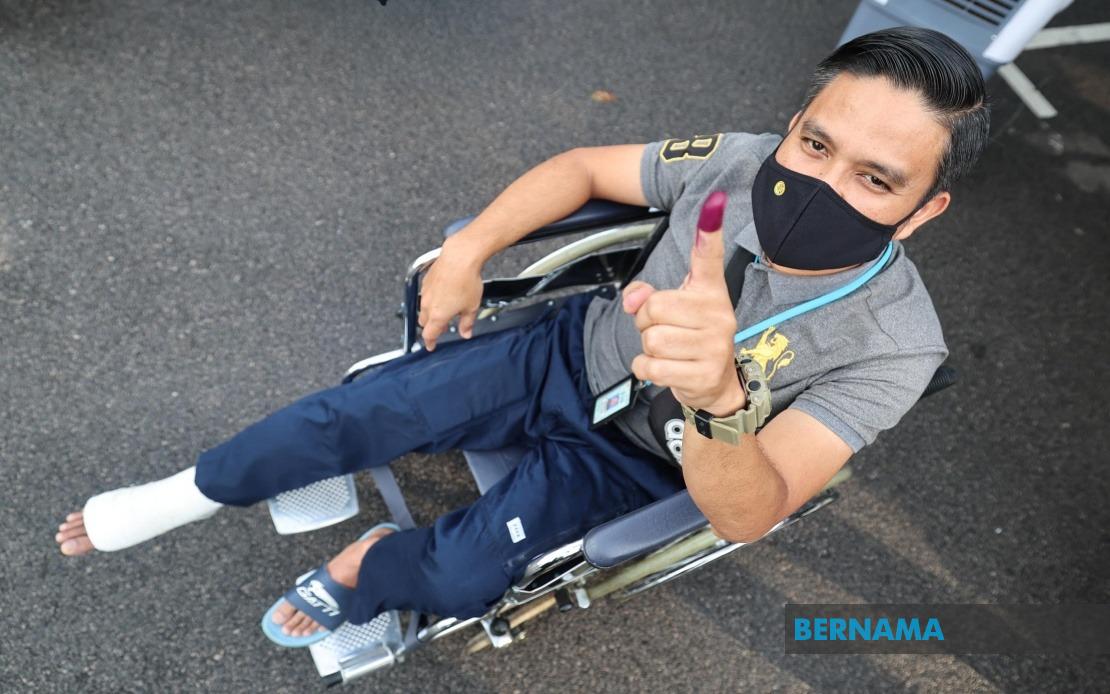
In a demonstration of commitment to democratic participation, Sergeant Syahrizal Musa refused to let a serious sports injury prevent him from fulfilling his voting responsibility during early polling for the 16th Johor state election. The 40-year-old police personnel, confined to a wheelchair following an Achilles tendon injury sustained during a sepak takraw match, travelled from his home in the Tampoi police quarters to the early voting centre at Johor Police Contingent Headquarters, underscoring the importance many civil servants place on their electoral obligations.
Syahrizal's participation in early polling came despite ongoing medical treatment and a leave period extending through July 16. The officer, attached to the Internal Security and Public Order Department at the Johor headquarters, had been advised to rest following medical confirmation of a minor tear to his Achilles tendon incurred during recreational play the previous week. Yet the prospect of missing his chance to vote proved more compelling than physical discomfort, illustrating the mindset of a dedicated public servant who views democratic participation as an essential duty rather than a mere convenience.
Originally from Seri Iskandar in Perak, Syahrizal has maintained an exemplary record of electoral engagement throughout his policing career. Across more than two decades with the Royal Malaysia Police, he has never missed voting in any election, a streak he was determined to preserve even while recovering from injury. This personal commitment reflects a broader responsibility held by uniformed personnel to model civic engagement for the broader public, particularly during state and federal electoral cycles when institutional participation demonstrates institutional values.
The early voting process accommodated security and armed forces personnel, as well as police and general operations officers, who require flexible polling arrangements due to their operational schedules. On the day of early polling, authorities opened 64 dedicated centres across Johor to process approximately 24,751 advance voters. This included 12,041 military personnel and spouses from the Malaysian Armed Forces, alongside 12,710 police and paramilitary officers and their families, representing a significant institutional component of the electoral process.
Syahrizal's willingness to vote while managing his injury carries particular resonance within the context of a competitive state election. The 16th Johor poll saw 172 candidates competing for 56 state assembly seats, with the result carrying implications for governance across one of Malaysia's most significant economic and politically important states. The ordinary electorate of 2.7 million registered voters would cast their ballots the following Saturday, making early voting a crucial mechanism for ensuring comprehensive participation.
The sepak takraw injury that sidelined Syahrizal highlights an interesting intersection between recreation, occupational welfare, and civic participation. An experienced player who has represented the Johor police contingent in multiple tournaments throughout his career, Syahrizal sustained his injury during the sport he has enjoyed since youth. Rather than viewing his temporary disability as a barrier to participation, he adapted his approach and sought assistance, demonstrating the kind of problem-solving resilience expected of law enforcement professionals.
Having transferred to the Johor headquarters in 2014 following nine years at the Muar police district office, Syahrizal has become established within the broader Johor policing structure. His decision to vote while injured sends a signal to colleagues and subordinates about institutional priorities and personal values regarding democratic processes. Within hierarchical organisations like the police force, such individual actions can influence broader institutional culture and attitudes toward voting participation.
When speaking to reporters at the early voting centre, Syahrizal articulated a perspective on electoral engagement that transcends personal interest. He emphasized that voting represents a fundamental responsibility for Malaysian citizens, regardless of physical circumstance. Moreover, he expressed hope that more Malaysians would recognize and exercise their voting rights as essential to shaping both their state's and nation's future. This perspective, voiced by someone literally overcoming physical obstacles to participate, carries particular weight as an implicit message about democratic values.
The logistics of accommodating early voters like Syahrizal reflect administrative preparations that extend beyond simple scheduling. Election authorities in Johor had established physical infrastructure and processes at 64 polling centres capable of managing the substantial volume of advance voters. These arrangements recognise that security and armed forces personnel represent a constituency requiring special polling provisions, effectively balancing operational security requirements with democratic inclusiveness.
Syahrizal's experience also underscores broader themes about participation and accessibility in Malaysian electoral processes. While the early voting system was designed primarily for institutional personnel with scheduling constraints, his experience suggests that accommodation of voters facing temporary disabilities remains an important practical consideration. The willingness of election authorities to facilitate his participation, combined with his determination to vote despite injury, demonstrates how democratic processes can function when both institutions and individuals prioritize inclusion.
The scale of early voting in Johor provides context for understanding the institutional component of the state's electoral participation. With approximately 24,751 early voters comprising mostly military, police, and paramilitary personnel and their immediate families, this advance polling represents a meaningful segment of electoral activity. These votes would contribute to the final composition of the 56-member state assembly and, by extension, to determining which coalition would govern Johor following the election.
Syahrizal's determination also reflects a particular ethos within Malaysia's uniformed services. Police and military personnel occupy a constitutional position requiring them to remain ostensibly apolitical while simultaneously being subject to electoral democracy alongside all other citizens. The ability of officers like Syahrizal to participate in voting, despite institutional constraints on direct political activity, preserves the democratic principle that all citizens possess equal electoral rights regardless of employment sector or institutional affiliation.

