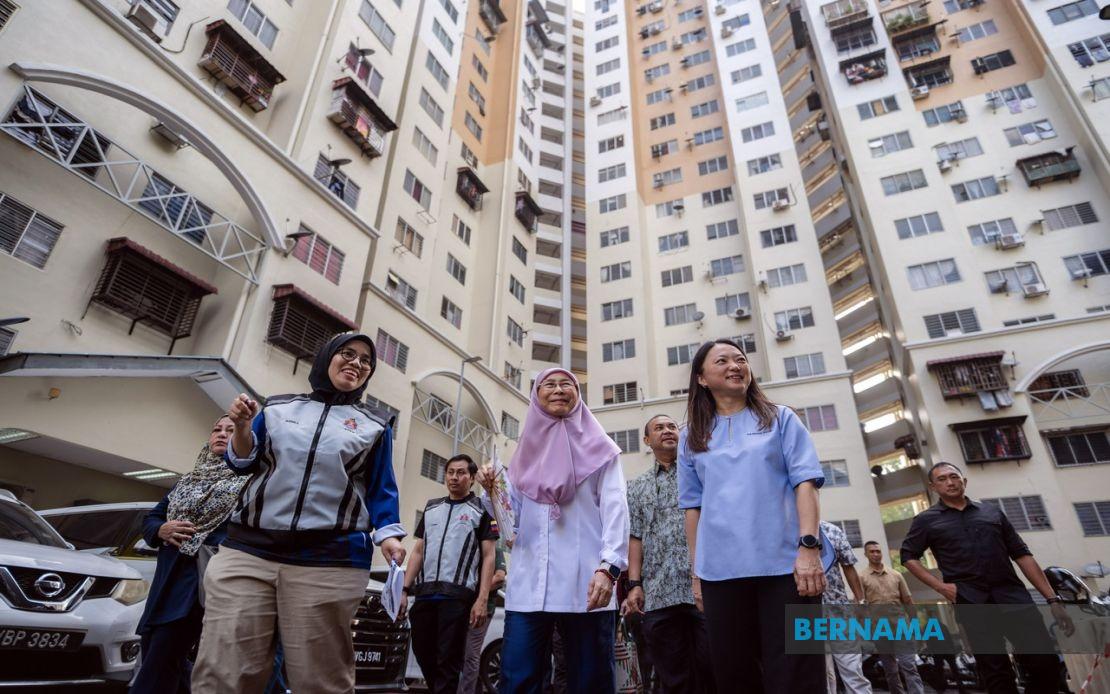
The RM9.6 million renovation programme at Desa Tun Razak People's Housing Project (PPR) in Kuala Lumpur has reached completion, marking tangible progress in the federal government's comprehensive initiative to revitalise all 61 public housing estates across the capital. The work represents one of 22 projects already finished under an expanded RM300 million budget allocation approved this year, signalling a deliberate shift toward long-term, systematic maintenance rather than fragmented, crisis-driven interventions.
Minister in the Prime Minister's Department (Federal Territories) Hannah Yeoh underscored the philosophical importance of this structured approach during an inspection of the completed works. She emphasised that securing dedicated maintenance funding is essential because the ability to construct housing developments means little without ensuring their continued safety and habitability over decades. Her remarks reflect growing recognition within government circles that affordable housing programmes can deteriorate rapidly without proper stewardship, ultimately defeating their social purpose of providing dignified accommodation for lower-income families.
The Desa Tun Razak estate, which has housed residents since 1998, now accommodates more than 8,000 people whose daily lives depend on functional infrastructure. The upgraded amenities directly affect their quality of living, from electrical safety to fire protection and basic road conditions. Yeoh noted that all Kuala Lumpur Members of Parliament endorsed this allocation, suggesting cross-party consensus on prioritising public housing maintenance—a relatively rare occurrence in Malaysian politics that may indicate genuine concern about the state of these communities.
Specific improvements executed at the Desa Tun Razak site address both cosmetic and safety concerns. The works included comprehensive electrical wiring replacement, road resurfacing, and enhanced fire safety systems. These interventions respond directly to documented hazards: fire incidents at PPR facilities during the previous year had exposed dangerous vulnerabilities in emergency systems and building infrastructure. The investment demonstrates that government policymakers recognised deficiencies and were willing to allocate substantial resources toward correction.
Kuala Lumpur Mayor Datuk Fadhlun Mak Ujud provided a detailed breakdown of expenditure, revealing that repainting consumed RM7 million of the total, while fire prevention and electrical upgrades accounted for RM1.68 million, with road resurfacing requiring nearly RM1 million. The prominence of cosmetic work—representing approximately 73 percent of spending—might raise questions among observers wondering whether appearance improvements adequately serve residents compared to structural and safety enhancements. However, the visible renewal of deteriorating estates can also provide psychological benefits and signal government commitment to communities that often feel neglected by public institutions.
Beyond the discrete project, Fadhlun expressed confidence that nearly all 61 PPR upgrading initiatives across Kuala Lumpur would reach completion by year's end, assuming implementation timelines remain on track. Such ambitious targets carry execution risks in Malaysian construction and urban administration, where delays commonly occur due to procurement processes, contractor performance, weather, and bureaucratic coordination challenges. The statement nevertheless reflects official determination to demonstrate tangible progress on a politically sensitive portfolio.
The drainage and fire riser systems also underwent upgrading at Desa Tun Razak, addressing fundamental infrastructure concerns that, while less visible than freshly painted walls, constitute essential services. Functional drainage prevents flooding and associated health hazards, while properly maintained fire suppression systems can mean the difference between contained incidents and catastrophic losses. These investments therefore represent genuine safety enhancements beyond aesthetic renewal, though public communication sometimes emphasises the latter at the expense of highlighting critical infrastructure improvements.
Parking shortages at Malaysian public housing estates persist as endemic problems, reflecting insufficient original planning and the subsequent expansion of vehicle ownership throughout Malaysian society. Fadhlun acknowledged this issue by committing Kuala Lumpur City Hall (DBKL) to identify vacant land for temporary parking zones. However, temporary solutions often become permanent problems if underlying capacity deficiencies remain unaddressed. The announcement suggests awareness of resident frustrations without necessarily implying comprehensive resolution of structural constraints.
Bandar Tun Razak Member of Parliament Datuk Seri Dr Wan Azizah Wan Ismail seized the opportunity to appeal for resident stewardship of upgraded facilities. Her remarks reflect a persistent challenge in public housing management: maintaining conditions depend partly on institutional maintenance capacity but also on community cooperation in preventing wilful damage and contributing to shared spaces. This appeal, while reasonable, also potentially shifts some responsibility for facility preservation toward residents themselves rather than emphasising government accountability for providing adequately resourced maintenance systems.
The RM300 million allocation represents significant financial commitment, yet distributing this across 61 estates yields approximately RM4.9 million per location on average. While the Desa Tun Razak expenditure exceeded this average, other PPRs may receive proportionally lesser investment. This raises questions about equity across estates and whether prioritisation criteria ensure that the most deteriorated or highest-need facilities receive adequate attention. Transparency regarding allocation methodology would strengthen public confidence in the programme's fairness.
For Malaysian observers and policymakers, the Desa Tun Razak completion illustrates both progress and ongoing challenge. The shift toward systematic, budgeted maintenance represents genuine policy improvement compared to historically reactive approaches. However, executing 39 remaining projects within established timelines, addressing persistent issues like parking and social maintenance culture, and sustaining funding commitments across political cycles will test the durability of current initiatives.
The programme also carries implications for Southeast Asian urbanisation more broadly. As regional cities expand and affordable housing becomes increasingly critical for social stability, the mechanics of managing large-scale public housing portfolios—particularly balancing capital investment with recurrent maintenance—will shape outcomes for millions of residents across the region. Kuala Lumpur's experience offers instructive lessons about the genuine costs and coordinated effort required to sustain public housing as functional, dignified shelter rather than allowing it to deteriorate into crisis-prone informal settlements.

