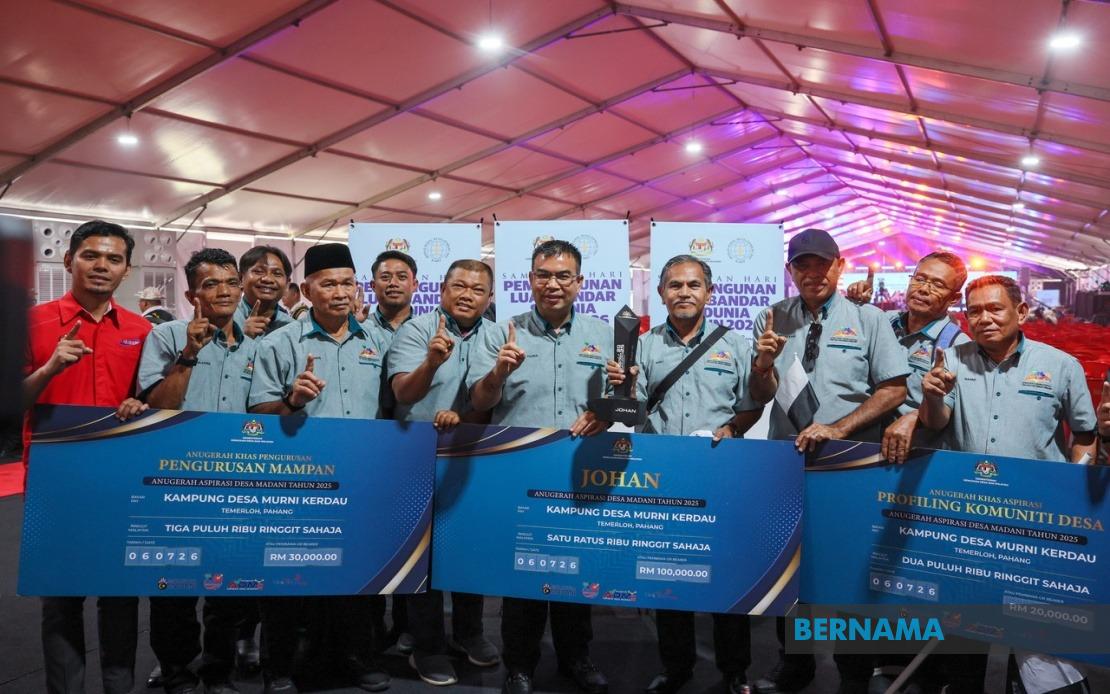
A rural community in Temerloh, Pahang has emerged as the standout performer at the World Rural Development Day 2026 observance, collecting three prestigious national awards that underscore its transformation into a model village. Desa Murni Kerdau received the coveted 2025 MADANI Rural Aspiration Award Champion designation alongside the Rural Community Profiling Aspiration Special Award and the Sustainable Management Special Award at a ceremony held at Tun Abdul Razak Stadium in Jengka Sentral on July 6. The recognition places this traditionally organised settlement among the country's most successful rural development initiatives and signals a broader commitment to elevating communities beyond Malaysia's urban centres.
Deputy Prime Minister Datuk Seri Dr Ahmad Zahid Hamidi personally handed over the primary MADANI Rural Aspiration Award, while Deputy Minister of Rural and Regional Development Datuk Rubiah Wang presented the two additional special awards. The high-profile presentation reflects the government's emphasis on celebrating rural achievement and underscores the strategic importance attached to grassroots development across the nation.
According to Mohamad Fazrul Ahmad, who chairs the Village Development and Security Committee of Desa Murni Kerdau, the triple award recognition validates the community's systematic approach to governance, local leadership capacity and sustained development initiatives. The village head expressed gratitude to the Ministry of Rural and Regional Development for instituting award recognition systems that highlight the accomplishments of rural communities, acknowledging that such validation encourages continued effort and sets benchmarks for peer communities.
The village's economic profile has strengthened considerably through entrepreneurial activity. Desa Murni Kerdau has cultivated approximately twenty business operators spanning diverse sectors including small and medium enterprises, farming operations, and the automotive industry. Beyond conventional economic sectors, the community has established itself within Malaysia's emerging rural tourism market through its "Kampung Stay" initiative, which has achieved notable popularity as a destination offering visitors authentic experiences of village life. This diversified economic base demonstrates how rural communities can transition beyond subsistence-oriented activities toward sustainable, income-generating enterprises.
Physically, Desa Murni Kerdau comprises around two hundred residential structures accommodating more than six hundred inhabitants, making it a substantial settlement rather than a small isolated hamlet. The village's organisational infrastructure appears robust enough to coordinate development across this population base and maintain the standards that attracted the awards recognition.
The financial awards accompanying these three accolades will be deployed strategically for community benefit. Rather than concentrating resources for administrative purposes, village leadership intends to distribute the monetary rewards among residents and channel funds toward infrastructure improvements and development projects serving the broader population. This approach suggests a commitment to collective advancement rather than elite capture of development resources, addressing concerns that sometimes characterise resource allocation in smaller communities.
The success of Desa Murni Kerdau carries broader implications for rural development policy across Southeast Asia and Malaysia specifically. As urbanisation and rural depopulation pressures intensify across the region, exemplars of sustainable rural prosperity become increasingly valuable. The village demonstrates that strategic governance, economic diversification, and community-driven initiatives can create conditions where residents choose to remain rather than migrate to cities seeking opportunity.
The MADANI Rural Aspiration Award program itself reflects evolving government thinking about rural development beyond infrastructure provision. Recognition systems that celebrate governance quality, leadership effectiveness, and sustainable management practices indicate a maturation in development frameworks that account for soft factors alongside physical capital investment. For other rural communities aspiring toward similar recognition, Desa Murni Kerdau provides a feasible template integrating tourism, agricultural activities, and SME development within a framework of effective village-level administration.
The achievements registered at the World Rural Development Day 2026 celebration also highlight the potential within Pahang state specifically. As a geographically large state with substantial rural populations, Pahang has capacity to nurture multiple exemplary communities following models demonstrated by Desa Murni Kerdau, potentially creating a network effect where successful practices diffuse across the broader state community.
Looking forward, sustainability of Desa Murni Kerdau's achievements will depend on continuous adaptation to economic and social changes. Tourism markets fluctuate, agricultural commodity prices vary, and demographic shifts affect community composition. The awards represent a snapshot of accomplishment rather than permanent status, challenging the village to maintain momentum and demonstrate that current success reflects systemic strengths rather than temporary advantages.

