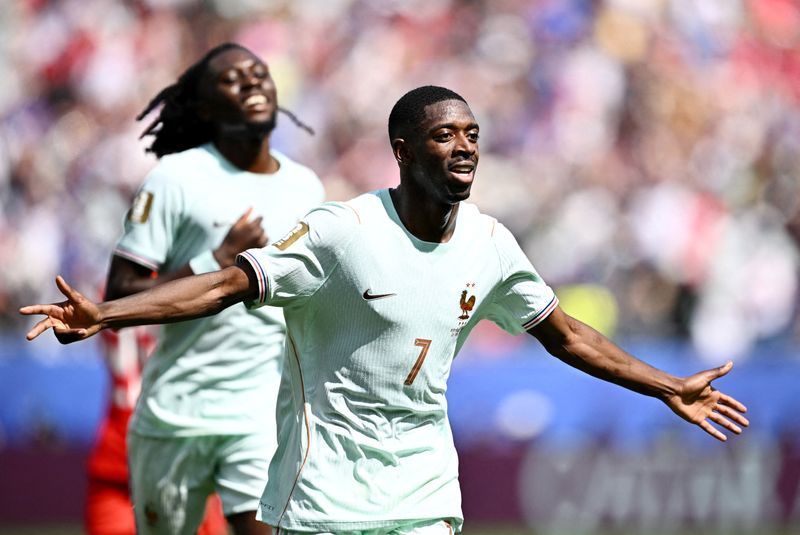
France made a commanding statement in their final group match by dismantling a significantly weakened Norway outfit 4-1 in Foxborough, Massachusetts, with winger Ousmane Dembele producing a masterclass in clinical finishing. The Paris St-Germain forward's three goals, all scored within an explosive 25-minute spell in the opening half, sent the 2018 world champions and 2022 runners-up through to the knockout stages in ruthless fashion and secured the top seeding that could prove decisive in their tournament trajectory.
The French squad had entered this fixture already assured of passage to the Round of 32, as had their Norwegian counterparts. However, Didier Deschamps' side harboured no intention of treating the contest as a formality. The France coaching staff had made an emotional appeal to the players before kickoff, asking them to play with intensity as a tribute to Deschamps, who had returned to his home country to attend his mother's funeral. That motivation, combined with France's desire to secure group leadership and the attendant benefits of their preferred travel schedule across North America, created an atmosphere of focused aggression from the opening whistle.
Norway's coach Stale Solbakken, conversely, had taken a calculated gamble by resting virtually his entire starting eleven from the midweek encounter with Senegal. The decision meant that goal-scoring sensation Erling Haaland and captain Martin Odegaard remained on the bench, fundamentally altering the competitive balance. This tactical choice would prove consequential, as France's overwhelming superiority in personnel and intensity created a mismatch that became apparent within seconds of the kickoff.
The hosts signalled their intentions immediately through Kylian Mbappe, whose well-struck angled attempt cannoned off the crossbar after just 20 seconds. The Paris St-Germain forward, who emerges as a leading contender for the tournament's Golden Boot alongside the rested Haaland, demonstrated early why he remains France's primary attacking threat. Minutes later, Mbappe orchestrated the opening goal with a sweeping cross-field pass that found Dembele in space. The winger's intelligent movement—cutting first inward then outward to create separation from his marker—culminated in a precisely angled drive past goalkeeper Egil Selvik in the sixth minute.
Dembele's threat became the dominant feature of France's attacking play. When Mbappe delivered another incisive pass in the 20th minute, the winger executed similar skill to create a yard of space and dispatched a dipping strike into the net. The efficiency of France's finishing stood in stark contrast to Norway's defensive disorganisation, though the visitors managed a brief moment of respite when Thelo Aasgaard converted almost immediately to reduce the deficit to 2-1. That reprieve proved fleeting. By the 32nd minute, Dembele had completed his hat-trick with a curled effort into the bottom corner, becoming only the third France player to achieve the feat at a World Cup, after Just Fontaine and Mbappe himself.
The speed of Dembele's treble—accomplished in just 25 minutes—marked the second-fastest hat-trick in World Cup history, surpassed only by Austria's Erich Probst, who netted three goals against Czechoslovakia in 1954 after 24 minutes. In the context of modern international football's tactical sophistication and improved defensive structures, Dembele's performance represented an exceptionally rare exhibition of clinical finishing against opposition that, while depleted, still fielded professional athletes.
Norway's attempt to mount a second-half resurgence foundered on the rock of France's defensive solidity and goalkeeper Mike Maignan's crucial interventions. Jorgen Strand Larsen squandered a significant opportunity early in the second period when his soft penalty kick proved insufficient to trouble the acrobatic French custodian. Winger Oscar Bobb subsequently tested Maignan again as the Scandinavians briefly exploited vulnerabilities in France's back line, but the visitors lacked the personnel to mount a sustained assault. France's fourth goal arrived in the match's dying moments when substitute Bradley Barcola's cross found Desire Doue, whose header capped a comprehensively dominant performance.
The victory's practical consequence extends beyond bragging rights. By topping Group I, France have positioned themselves to face Sweden in the Round of 32, a fixture perceived as favourable given the tournament's geographical organisation across North America. Norway, finishing as runners-up, will encounter Ivory Coast in their first knockout match. For Malaysian and Southeast Asian observers, France's overwhelming victory exemplifies the gulf in competitive depth between fully-committed international squads and reduced-strength lineups, a lesson increasingly relevant as Asian nations seek to compete at the World Cup's highest level. The display also underscores the tournament's capacity to produce unexpected statistical landmarks—Dembele's performance will feature prominently in record books for years to come.

