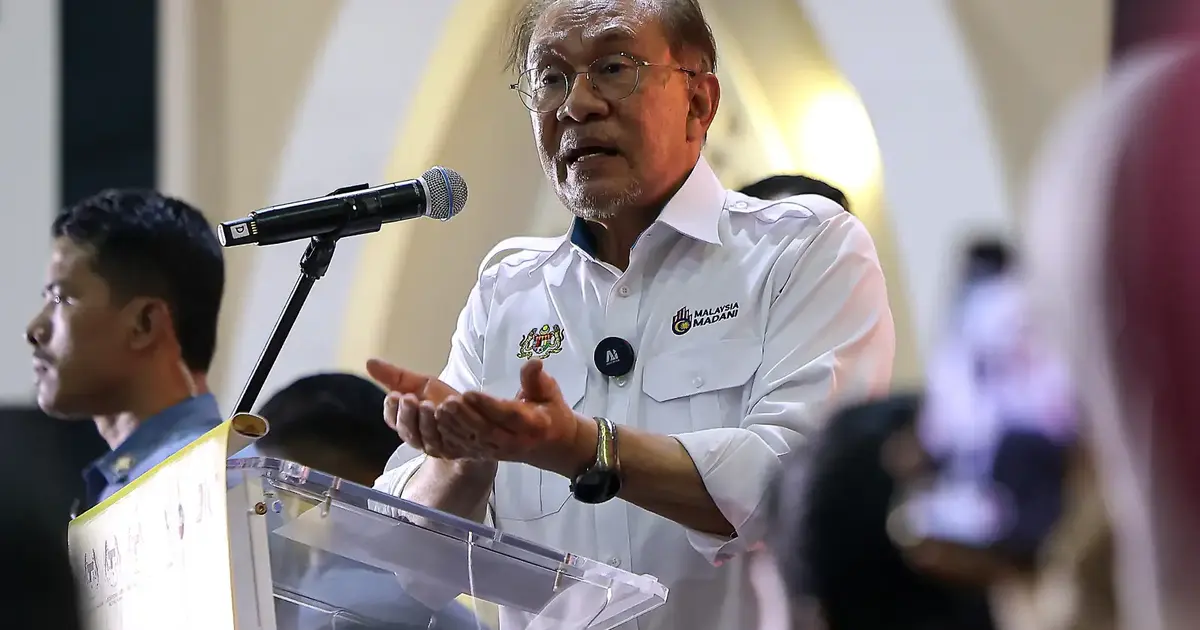
Prime Minister Anwar Ibrahim has moved to dispel concerns that championing the rights and welfare of Malaysia's Chinese and Indian minorities represents a departure from the nation's foundational constitutional arrangements regarding Malay-Muslim interests. In remarks addressing longstanding sensitivities within the political landscape, the premier stressed that protective measures for all communities can coexist harmoniously with the constitutional framework that underpins the social contract between different ethnic groups.
The statement reflects an attempt to navigate one of Malaysia's most delicate political fault lines—the relationship between Article 153 of the Federal Constitution, which enshrines special rights and privileges for Malays and Bumiputeras, and the need to foster inclusive governance that recognises the legitimate aspirations of non-Malay Malaysians. Anwar's positioning suggests the government believes these objectives need not be inherently contradictory, a message clearly targeted at constituents across the political spectrum who harbour concerns about their community's standing in the federation.
The timing of these clarifications is significant given Malaysia's complex political dynamics, where rhetoric around ethnic and religious identity frequently dominates electoral discourse and policy debates. For decades, the invocation of Malay-Muslim interests has served as a powerful political currency, and any suggestion that a government might prioritise minority concerns has historically triggered fierce backlash from conservative sections of the Malay electorate and religious establishment. By explicitly reaffirming his commitment to constitutional protections for Malays whilst simultaneously defending minority rights, Anwar appears to be attempting a careful recalibration that acknowledges both camps.
For Chinese and Indian Malaysians, who have periodically felt marginalised or overlooked in national policymaking, Anwar's statement carries significance as a signal of governmental attentiveness to their concerns. These communities, which together comprise roughly forty percent of Malaysia's population, have historically experienced cyclical periods of political vulnerability and economic uncertainty, particularly when political parties compete aggressively for Malay votes by adopting hardline stances on constitutional privileges. Investment in education, business opportunity, representation in public institutions, and linguistic rights have remained contentious issues across successive governments.
The Indian Malaysian community, smaller in numbers than the Chinese population but demographically concentrated in plantation areas and urban centres, has faced particular challenges including socioeconomic disparities and underrepresentation in higher education and professional sectors. Chinese Malaysians, meanwhile, have navigated complex dynamics around language policy, business restrictions, and cultural autonomy within a framework designed primarily to protect Malay-Muslim majority interests. Both communities have long sought governmental acknowledgment that their welfare constitutes a legitimate national concern rather than a threat to existing constitutional arrangements.
Anwar's framing effectively proposes that constitutional protections for Malays and Islam need not function as a zero-sum arrangement in which gains for minorities automatically translate to losses for the Malay-Muslim majority. This interpretation stands at odds with a political narrative that has long dominated discourse—one in which defending Article 153 requires constant vigilance against perceived encroachment and in which any expansion of minority rights automatically signals constitutional dilution. The premier's reframing suggests instead that a secure constitutional foundation for Malays can accommodate policies demonstrating governmental responsiveness to all citizens.
This approach carries implications for Malaysia's regional standing as well. Southeast Asia's other diverse democracies, including Indonesia and Singapore, have grappled with similar questions about balancing majority protections with inclusive governance. Malaysia's ability to articulate a credible vision of plural belonging—where constitutional arrangements favouring one community coexist with genuine concern for all—affects both its soft power within the region and its capacity to attract investment and talent from international sources. Many multinational corporations and global talent pools view minority treatment as a barometer of governance quality and social stability.
However, translating this rhetorical positioning into sustained policy implementation represents a formidable challenge. Previous Malaysian governments have periodically issued similar reassurances about protecting minority interests, only to face coordinated political pressure or electoral consequences when implementing such policies. Education ministry initiatives expanding vernacular language support, for instance, or business licensing policies perceived to favour non-Malay entrepreneurs, have repeatedly triggered backlash that forced policy reversals or compromises. Anwar's statements therefore require concrete follow-through in budgetary allocations, institutional reforms, and political will to withstand inevitable criticism.
The government's capacity to deliver on minority-oriented initiatives while simultaneously reassuring Malay-Muslim constituencies will substantially determine both its electoral viability and its success in building a genuinely cohesive nation. For Malaysian Chinese and Indians, Anwar's statements represent a necessary starting point—acknowledgment that their concerns merit serious consideration—but will ultimately prove hollow without corresponding resource allocation and policy action. For Malays and Muslims, the premier's dual commitment requires confidence that constitutional protections remain robust despite governmental attention to minority welfare.
Looking forward, the success of this balancing act depends partly on skillful political communication that consistently reinforces the compatibility between these objectives. It also requires institutional mechanisms that institutionalise protection for minorities, making such concerns less dependent on any single leader's political choices or rhetorical priorities. Whether Malaysia can evolve from periodic pronouncements about minority welfare toward sustainable, institutionalised approaches that satisfy all communities remains a central question for national cohesion and democratic maturity.

