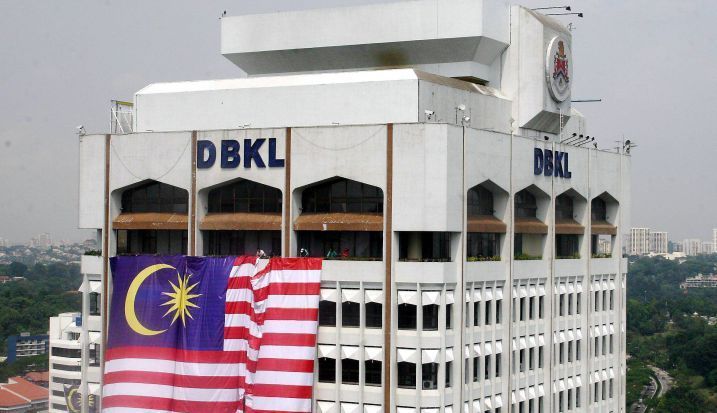
Kuala Lumpur City Hall has escalated its enforcement action against gated-neighbourhood access controls by issuing a formal two-week removal notice to the Taman Desa Phase 1 Residents Association, demanding the dismantling of facial-recognition scanning equipment and automated boom gates installed without municipal authorisation. The deadline marks the latest chapter in a protracted dispute between the residential body and city authorities over whether private security infrastructure should obstruct movement along public thoroughfares in one of Kuala Lumpur's established neighbourhoods.
Enforcement officers from DBKL descended on Guard Posts 1 and 4 on Thursday, 27 August, affixing red notices to the scanners and wrapping the equipment in yellow enforcement tape to signal official intervention. The notices explicitly reference Section 70 of the Street, Drainage and Building Act 1974, establishing the legal foundation for DBKL's position that the structures constitute unauthorised obstructions on publicly-owned roads. A spokesperson for City Hall confirmed the two-week window was determined after consultation with the municipal legal department, underscoring the formal nature of the directive and the authority's readiness to pursue compulsory removal if voluntary compliance does not materialise.
The current enforcement action did not materialise in isolation but rather represents the culmination of months of administrative back-and-forth between DBKL and the residents association. In March, City Hall first flagged that the facial-recognition and CCTV infrastructure lacked the necessary mayoral approval. Following an inspection conducted on 17 August, enforcement officers discovered that despite being granted an additional 30-day grace period to rectify violations, the association had failed to bring the scheme into compliance with municipal requirements. An official letter dated 18 August explicitly ordered the full opening of Posts 2, 5 and 6 to vehicle traffic, the removal of unapproved structures, and the restoration of unfettered access to the affected public roads.
The disputed security apparatus extends beyond scanning technology to encompass a network of physical barriers that have fundamentally altered traffic patterns within the neighbourhood. Gate 5 on Jalan Desa Ria, for instance, remains permanently sealed to vehicles and locked to pedestrians until 6 in the morning, forcing residents who wish to access a nearby public park to undertake longer diversions along congested main roads. This setup has generated genuine practical hardships for early-morning walkers and raises substantive questions about whether residents associations possess legitimate authority to restrict access to roads that, regardless of their immediate surroundings, remain public assets vested in municipal ownership.
The controversy has mobilised public opposition among residents themselves, particularly among older community members who depend on regular use of the neighbourhood's pathways for exercise and leisure. On 24 August, over 40 residents, predominantly aged 50 and above, gathered at Gate 5 to protest the access restrictions, voicing concerns that the security barriers introduce unnecessary obstacles to their daily routines. Beyond convenience, protesters raised substantive safety arguments, contending that the boom gates and access controls could hinder the rapid passage of emergency vehicles responding to medical incidents, a legitimate preoccupation in a densely populated residential area where every second matters during critical situations.
Resident objections also target the broader philosophical implications of the facial-recognition system itself. Characterising the technology as intrusive, critics have flagged growing anxieties about surveillance infrastructure that transforms entry into one's own neighbourhood into a biometric checkpoint. These concerns reflect broader regional conversations about the appropriate balance between private security and individual privacy, particularly in communal residential spaces where the boundary between collective safety and invasive monitoring remains contested. The residents association's decision to implement such systems without transparent consultation with all affected households has amplified these sensitivities.
Despite the enforcement action, the Taman Desa Phase 1 Residents Association maintains that it followed proper procedures in establishing the guarded-neighbourhood scheme. Association president Frank Yeh has previously asserted that the body obtained support from 81 per cent of residents, suggesting strong community backing for the security measures and implying that DBKL's intervention potentially overrides the expressed preferences of the resident majority. This claim introduces a contentious governance question about whether majority voting within a residents association can legitimise restrictions on public roads, or whether municipal authorities possess overriding powers to protect the broader public interest in preserving unimpeded access to thoroughfares nominally under their jurisdiction.
The dispute exemplifies the structural tensions that often emerge in urban Malaysia where affluent neighbourhoods establish gated-community models but occupy land containing publicly-classified roads. These arrangements exist in legal and administrative grey zones, with residents associations frequently operating under the assumption that private security arrangements on private lands should extend without impediment, whilst municipal authorities increasingly assert that public roads—no matter their immediate context—cannot be subject to access restrictions unilaterally imposed by resident groups. The Taman Desa situation represents a test case for how clearly DBKL will enforce this principle going forward.
Beyond the immediate question of compliance, the two-week deadline carries broader implications for how residents associations across Kuala Lumpur and indeed the nation will approach security upgrades in coming years. Clear municipal enforcement suggests that aspirational gated-community models cannot simply proceed without explicit approval from the relevant local authority, potentially discouraging similar initiatives elsewhere. Conversely, failure to enforce the order decisively would signal that residents associations can effectively ignore municipal directives, emboldening other neighbourhoods to implement comparable restrictions. The credibility of DBKL's planning and enforcement authority depends substantially on whether it follows through on the removal threat if voluntary compliance does not materialise within the stipulated timeframe.

