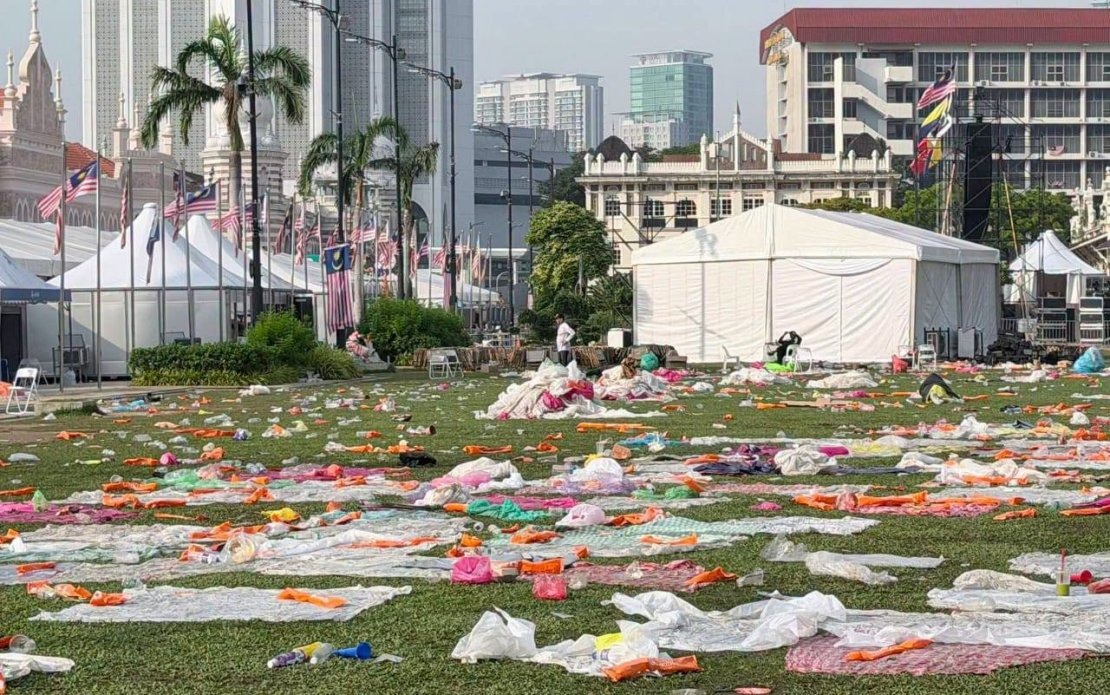
Kuala Lumpur City Hall (DBKL) announced today that it will deploy cleaning crews to restore Dataran Merdeka to its former condition after the historic site became the focal point for a massive public gathering overnight. More than 25,000 football enthusiasts descended upon the national landmark in the early morning hours to witness the live broadcast of the 2026 FIFA World Cup final, during which Spain secured a 1-0 victory over Argentina. The event left behind extensive litter scattered across the open field, prompting the municipal authority to mobilize its sanitation workforce to address the aftermath.
Beyond the operational response to clear debris, DBKL used the occasion to reflect on broader attitudes toward shared public spaces and civic responsibility. In a Facebook statement, the authority acknowledged that while the gathering itself represented a joyful expression of sporting passion among residents and visitors alike, the condition left behind contradicts the values that should accompany such celebrations. The message struck a philosophical tone, emphasizing that Dataran Merdeka transcends its function as a venue—it embodies Malaysia's national pride and historical significance, making its stewardship a matter of collective conscience rather than solely the responsibility of government staff.
The municipal authority articulated a nuanced position that distinguishes between enjoying public spaces and respecting them. Officials noted that the freedom to gather, cheer, and celebrate does not extend to the liberty of leaving behind environmental damage or diminishing the amenity for others. This framing transforms what might appear to be a simple cleanliness issue into a commentary on social contract and community values. DBKL's statement suggests that the character of a city—and by extension, a nation—is measured not merely by the attractions it offers or the events it hosts, but by the collective mindset residents demonstrate when using shared resources.
The scale of the World Cup final broadcast event underscores the growing appetite among Malaysians for communal experiences centered on global sporting moments. The congregation of over 25,000 people at a single venue overnight demonstrates the capacity of such events to mobilize large segments of the urban population. Dataran Merdeka, as Malaysia's most symbolically resonant public square, has historically served as the backdrop for significant national moments. Its deployment as an informal stadium for this particular match reflects evolving patterns in how Malaysians engage with international sporting culture and the infrastructure that municipalities must accommodate.
For Southeast Asian cities grappling with rapid urbanization and growing populations, the challenge of maintaining public spaces amid increased usage patterns has become increasingly acute. The Dataran Merdeka incident provides a case study in the tension between enabling public participation in global events and preserving the integrity of heritage landmarks. Other regional capitals face similar pressures when large crowds gather for concerts, political rallies, or sporting broadcasts. The manner in which DBKL addresses this situation may influence how peer municipalities across the region approach event management and public space stewardship.
The authority's appeal for public cooperation in maintaining cleanliness represents a strategic communication approach that seeks to shift responsibility from reactive cleanup to proactive individual behavior. Rather than imposing penalties or restrictions on future gatherings, DBKL framed the issue as a shared endeavor requiring everyone's participation. This softer messaging suggests an institutional preference for fostering civic consciousness rather than enforcing compliance through regulation. The implicit argument is that citizens should internalize the value of maintaining Dataran Merdeka as their own responsibility, akin to caring for a personal residence.
The 2026 FIFA World Cup broadcast at Dataran Merdeka also highlights the role of public venues in democratizing access to global events. Not all Malaysians can travel to stadiums internationally or afford premium viewing experiences, yet the open-air arrangement permitted tens of thousands to participate in a significant sporting moment collectively. This inclusionary aspect of the gathering deserves recognition alongside the cleanup response. The challenge lies in finding mechanisms that preserve accessibility while encouraging respectful usage and environmental stewardship.
The incident raises questions about infrastructure and event planning in Malaysian cities. When municipal authorities anticipate large gatherings, should they deploy waste management resources beforehand to facilitate cleanup, or position such infrastructure in ways that encourage proper disposal during events? Dataran Merdeka's design and facilities may not have been optimized for crowds of this magnitude, suggesting that future planning might benefit from embedded waste management solutions and clear signage regarding litter disposal.
Beyond the immediate cleanup operation, the DBKL statement reflects a philosophical position about the relationship between citizens and public spaces that extends well beyond football. The authority essentially argued that the dignity of a city depends less on grand monuments than on the collective behavior of those who inhabit and utilize them. In an era when public spaces face competing pressures from commercialization, neglect, and overcrowding, this message carries relevance for urban governance across Malaysia and the broader region. The challenge of maintaining beloved public spaces amid growing populations and competing interests remains one of the defining urban management questions of our time.

