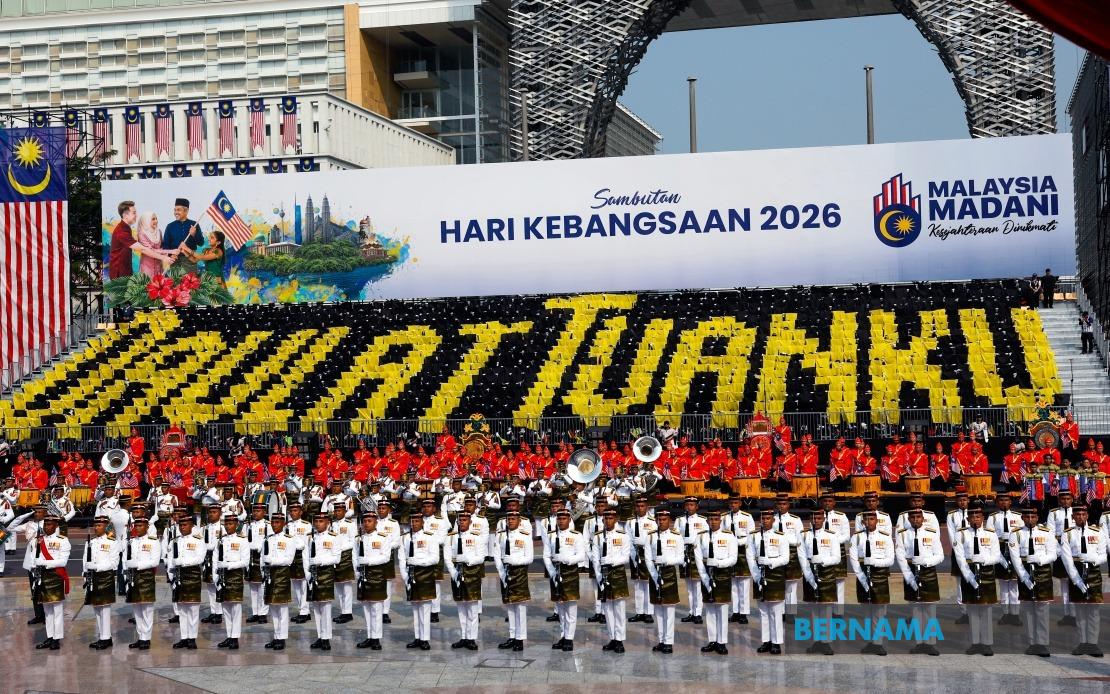
Dataran Putrajaya will transform into a focal point of national celebration tomorrow as Malaysia commemorates its 69th National Day with one of the largest coordinated public events in the administrative capital. The gathering, anchored by the theme "Malaysia MADANI: Kesejahteraan Dinikmati", aims to crystallise the public's connection to national values while showcasing the country's institutional strength and cultural diversity across a day-long programme beginning at 8:00 am.
The scale of the undertaking underscores the significance authorities place on this year's commemoration. Organisers have mobilised 10,819 parade participants organised into 76 contingents, supported by 22 marching bands and 11 float vehicles. The logistics extend to 328 military assets spanning land, naval, and air operations, alongside 112 working animals and 22 electric vehicles, signalling both the ceremonial grandeur and the emphasis on modern sustainability. His Majesty Sultan Ibrahim and Her Majesty Raja Zarith Sofiah will grace the event, lending constitutional gravitas, while Prime Minister Datuk Seri Anwar Ibrahim and Cabinet members will represent the executive branch.
The opening salvo arrives through "Gema Inovasi MADANI", a performance coordinated by the National Department for Culture and Arts that deliberately fuses traditional and contemporary elements. The spectacle will deploy 150 musical instruments and 700 kompang—traditional frame drums—arranged to represent Malaysia's ethnic mosaic. This approach carries deliberate symbolism: by positioning cultural heritage alongside innovation, organisers attempt to frame Malaysia's independence narrative not as a static achievement but as an evolving project rooted in pluralism and creative adaptation. For regional observers watching Malaysia navigate complex identity politics, such symbolism matters as signals of how the nation constructs inclusive national narratives.
The parade structure itself reflects how modern Malaysia choreographs patriotism through institutional representation. The statehood component includes contingents from the National Resilience Leadership Academy and National Defence University of Malaysia, establishing military and defence institutions as custodians of national continuity. The National Service Training Programme (PLKN) contingent reinforces youth investment in national consciousness. Meanwhile, the sports component featuring Glasgow 2026 Commonwealth Games medalists projects Malaysia's international competitive aspirations as integral to national identity—a subtle recalibration where sporting excellence becomes patriotic expression.
The public well-being and economy segment reveals how celebration extends beyond ceremony into economic messaging. The participation of corporate entities including Munchy's Malaysia, ZUS Coffee, MR. D.I.Y Group, and the cooperative movement demonstrates official attempts to bind commercial success to national progress. For Malaysian readers tracking government-business alignment, this suggests continued state efforts to narrativise the private sector as stakeholder in national development rather than merely profit-seeking entity. The inclusion of Carsome underscores digital economy priorities, while the Malaysian Security Industry Association's presence signals how service sectors connect to state security narratives.
Public order and safety agencies—the Civil Defence Force, Road Transport Department, and Fire and Rescue Department—formalise the security apparatus as protective institution deserving public recognition. This reflects post-independence Malaysia's consistent framing of state institutions as guarantors of citizen well-being. The Johor Military Force's participation adds historical depth, reminding audiences that military structures predate the federation itself, anchoring national defence in institutional continuity rather than modern invention.
Tourist promotion through Visit Malaysia Year 2026-2027 floats featuring regional diversity, flora, fauna, and traditional dress extends celebration into economic strategy. Airlines—Malaysia Airlines, AirAsia, Batik Air, and Air Borneo—feature as strategic partners, reflecting how aviation networks undergird both national connectivity and international projection. For Southeast Asian readers, this illustrates Malaysia's integration of tourism promotion, aviation expansion, and national branding into unified messaging strategies. The inclusion of Les' Copaque's Upin and Ipin characters strategically targets younger audiences, ensuring celebration resonates across generational lines.
The human graphics performance, coordinated through 1,500 students from 36 Selangor schools, transforms participants into living visual art—a technique increasingly common in state spectacles across the region. These formations, synchronised to music with choreographed visual transitions, create immersive sensory experience designed to forge emotional connection between individual participants and collective national project. The deliberate marshalling of youth labour for patriotic expression carries both inspirational and concerning dimensions worth noting for observers of state power and symbolic mobilisation.
The airshow climax—featuring Royal Malaysian Air Force fighter jets—translates military capability into public theatre. Aircraft perform overhead manoeuvres before thousands of spectators gathered at Putrajaya's administrative heart, literalising aerial sovereignty while projecting defence readiness. This spectacle serves multiple audiences: domestic citizens witnessing national prowess, regional neighbours observing Malaysia's military investment, and international observers reading signals about defence posture. The aerial component thus transcends ceremony to function as soft power display.
Composer and performer Faizal Tahir's contribution of "Aku Berjanji"—the National and Malaysia Day 2026 theme song—provides emotional punctuation as the event concludes around 10:00 am. Music's inclusion recognises that national sentiment operates through affective channels beyond visual spectacle; songs lodge in collective memory and resurface during moments of national reflection, embedding patriotic messaging into popular culture and domestic memory.
Practical health measures reveal governance amid environmental challenge. Communications Minister Datuk Seri Fahmi Fadzil's recommendation that attendees wear N95 masks addresses current haze conditions affecting the region, demonstrating how climate hazards now necessitate integration into public health protocols even during celebratory events. The organisers' provision of 10,000 masks to participants acknowledges that contemporary Malaysia cannot fully separate environmental quality from political messaging—a development with implications for how future celebrations adapt to regional air quality volatility.
Logistical disruptions underscore the event's centrality to state infrastructure. The Ministry of Home Affairs has imposed comprehensive road closures across Putrajaya's Core Island from 5:00 am August 30 through 6:00 pm August 31, affecting five major bridges including Seri Wawasan, Seri Saujana, Seri Gemilang, Putra, and Seri Ehsan, alongside surrounding arterial routes. For residents and commuters, this represents significant dislocation, though positioning it as necessary sacrifice for collective celebration remains official framing. Public transport usage recommendations acknowledge that contemporary urban governance increasingly channels citizens toward specific mobility modes during major events.
The National Day celebration ultimately functions as comprehensive national statement—simultaneously military display, economic promotion, cultural expression, youth mobilisation, and environmental adaptation. Malaysia's approach to its 69th independence commemoration illustrates how modern Southeast Asian nations orchestrate complex symbolic performance intended to reinforce institutional legitimacy, project international standing, and cultivate domestic cohesion across plural societies. The gathering's scale and coordination demonstrate significant state capacity, while its multi-dimensional messaging reveals how patriotism becomes operationalised through institutional participation, commercial integration, artistic expression, and carefully managed public experience.

