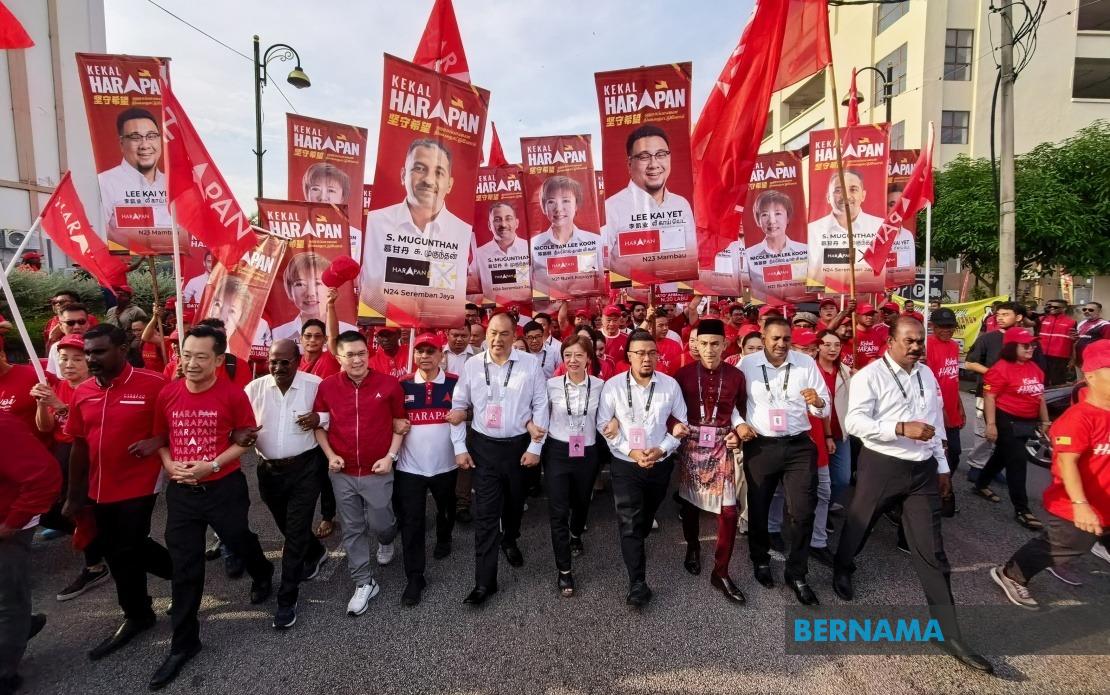
The Rahang constituency in Negeri Sembilan is shaping up to be one of the most competitive battlegrounds in the upcoming state election, with Pakatan Harapan-backed Siaw Meow Keong, the DAP's state treasurer, facing a challenging multi-sided contest to retain his seat. Since capturing the constituency in 2023, Siaw has emerged as a notable figure within the opposition coalition, and his performance in Rahang will be closely watched as an indicator of PH's standing in the state ahead of the August 1 polling day. The complexity of this four-way race reflects the increasingly fragmented political landscape in Malaysia's central region, where traditional two-bloc contests have given way to more unpredictable configurations.
Siaw's rivals represent a diverse political spectrum that will test his support across different voter demographics. Yap Siok Moy, fielded by Barisan Nasional and notably serving as Rasah MCA Wanita chief, brings the BN machinery and gender appeal to her candidacy. S. Thinagaran of Parti Sosialis Malaysia represents a left-wing alternative with growing appeal among certain segments of the electorate, while Tang Jay San of Bersatu carries the backing of a party that has fundamentally reshaped Malaysian politics through its grassroots mobilisation strategy. The nomination process, conducted formally at Seremban City Council Hall on July 18, confirmed all four candidates' eligibility, with the returning officer Mohamad Najib Mustafa overseeing proceedings that lasted the statutory one-hour window.
Across other Negeri Sembilan constituencies, the political contests reveal similarly fragmented patterns that will make predictive analysis challenging for observers. In Bukit Kepayang, the battle appears more straightforward, presenting itself as a direct contest between Nicole Tan Lee Koon, the DAP's state Wanita chief defending for PH, and Lee Boon Shian representing Perikatan Nasional. This two-cornered race removes some variables present in multi-way contests and may allow for clearer messaging from both camps. The stark difference in configuration between Rahang and Bukit Kepayang underscores how different constituencies will require tailored strategies and resource allocation, particularly for larger coalitions managing multiple fronts simultaneously.
Three-cornered contests in Labu, Mambau and Seremban Jaya further complicate the electoral mathematics for all competing coalitions across the state. In Labu, Datuk Ahmad Faez Abdul Razak of PH faces Mohamad Hanifah Abu Baker representing Bersatu and Siti Nur Umaira Hasim of BN, creating a genuinely open scenario where vote splitting could determine outcomes. Mambau presents another three-way tussle between PH's Lee Kai Yet, Bersatu's N. Sarawanan and PN candidate Eric Michael, while Seremban Jaya rounds out this category with S. Mugunthan from PH competing against Datuk T. R. Thinalan of BN and R. Mahendran of Bersatu. These overlapping contests suggest that Negeri Sembilan has evolved into a genuinely competitive state where no single coalition can take victory for granted.
The implications for Malaysian politics extend beyond Negeri Sembilan's borders. The state election serves as a crucial test of PH's ability to maintain support in mixed-constituency battlegrounds where multiple parties can viably compete. For BN, the election represents an opportunity to reclaim ground in a state where the coalition's influence has waned considerably since 2018. Bersatu's participation across multiple seats, often fielding candidates who directly challenge both PH and BN candidates, demonstrates the party's strategy of positioning itself as a disruptive political force capable of shifting outcomes through strategic placement rather than necessarily winning seats outright. The presence of PSM in Rahang, meanwhile, highlights how Malaysia's left-wing movements continue seeking electoral opportunities despite historical organisational challenges.
The Electoral Commission has structured the voting process to allow maximum participation, with early voting scheduled for July 28 and the main polling day set for August 1. This two-stage approach reflects international best practices in electoral administration, particularly important in constituencies where diverse voter bases require accessibility options. For voters in constituencies like Rahang, this expanded voting window provides flexibility for those unable to vote on the primary polling day, though it also extends the campaign period during which candidates must maintain momentum and visibility. The preparation and rollout of these electoral mechanics in Negeri Sembilan will provide valuable operational insights for future national-level exercises.
Campaign dynamics in Negeri Sembilan will likely emphasise local concerns around infrastructure, economic opportunity and representation alongside broader national political narratives. Siaw's positioning as DAP treasurer adds weight to his candidacy within PH circles but simultaneously makes him a focal point for opposition criticism regarding the coalition's governance record at federal level. His defence of Rahang will be scrutinised as a test of whether PH can maintain support among urban and semi-urban constituencies that traditionally vote for alternative coalitions when dissatisfied with incumbents. Conversely, BN's strategy through Yap Siok Moy suggests an attempt to mobilise women voters and community-level support through a candidate closely connected to grassroots structures.
The four-way nature of Rahang's contest creates unprecedented tactical considerations for all camps. Vote distribution across the four candidates will determine the outcome in ways that traditional analyses of BN versus PH dynamics cannot fully capture. Strategic voters might attempt to coordinate their choices to either reinforce or dilute particular candidacies, while turnout variations could dramatically alter competitive positions. For PH, maintaining Rahang becomes important symbolically as well as substantively, signalling that the coalition retains capacity to defend urban and semi-urban seats against combined opposition. For BN, capturing the seat would represent a recovery in Negeri Sembilan after years of opposition dominance.
Bersatu's multi-constituency presence in the state election reflects its broader electoral strategy since its departure from governing coalitions at federal level. By fielding candidates across key constituencies, Bersatu maintains political relevance and keeps open options for future coalition arrangements regardless of the election outcome. This flexibility, combined with the party's acknowledged organisational strengths in grassroots mobilisation, positions Bersatu as a potential kingmaker in any post-election coalition negotiations should no single bloc secure overwhelming state assembly dominance. The party's performance across Labu, Mambau, Seremban Jaya and other constituencies will signal whether its strategic positioning is translating into electoral viability.
For Malaysian political observers and analysts, the Negeri Sembilan state election functions as a microcosm of contemporary Malaysian electoral competition. The diversity of contests across different constituencies, the presence of multiple political blocs competing simultaneously and the apparent willingness of voters to consider varied political alternatives all suggest that Malaysian politics continues evolving toward increasingly complex configurations. Unlike the binary BN-versus-opposition contests that dominated 2018 and 2020, the Negeri Sembilan election reflects a multipolar political environment where local factors, candidate appeal, party machinery and coalition positioning all interact to produce outcomes that resist simple prediction. The August 1 results will provide crucial data points for understanding how Malaysian voters are thinking about political choice, representation and governance in this significant moment for the nation's democratic development.

