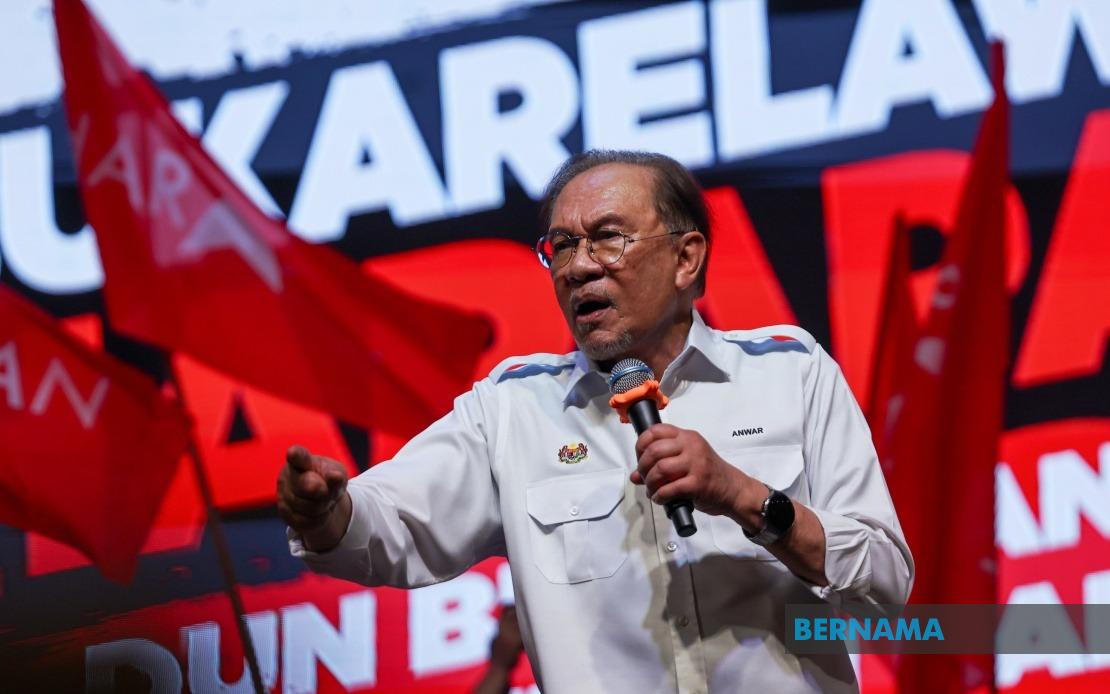
Prime Minister Datuk Seri Anwar Ibrahim mounted a robust defence of the Democratic Action Party's record on Malay rights on July 5, directly challenging narratives that portray the multiracial coalition partner as hostile to indigenous interests. Speaking at a grassroots engagement event in Muar during campaign activity for the Johor state election, Anwar sought to dispel what he characterised as a deliberate misrepresentation by certain quarters seeking political advantage through communal polarisation. The Prime Minister's intervention underscores a persistent tension within Malaysia's political landscape, where questions about how power-sharing arrangements balance competing communal interests remain potent electoral currency.
To substantiate his assertion, Anwar pointed to DAP's acquiescence in the government's proposal to gazette 20.23 hectares of land in Bandar Malaysia as Malay Reserve Land. This concrete example carries particular weight because constitutional safeguards for Malay-Muslim interests rank among the most sensitive issues in Malaysian politics, and opposition to such measures can inflame community sentiment. DAP's acceptance of this designation, according to Anwar's logic, demonstrates that the party accepts the legitimacy of provisions enshrined in the Federal Constitution protecting Bumiputera status and related privileges. The significance of this point extends beyond symbolic territory; it suggests that the Unity Government's multiracial configuration does not necessarily entail dismantling existing constitutional frameworks favouring Malays and indigenous groups.
Anwar articulated a nuanced governing philosophy centred on proportionate allocation of resources and opportunities across demographic categories rather than zero-sum competition between communities. He acknowledged that his administration actively pursues programmes targeting the Malay and Bumiputera communities, including enhanced funding through agencies such as Perbadanan Usahawan Nasional Berhad, without encountering resistance from DAP coalition partners. This framing rejects the premise that inclusive governance requires diminishing support for any particular group, instead positioning equitable distribution as compatible with maintaining targeted initiatives for communities traditionally advantaged by state mechanisms. For Malaysian readers and policymakers, this articulation matters because it suggests a potential middle path between the polarisation of previous administrations and wholesale redistribution fears.
Simultaneously, Anwar invoked his responsibility as head of the Unity Government to ensure that disadvantaged populations across all ethnic lines receive substantive assistance. He specifically mentioned extending welfare and development programmes to poor Chinese and Indian communities, framing this not as a departure from constitutional commitments but as fulfilment of humanitarian obligations transcending ethnic boundaries. This rhetorical move redefines the debate: rather than asking whether non-Bumiputera populations receive fewer benefits due to constitutional protections, Anwar suggested that the proper question concerns whether government programmes reach those facing genuine hardship irrespective of background. Such reframing carries implications for how future administrations might justify resource allocation decisions to increasingly diverse and migration-affected constituencies.
The Prime Minister connected his governance vision to macroeconomic performance, contending that sustained economic growth must translate into tangible improvements in living standards across society. Rather than allowing aggregate growth figures to mask inequality or concentrate wealth among connected elites, Anwar proposed channelling economic dynamism into accessible housing, reliable basic infrastructure, and educational quality improvements available to ordinary Malaysians. This approach acknowledges a legitimate public frustration that headline GDP growth often fails to reach lower and middle-income households experiencing stagnant wages and rising costs. For Southeast Asian observers, Anwar's emphasis resonates with broader democratic pressures across the region where growth without shared prosperity fuels political instability.
Anwar's statements carry particular weight in the context of the July 11 Johor state election, where 172 candidates compete for 56 assembly seats. The Johor contest serves as a significant barometer of public sentiment toward the Unity Government and its internal coalition dynamics, with particular attention to whether voters in this traditionally Malay-Muslim-majority state accept DAP participation in a governing coalition. The willingness of Johor's predominantly conservative electorate to support Unity Government candidates could validate Anwar's argument that multiracial governance need not threaten Malay-Muslim interests, or alternatively, voter hesitation might suggest lingering communal apprehension about power-sharing arrangements. The electoral stakes thus transcend local administration, touching on fundamental questions about Malaysia's political trajectory under post-2022 coalition governance.
The Prime Minister's emphasis on ethical governance and distinguishing political service from personal enrichment speaks to another dimension of public concern affecting his credibility. He underscored that wielding political power constitutes a public trust rather than an opportunity for personal accumulation, and framed developmental initiatives through this lens of custodial responsibility. This rhetorical positioning becomes significant given Malaysia's history of governance scandals and corruption allegations that have undermined public confidence in state institutions. By anchoring his defence of multiracial governance in principles of integrity and public orientation, Anwar potentially addresses concerns that the Unity Government represents merely a rotating system where different coalitions access state resources for partisan or personal benefit.
The broader subtext of Anwar's intervention involves defending the legitimacy of DAP's role within Malaysia's governing coalition against persistent suggestions that the party harbours hidden anti-Bumiputera or anti-Islamic agendas. Such accusations, whether substantiated or not, carry considerable political potency in Malaysia's communal environment, where historical grievances and constitutional settlements remain contested terrain. By invoking concrete policy examples and articulating a coherent governance framework, Anwar attempted to move discussion beyond rhetorical accusations toward examination of actual resource distribution and programme implementation. Whether such efforts successfully reshape public perception, particularly among more conservative constituencies, remains uncertain and will receive empirical testing through electoral outcomes.
For regional observers, Malaysia's experiment with formal multiracial coalition governance carries implications extending beyond national borders. If the Unity Government can demonstrate that power-sharing arrangements need not automatically disadvantage majority communities or eliminate targeted support for traditionally privileged groups, the model might offer instructive lessons for other Southeast Asian democracies managing ethno-religious diversity and constitutional pluralism. Conversely, should the arrangement falter amid communal tensions or prove unsustainable, the experience would provide cautionary insights into the institutional and cultural preconditions necessary for truly inclusive governance in societies with constitutional provisions protecting majority interests.

