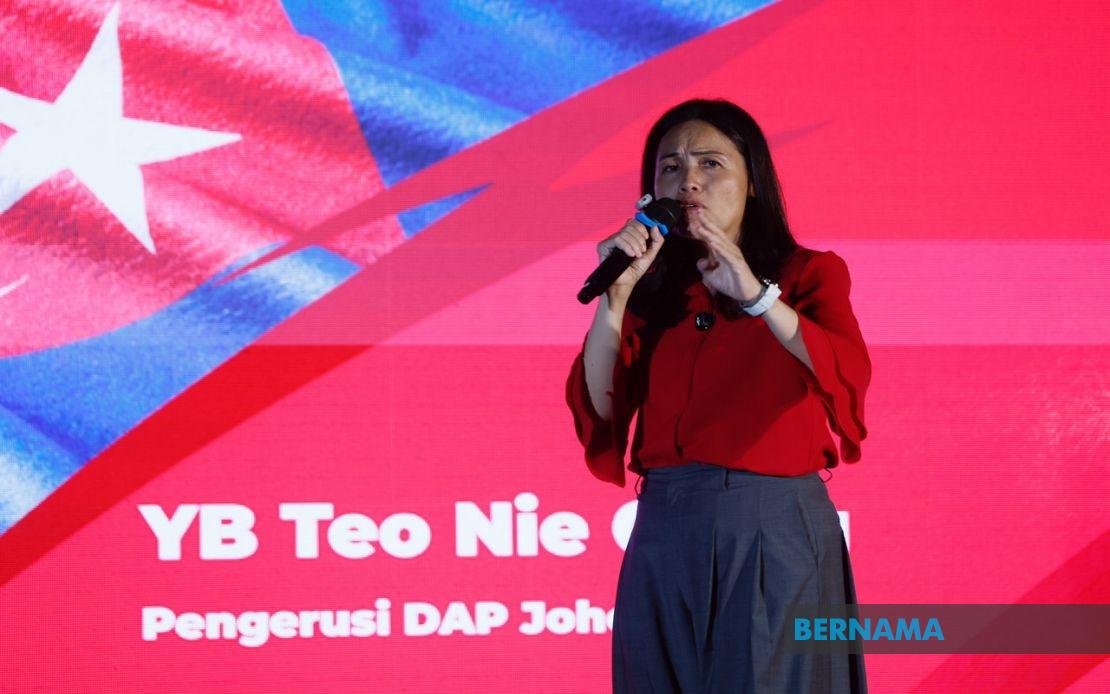
The Democratic Action Party has committed to a detailed examination of its electoral setbacks in Johor following the state election held on July 12, acknowledging that the results underscore the need for significant organisational change. Party chairman Teo Nie Ching, who also serves as Deputy Communications Minister, issued a statement accepting responsibility for the party's poor showing and pledging to identify the specific weaknesses that contributed to each constituency loss. The admission comes as the DAP absorbed considerable damage in a state where it has traditionally maintained significant support, particularly losing ground in constituencies like Jementah, Tangkak, Johor Jaya, and Perling.
The scale of DAP's defeat in the 16th Johor election was substantial. Out of 17 seats the party contested, it successfully retained only six, meaning it lost 11 seats overall. More damaging still were the four seats that DAP had previously held and failed to defend, indicating a reversal of its electoral fortunes rather than merely falling short in new territories. These losses represent not merely a failure to gain ground but a genuine contraction of the party's presence in one of Malaysia's most politically significant states. The party's performance stands in stark contrast to Barisan Nasional, which demonstrated remarkable dominance by securing all 48 seats it previously held while gaining additional constituencies, resulting in a commanding 48 of 56 seat supermajority in the Johor State Assembly.
Teo's acknowledgment of shortcomings signals a recognition within DAP leadership that the party requires fundamental changes rather than superficial adjustments. In her Facebook statement, she emphasised that the electoral outcome constituted a clear message demanding improved performance across multiple dimensions of party operations. This language suggests the party plans to examine not only campaign strategy and messaging but also grassroots organisation, candidate selection processes, and engagement with local communities. The comprehensive nature of the promised review indicates DAP recognises that the problem extends beyond any single factor, whether messaging, candidate quality, or campaign execution.
A particularly revealing aspect of voting patterns emerged in constituencies like Johor Jaya and Perling, where a significant shift occurred compared to the 2022 state election. In both these seats, Perikatan Nasional candidates had previously attracted substantial voter support, yet that backing swung decisively toward Barisan Nasional in the 2024 election. Notably, while Pakatan Harapan's overall vote share increased in both constituencies, this improvement proved insufficient to overcome the realignment of opposition voters consolidating around the BN banner. This dynamic suggests that the political landscape in Johor has stabilised around the Barisan Nasional as the dominant force, with voters who might previously have been divided between different opposition blocs choosing to support the ruling coalition.
The broader electoral landscape in Johor during this election proved particularly challenging for alternative political forces. Beyond DAP's struggles, Perikatan Nasional failed entirely to translate its previous support in the state into any seat victories. Similarly, Parti Bersama Malaysia, Parti Sosialis Malaysia, MUDA, and the newer Parti Orang Asli Malaysia all drew blanks despite contesting, while six independent candidates also failed to achieve election. This complete exclusion of all non-Barisan, non-Pakatan Harapan political entities from the state assembly reflects a consolidation of Johor politics into essentially a two-sided contest, with Barisan Nasional emerging as the overwhelming victor in this binary struggle.
For Pakatan Harapan overall, the Johor result represents a significant setback that could have implications for the federal coalition's standing. While PH managed to secure eight seats through its combined effort across various member parties, this represents a dramatic erosion compared to its previous presence in the state. The coalition's inability to present a more unified or compelling alternative vision to Johor voters, and its failure to retain seats previously won, suggests that the coalition's federal positioning may not be translating into strong state-level support in key constituencies. This disconnect between federal political dynamics and state-level electoral outcomes raises questions about whether Pakatan Harapan's governance at federal level is effectively resonating with voters in states traditionally seen as coalition territory.
Teo's gracious acceptance of the electoral result and congratulations to Barisan Nasional reflect the DAP's commitment to democratic norms and mature political conduct. Her acknowledgment that Johor voters have expressed their preference through the ballot box, combined with gratitude for those who supported the party, demonstrates an understanding that electoral losses, while painful, represent legitimate expressions of public will. She extended thanks to all voters who participated in the democratic process, recognising that voter turnout itself represents an affirmation of the electoral system's legitimacy. This measured response, rather than contesting results or attributing defeat to external factors, positions the DAP as a responsible parliamentary player willing to accept democratic verdicts.
The path forward for DAP in Johor will require addressing questions about candidate quality, campaign messaging, local organisation, and connection with community concerns. The promised comprehensive review must move beyond identifying problems to implementing concrete solutions that rebuild voter confidence and organisational capacity. For a party that has historically drawn support from urban middle-class voters and Chinese-majority constituencies, understanding why these traditional supporters shifted away or failed to mobilise will be crucial. The party will need to examine whether its national-level positioning, its engagement with state and local issues, or its internal party dynamics contributed to the disconnect with Johor voters.
The Johor election outcome carries significance beyond the state's boundaries, offering insights into broader Malaysian political trends. The strength of Barisan Nasional's performance suggests that Prime Minister Anwar Ibrahim's government, despite its federal coalition configuration, has not significantly weakened the traditional opposition's structural advantages in traditionally BN-friendly states. Conversely, the weakness of Perikatan Nasional in Johor, despite its strength elsewhere in Malaysia, indicates that regional political dynamics remain highly variable. For DAP and Pakatan Harapan, the challenge involves rebuilding momentum and recovering ground in key states while simultaneously supporting their federal coalition partner.

