The Johor state election campaign has taken a contentious turn with opposition lawmakers challenging the Menteri Besar over the conduct of what was officially presented as a vocational training initiative. Johor DAP chairman Teo Nie Ching has demanded clarity from Datuk Onn Hafiz Ghazi regarding complaints that students attending a Technical and Vocational Education and Training roadshow were subsequently exposed to Barisan Nasional political messaging, raising serious questions about the blurring of government and party interests during an active electoral period.
According to accounts presented by Teo, parents and students have reported that participation in the Johor MARA TVET Roadshow, held on July 4 at the Inland Revenue Board Hall in Kluang, was essentially mandatory. Young attendees were allegedly informed that failure to participate would be recorded as absenteeism, placing them in a position where refusing attendance carried academic consequences. This practice of coercing attendance through administrative mechanisms raises fundamental concerns about the appropriateness of using educational settings for political mobilisation, particularly when the students involved have no realistic option to decline.
The controversy deepens with allegations about how the event subsequently unfolded. Teo, who also serves as Deputy Communications Minister, contends that the programme shifted from its ostensible educational purpose to one explicitly promoting the Barisan Nasional candidate. According to the DAP account, the Menteri Besar used the platform to encourage students to vote for the BN contender, even publicly identifying the candidate by their ballot number. Such direct solicitation of political support among a captive audience of TVET students would constitute a clear violation of electoral norms and the principle that government programmes should remain politically neutral.
What renders this situation particularly problematic is the ambiguity surrounding the event's fundamental nature. Teo articulated this dilemma with precision: if the roadshow was genuinely a government programme, then its conversion into a political campaign venue would represent an improper fusion of state resources and party activities. Conversely, if the event was fundamentally a party-sanctioned political gathering, the use of a government agency's premises to conduct political campaigning raises distinct legal and ethical questions about whether such facilities can legitimately be employed for partisan purposes. Either interpretation points toward a breach of electoral conduct standards.
The opposition has gathered documentary evidence supporting their allegations. DAP representatives claim to possess the official event itinerary, written correspondence mandating attendance, and video recordings purportedly capturing the campaign-related remarks attributed to the Menteri Besar. The existence of such materials suggests this is not merely a matter of competing narratives but rather a situation where verifiable evidence may demonstrate how the event actually unfolded. The video footage would be particularly significant, as it could provide objective documentation of whether political campaigning indeed occurred at what purported to be a vocational training initiative.
Teo's intervention carries added weight given her position as a federal minister responsible for communications. By raising these concerns, she is signalling that the apparent misuse of an educational programme for political purposes has attracted attention at the national level and that opposition parties view this as a matter requiring official scrutiny. Her invocation of her role as a parent also resonates beyond narrow political calculations, framing the issue as one that affects ordinary citizens' children and their educational experiences.
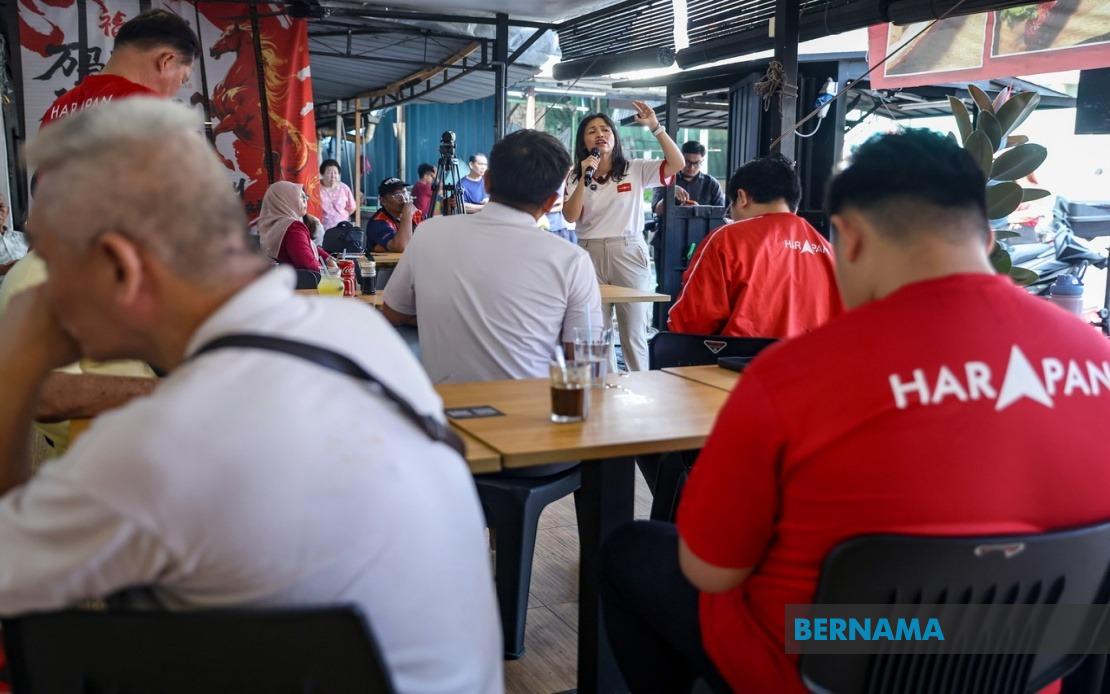
The involvement of veteran DAP leader Tan Sri Lim Kit Siang underscores the seriousness with which the opposition coalition is treating these allegations. Lim's presence at the Kulai forum alongside DAP and PH candidates demonstrated a unified opposition stance on this issue. More significantly, Lim used the occasion to articulate a broader campaign message centred on rejecting divisive racial politics in favour of what he termed the "Malaysian Dream"—a vision predicated on equality, freedom, prosperity and human rights protection. This framing attempts to position the Johor election not merely as a contest between political vehicles but as a fundamental choice about Malaysia's political direction.
Lim's call for voters to consolidate rather than fragment their support carries specific strategic implications for the Johor contest. With 56 state seats attracting 172 candidates, vote fragmentation could significantly determine outcomes in closely contested constituencies. His emphasis on consistency rather than splitting votes appears directed at PH supporters tempted to vote for independent candidates or other opposition figures, a concern that reflects realistic assessment of Johor's electoral dynamics.
The Menteri Besar's recent criticisms of federal government policies provided an additional target for DAP scrutiny. Teo characterised Onn Hafiz's complaints as selective and disingenuous, observing that state leaders consistently claim credit for popular policies while blaming federal authorities for unpopular measures. She pointed out that major policies require Cabinet approval, implying that state-level officials cannot validly distance themselves from frameworks they themselves participated in designing. This counterargument positions the Menteri Besar as attempting to have it both ways—benefiting from federal programmes while shifting blame for their drawbacks.
The allegations regarding the TVET event have prompted consideration of formal complaints to the Election Commission. Teo indicated that PH candidates would assess appropriate responses, potentially including official submissions to electoral authorities. Such action would escalate the matter from political controversy to formal investigation, triggering official review of whether electoral laws and codes of conduct were violated. The Election Commission's receptiveness to these concerns could significantly influence the campaign's trajectory and cast shadows over state government conduct during the electoral period.
These developments occur against the backdrop of a 56-seat state election featuring three electoral phases. Early voting commenced on July 7, with general polling scheduled for July 11, meaning the election timeline compressed the window for addressing these allegations before many voters cast ballots. This temporal constraint affects both the opposition's ability to drive the narrative and the public's opportunity to digest these serious claims about electoral proprieties. For Malaysian observers following Johor politics, the resolution of these allegations will indicate whether state electoral processes maintain integrity and whether government resources remain genuinely neutral during campaign periods—concerns extending well beyond this particular contest.

