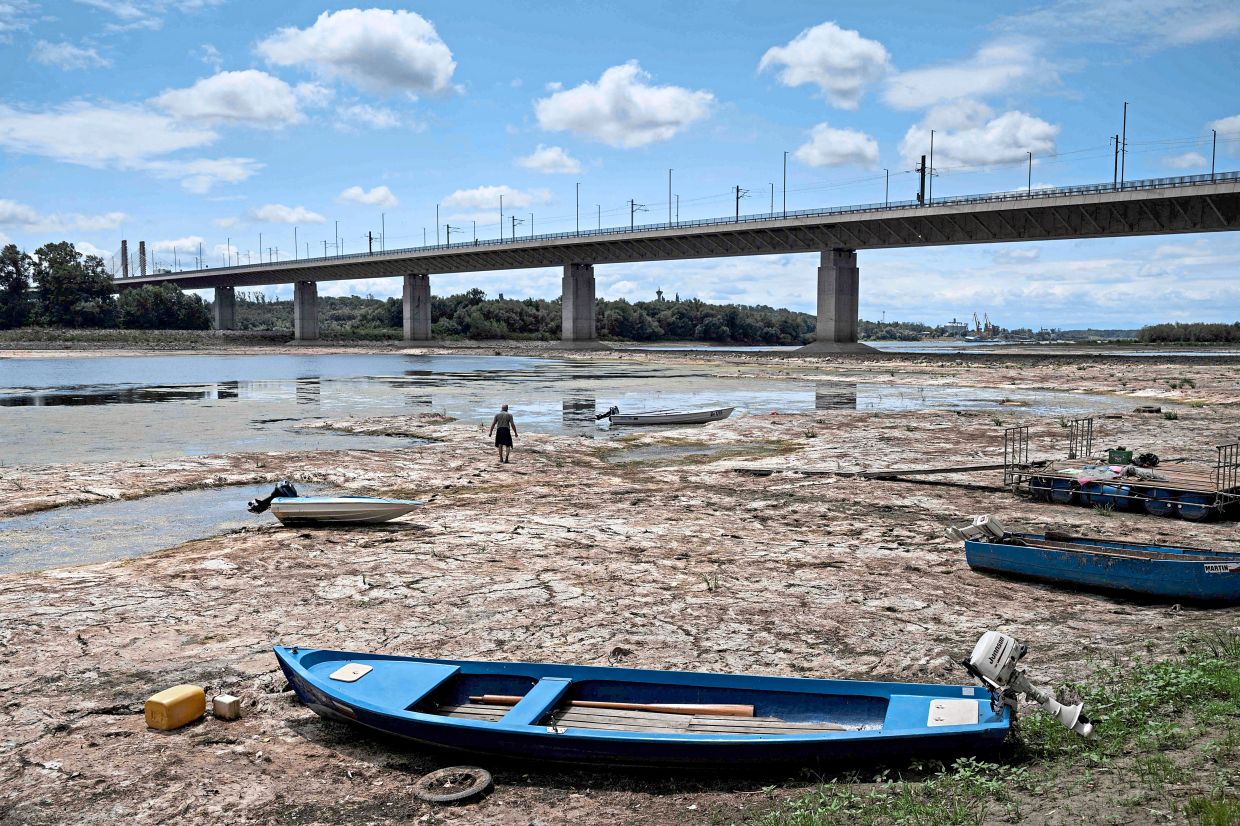
The Danube River, which flows through ten countries from southwestern Germany to the Black Sea, has reached unprecedented lows across much of its course, exposing submerged landscapes and forcing governments to confront the economic and safety ramifications of an extended drought gripping Central Europe. In Budapest, water authorities recorded a depth of just 23 centimetres on 29 July—shattering the previous record minimum of 33 centimetres established in 2018—with forecasts predicting further decline as temperatures across the region climb above 38°C and no meaningful rainfall appears on the meteorological horizon.
The visible transformation of the riverscape has become almost apocalyptic in character. Along the Danube's path, rocks long submerged have emerged, sandbars stretch across formerly navigable channels, and wartime shipwrecks lie exposed to daylight for the first time in decades. In Budapest, the base of Margaret Bridge—normally several metres below the surface—now forms an accessible shoal, prompting photographers to document what many residents describe as a shocking glimpse into the river's pre-industrial form. The psychological impact on local communities is profound, with observers linking the visible environmental crisis directly to climate disruption and raising anxious questions about the region's hydrological future.
Much of Central Europe has endured a persistent drought throughout the year, compounded by successive heat waves that have accelerated evaporation rates and starved waterways of replenishment. According to Hungary's Meteorological Service, cumulative rainfall over the preceding ninety days fell between 80 and 130 millimetres below long-term averages across nearly the entire nation. This deficit represents not a seasonal anomaly but a systemic drying that has gradually depleted aquifers, reduced tributary flows, and concentrated the Danube's water into an ever-thinning ribbon.
The economic consequences have manifested swiftly across the river-dependent tourism sector. Cruise vessels that typically provide Budapest as a centrepiece destination for Central European river cruises now find themselves forced to dock at remote upriver locations, rendering the planned tourist experience essentially impossible. According to Hungary's Ministry of Transport and Investment, cargo shipping has nearly ceased entirely, with commercial operators unable to navigate the shallow channels. In Bulgaria, this crisis reached a dramatic crescendo when authorities evacuated 186 passengers from the Viking Ullur after the cruise ship ran aground on a shoal near the port city of Vidin on 28 July. The vessel's passengers faced shortages of both food and water, having been unable to reach the port for resupply after encountering unexpected shallows, according to Bulgaria's state news agency. The ship's 52-member crew remained aboard awaiting navigation conditions favourable enough to refloat the stranded vessel.
Serbia has witnessed its own maritime catastrophe, with hundreds of small leisure boats and dozens of cargo vessels marooned along the riverbank near Novi Sad in the north. Boat operators who depend on seasonal tourism for their livelihoods report that the Danube has retreated between 15 and 20 metres from its normal shoreline, rendering conventional operations impossible. One houseboat proprietor running river excursions lamented that the summer season had effectively concluded, highlighting the cascading employment implications for businesses dependent on the river's navigability.
Beyond tourism and commerce, the drought threatens the continent's energy security through its impact on nuclear power generation. Multiple Central European nations rely on Danube water to cool nuclear reactors, and the crisis has already forced emergency shutdowns. Romania's water authority observed Danube flows declining to approximately 1,630 cubic metres per second—roughly a third of typical July volumes—prompting authorities to shut down a reactor unit at the Cernavoda power station for safety reasons and signalling imminent closure of another unit. Hungary's Paks nuclear plant, which generates nearly half the country's electricity supply, initiated emergency power reductions on 29 July due to insufficient cooling-water availability. These reductions followed two consecutive days of partial power cutbacks at other reactor units, signalling a fragile energy situation as summer demand peaks.
The receding waters have exposed not only environmental hazards but also remnants of warfare. Budapest authorities closed Margaret Bridge after discovering a World War II-era bomb at its base, newly exposed by the falling water levels. This discovery illustrates how the Danube has historically served as a repository for military debris and how contemporary environmental change can rapidly transform riverscapes, exposing dangers long considered safely submerged. Such incidents underscore the compound risks posed by extreme hydrological events in densely populated areas with complex historical legacies.
The crisis has even spawned an unexpected cottage industry. Treasure hunters with powerful magnets now exploit the exposed riverbed to extract metal objects—ammunition casings, abandoned weaponry, discarded electronics—from the historical sediments. While such activity provides some individuals with a sense of purpose and modest income during the drought, it simultaneously encapsulates the peculiar nature of environmental catastrophe: for every loser, there emerges an improbable winner. The paradox is not lost on practitioners, who acknowledge that while extreme low-water conditions enable certain activities, they represent an unmistakable curse for the broader economy and ecosystem.
For Malaysian observers, the Danube crisis offers instructive parallels to water stress scenarios across Southeast Asia. Many major rivers in the region—the Mekong, the Irrawaddy, the Salween—face comparable threats from drought, damming, and climate change. The cascade of consequences visible along the Danube—disrupted shipping, energy shortages, tourism collapse, and exposed environmental hazards—provides a cautionary blueprint for how connected infrastructure becomes fragile when water availability plummets. The European crisis also demonstrates that even wealthy, technologically advanced nations struggle to rapidly adapt to hydrological disruption, suggesting that developing economies in Southeast Asia face considerably steeper challenges in managing similar scenarios. The Danube's crisis is ultimately a preview of climate-induced water stress that will increasingly confront Asia's river-dependent economies in coming decades.

