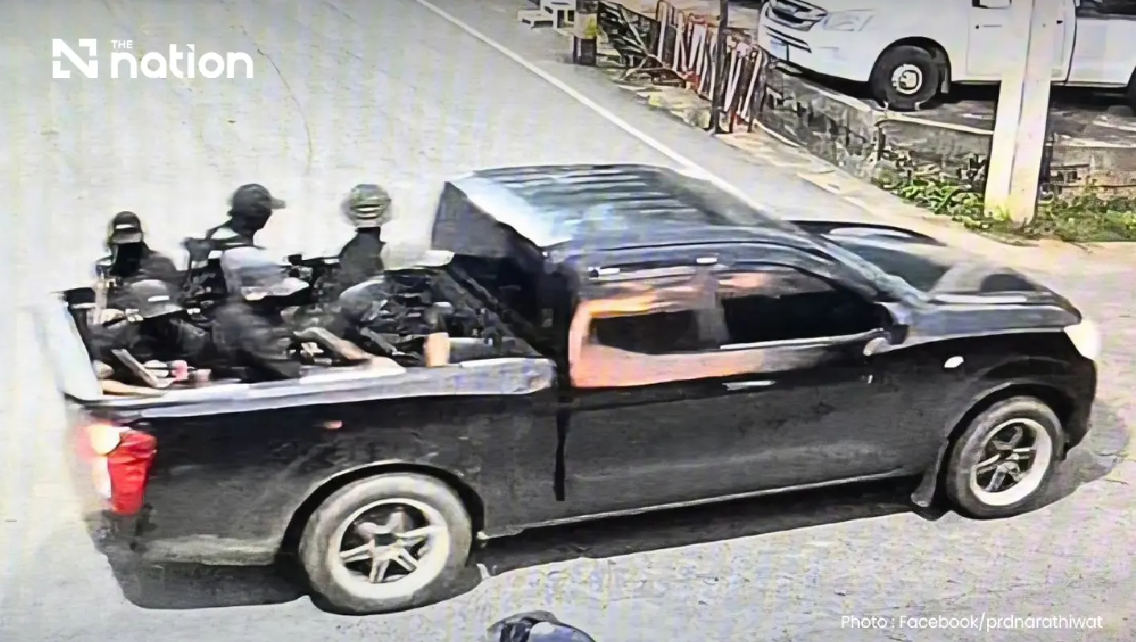
A devastating raid on the Bukeh Sami checkpoint in Thailand's southernmost Narathiwat province has been fully documented by security cameras, revealing the cold precision of what authorities now understand was a nine-person operation rather than the initially suspected six attackers. The assault lasted just 90 seconds on the evening of Wednesday, July 22, at approximately 6:45pm, but resulted in the deaths of five paramilitary rangers stationed at the checkpoint in Tanyong Mat subdistrict, Ra-ngae district, which falls under the jurisdiction of the 45th Ranger Regiment Task Force's 4509th Ranger Company. The speed and coordination of the attack underscores the operational sophistication of militant groups active in Thailand's deep south, an area that has experienced decades of intermittent violence rooted in historical and communal tensions.
The recorded footage reveals a meticulously planned two-pronged approach to the assault. A seven-member strike force arrived in a black Nissan pickup truck registered in Songkhla, with one driver and six armed personnel occupying the truck bed. Each member of this primary assault team wore black attire resembling paramilitary uniforms and broad-brimmed hats that effectively obscured their facial features, suggesting either prior familiarity with security force dress codes or deliberate tactical planning to create confusion at the checkpoint. They were accompanied by a second unit on a red-and-white Honda Wave motorcycle whose registration could not be fully captured on camera. The motorcycle rider wore a white shirt and helmet, while his passenger disguised himself in a black women's hijab before the attack, a detail that highlights the tactical thinking employed by the group.
The initial moments of the assault proved deadly for the checkpoint's defenders. Three paramilitary rangers were positioned at a roadside checkpoint when the pickup vehicle slowed in front of them. The six gunmen in the truck bed immediately opened fire with M16 and AK-type rifles, quickly overwhelming the three officers before they could mount any meaningful defensive response. Once the vehicle came to a halt, additional members of the assault team dismounted and continued their barrage, directing sustained fire toward the checkpoint's fortified bunker position where two additional rangers were stationed. The comprehensive nature of the attack, with coordinated covering fire and tactical movement between positions, demonstrates familiarity with military assault procedures.
After neutralizing the ranger positions, the attackers conducted what appeared to be a deliberate weapons collection operation. They systematically searched the checkpoint post and extracted four folding-stock AK-type rifles, one 11mm pistol, four ammunition magazines, and four bulletproof vests before departing the scene. As the group withdrew toward the pickup truck, one attacker hurled a pipe bomb toward an elevated structure positioned near a bridge adjacent to the checkpoint, potentially aimed at disrupting pursuit or destroying additional evidence. The assailants then fled in both vehicles toward Dusongyo subdistrict in Ra-ngae district, with the motorcycle providing rearguard protection. The pickup truck was subsequently discovered abandoned and deliberately set ablaze, indicating a conscious effort to eliminate forensic traces.
The five rangers killed in the assault were identified as Sergeant Major First Class Theerayut Somakerd and ranger volunteers Sakiriya Jena, Wimon Dabthong, Nattasit Kaewsena, and Salahuding Pi. Beyond the military casualties, six civilians were also wounded during the exchange, including a 10-year-old boy, all of whom were transported to nearby medical facilities for treatment. Initial reports regarding civilian injury figures proved unreliable, fluctuating between two and five injured before the final tally of six was confirmed, a discrepancy that reflects the chaos typical of such incidents and the challenges authorities face in establishing accurate casualty counts in immediate aftermath situations.
Forensic investigators and tactical police teams worked through the night examining the checkpoint, recovering over 100 spent cartridge cases from the road surface, including rounds from M16 rifles, AK-type weapons, and an 11mm pistol. Additional ammunition evidence suggested the attackers had experienced weapons malfunctions during the assault and had cleared jammed mechanisms, indicating these were operational personnel rather than untrained fighters. The checkpoint's defensive bunker bore extensive bullet scarring from the sustained gunfire, while investigators also recovered evidence related to the pipe bomb detonation near the bridge structure. Despite these findings, authorities acknowledged that determining the precise inventory of stolen weapons and equipment remained incomplete due to conflicting early accounts from checkpoint personnel and survivors.
The incident prompted an immediate and coordinated response from Thailand's security hierarchy. Narathiwat Governor Boonchuay Homyamyen supervised the overnight crime scene investigation alongside Provincial Police Region 9 commissioner Pol Lt Gen Piyawat Chalermsri, Narathiwat police chief Pol Maj Gen Prayong Khot Sakha, and Col Witthaya Sariya, commander of the 45th Ranger Regiment Task Force. Multiple specialist units were deployed, including bomb-disposal personnel and forensic teams tasked with securing evidence and pursuing investigative leads. Security forces subsequently established checkpoints and roadblocks throughout the region on likely escape routes, though the initial response was delayed relative to the attackers' head start.
This assault represents a significant security incident within Thailand's southern provinces, where insurgent and militant activity has persisted despite decades of counter-insurgency efforts and peace initiatives. The attack's apparent sophistication, including the use of coordinated multi-team tactics, vehicle-based movement, and planned weapons acquisition, suggests either training by experienced military personnel or operational learning accumulated through previous incidents in the region. For Malaysia and broader Southeast Asia, the incident underscores the persistent cross-border security challenges facing the region and raises questions about the movement of armed personnel and weapons across international frontiers in the Malaysia-Thailand border zone.
The technical execution of the raid demonstrates that despite increased security measures and checkpoint installations across southern Thailand, determined and well-coordinated groups retain the capability to inflict significant casualties on fixed defensive positions. The 90-second timeframe indicates that response mechanisms, whether alarm systems or reinforcement procedures, proved insufficient to prevent the assault's completion. This tactical lesson likely extends implications for regional security forces evaluating checkpoint protocols, personnel deployment patterns, and rapid response capabilities. The incident will almost certainly influence future discussions within the Thai security establishment regarding resource allocation, training standards, and defensive posture in border regions where both state capacity and militant capabilities remain in flux.

