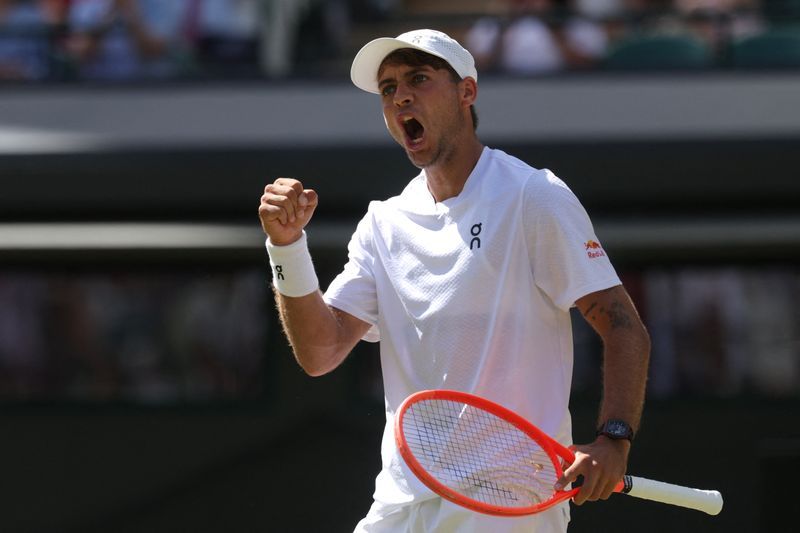
Flavio Cobolli has consolidated the finest Grand Slam campaign of his professional tenure by dispatching Australian fifth seed Alex de Minaur on the opening day of the Wimbledon second week, securing a berth in the quarter-finals for the second consecutive year. The victory, achieved in straight sets on Court One with a scoreline of 7-5 7-6(4) 6-3, represents a continuation of extraordinary form for the Italian ninth seed, who remains buoyed by his runner-up finish at Roland Garros just weeks earlier. The comprehensive nature of the triumph underscores Cobolli's growing comfort at the elite level of professional tennis, particularly in the demanding conditions that have characterised this year's Championships at the All England Club.
Cobolli's passage through the fourth round came with considerable advantage in his immediate horizon, as his prospective opponent will emerge from a match between British prospect Arthur Fery and seasoned Bulgarian competitor Grigor Dimitrov, both of whom have demonstrated notable success during the preceding rounds at grass level. The draw presents a favourable configuration for the Italian's continued advancement, offering realistic prospects of reaching his second Grand Slam semi-final of the season should he maintain the intensity displayed throughout his encounter with the Australian.
The opening set proved decisive in establishing Cobolli's dominance, with the 24-year-old manufacturing a critical break in the eleventh game after forcing a backhand error from De Minaur. Completing the set in fifty minutes telegraphed the Italian's intent and physical superiority in the early proceedings, though the subsequent sets would present more resolute resistance from his opponent. The tactical acuity demonstrated by Cobolli in targeting De Minaur's less reliable wing proved instrumental throughout, as the Italian executed the game plan with precision and composure characteristic of a player ascending the rankings.
The second set witnessed a dramatic shift in context as extreme heat affected both players and spectators alike. A spectator required medical assistance during play, prompting tournament officials to suspend proceedings as temperatures soared across the grounds. The environmental challenges provided an unexpected backdrop to the contest, with both competitors demonstrating awareness of the conditions whilst maintaining professional standards. Rather than allowing the disruption to fracture his rhythm, Cobolli engaged in courtside conversation with De Minaur during one such interruption, showcasing the mutual respect that characterises the emerging generation of professional tennis players.
Cobolli's ability to recover from a precarious position in the second set encapsulated his developing mental fortitude at major tournaments. Trailing 2-5 in the set, the Italian engineered three consecutive games to level proceedings before ultimately prevailing in a tiebreak contested at 6-6. The momentum shift demonstrated tactical flexibility and resilience under pressure, qualities essential for sustaining a deep run through Grand Slam competitions. De Minaur, despite his fifth-seeding and considerable ranking, proved unable to capitalise on the advantage he had constructed, succumbing to Cobolli's attacking tennis and superior consistency.
Recovering from early deficits became a recurring theme in the third set, where Cobolli found himself trailing 0-2 before orchestrating a complete reversal of fortune. A subsequent break in the sixth game consolidated his position, allowing him to accelerate through the closing games and secure the match without extended drama. The powerful groundstrokes that had troubled De Minaur at crucial junctures in the second set continued to provide dividends, as the Italian's aggressive baseline game proved difficult to counteract on the rapid surface.
Cobolli's assessment of his own performance reflected both satisfaction and awareness of the physical toll accumulated across the season. His post-match commentary stressed the significance of completing the victory in three sets, enabling him to preserve energy reserves for subsequent challenges. The toll of extended tournament schedules and the cumulative fatigue from competing across multiple continents evidently weighs upon the Italian's calculations, making efficient progression through the draw a matter of strategic importance alongside mere tennis excellence.
The atmospheric conditions surrounding this year's Championships have proven unprecedented, with sustained heat creating genuine welfare concerns among spectators and participants alike. Cobolli's observations regarding the spectator experience and the number of interruptions necessitated by medical incidents underscored the severity of the situation. The mutual acknowledgement between Cobolli and De Minaur of these circumstances, discussed candidly during the match interruptions, illustrated how professional athletes navigate conditions beyond conventional playing parameters.
Whilst many competitors would devote their immediate post-match period to analysing forthcoming opponents, Cobolli opted for a conspicuously different approach to recovery and preparation. Rather than committing to viewing the Fery-Dimitrov encounter, the Italian expressed preference for palliative measures against the oppressive heat, specifically acknowledging the restorative benefits of ice cream consumption. His intention to enjoy home-cooked pasta prepared by his father, combined with a relaxed training session and viewing of international football fixtures between Spain and Portugal, illustrated a recovery philosophy emphasising mental respite alongside physical recuperation.
The contrast between Cobolli's priorities and the intensity of professional tennis competition speaks to the broader evolution of player welfare considerations within the sport. Rather than adhering to traditional pre-quarterfinal preparation protocols centred on opponent analysis and tactical drilling, the Italian's approach prioritises psychological refreshment and family connection. This philosophy may paradoxically enhance his capacity to perform under pressure during the ensuing quarter-final confrontation, as mental readiness increasingly determines outcomes in contemporary professional tennis at the highest echelon. Cobolli's trajectory this season, punctuated by his unexpected French Open final appearance and now a second successive Wimbledon quarter-final appearance, suggests that his unconventional approach to preparation and recovery contains sufficient merit to warrant continued refinement.

