Malaysia's push towards digital government administration has delivered tangible financial results, with the civil service paperless initiative generating RM1.99 million in cost savings by eliminating 116,405 reams of paper. The accomplishment underscores the government's commitment to modernising public sector operations while simultaneously reducing environmental impact. Chief Secretary to the Government Tan Sri Shamsul Azri Abu Bakar highlighted the milestone during a cabinet-level meeting focused on digital economy priorities, signalling that efficiency gains from digitalisation are now measurable and substantial across federal administration.
The paperless programme represents more than simple cost reduction—it marks a fundamental shift in how Malaysia's public institutions process routine transactions and internal communications. By transitioning simple transactions away from paper-based workflows starting in February, the civil service has demonstrated that digital-first processes can be implemented at scale within large bureaucratic systems. This transition addresses a longstanding challenge in Southeast Asian governance, where entrenched reliance on physical documentation has often slowed administrative efficiency and created logistical bottlenecks.
The initiative was officially discussed during the Digital Economy and Fourth Industrial Revolution Council meeting chaired by Prime Minister Datuk Seri Anwar Ibrahim. This positioning within a high-level economic council reflects the government's view that digital transformation extends beyond technology adoption into core strategic planning. The framework connecting paperless operations with broader AI development goals suggests policymakers recognise digitalisation as foundational infrastructure supporting more ambitious technological ambitions.
Alongside the paperless savings, the government is advancing interconnected digital initiatives including MyDigital ID and MyGov platforms, both designed to consolidate citizen interactions with government services onto unified digital channels. These programmes complement the paperless approach by creating demand-side incentives for digital service adoption. When citizens experience seamless digital government services, they contribute to reducing paper usage across the system. The integration of these initiatives reflects sophisticated policy design that addresses both supply-side efficiency and citizen engagement simultaneously.
Higher education institutions emerged as another focal point for digital expansion, with the government committing to broaden digital access across Malaysia's university sector. This investment in educational digital infrastructure creates important spillover effects, as universities train future civil servants, technologists, and managers who will carry digital-first assumptions into their careers. Building digital competency at the tertiary education level establishes foundations for sustained digital transformation across multiple sectors and generations of public sector workers.
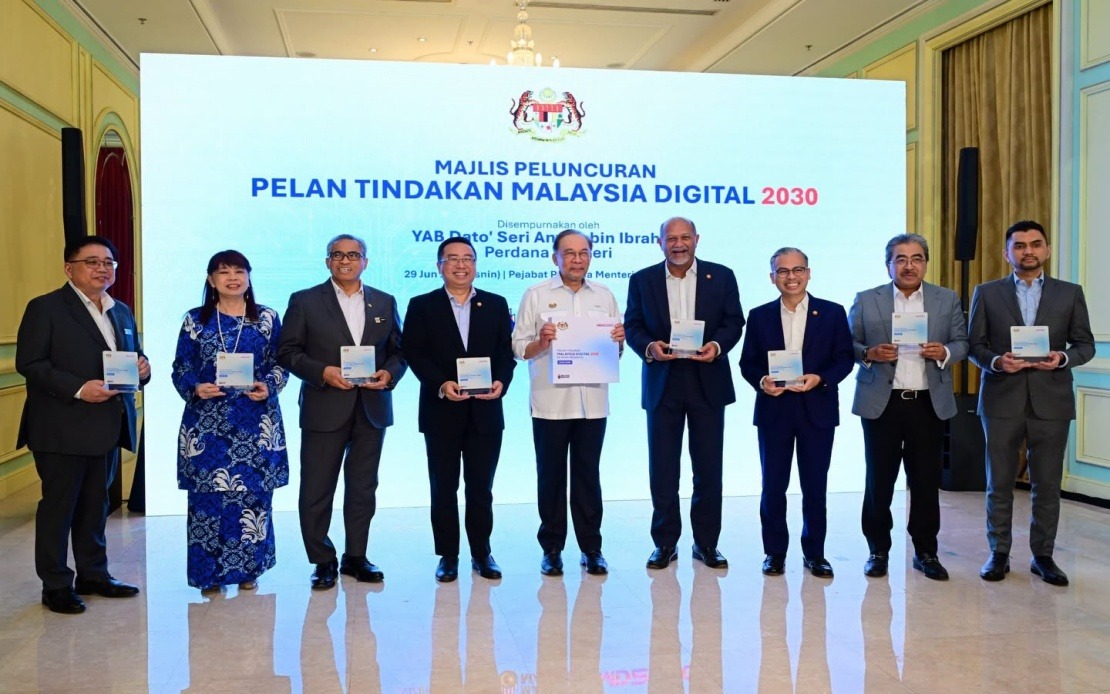
Developing digital talent represents a critical bottleneck in Malaysia's technological ambitions, which the government is addressing through the MyMAHIR National AI Council for Industry. This institutional innovation connects education, training, and industry demands within a coordinated framework. By explicitly focusing on artificial intelligence talent development, the council signals that Malaysia's digital strategy extends beyond operational efficiency into competitive positioning within the global AI economy. This aligns with the broader Malaysia Digital 2030 framework recently launched by the Prime Minister, which establishes 2030 as the target date for Malaysia to establish itself as an Artificial Intelligence Nation.
The Malaysia Digital 2030 strategy represents an evolution from earlier digital initiatives, incorporating lessons from implementation challenges while establishing more ambitious outcome targets. Positioning AI development as a central strategic objective acknowledges that generic digitalisation—moving existing processes online without fundamental innovation—cannot sustain Malaysia's economic competitiveness. The government appears to recognise that true digital transformation requires cultivating artificial intelligence capabilities as both applications within government and competitive advantages for Malaysian industries.
For Malaysian organisations outside government, the civil service's paperless success offers both inspiration and practical benchmarks. Private sector companies wrestling with digitalisation decisions can observe that large, complex institutions with legacy systems can successfully transition to paperless operations. The RM1.99 million savings, while significant, may underestimate total benefits when environmental costs, space savings, and productivity improvements from faster document processing are factored in. Corporate executives evaluating digitalisation investments can reference government results as evidence that transition costs typically prove recoverable within reasonable timeframes.
Regional context matters considerably here. Southeast Asian governments frequently lag behind peer emerging economies in digital adoption metrics, with Malaysia historically occupying a middle position relative to Singapore and Thailand. The visible progress on paperless operations and coordinated AI development strategy positions Malaysia to narrow this gap. Other ASEAN nations monitoring Malaysia's approach will likely incorporate similar initiatives, creating positive competition that benefits the entire region's digital maturity.
The environmental dimensions of the paperless initiative deserve emphasis for Malaysian policymakers and citizens increasingly concerned with sustainability. The elimination of 116,405 reams annually translates into reduced deforestation, lower transportation emissions, and decreased landfill burden. When multiplied across multiple government transitions—other states and federal departments potentially adopting comparable programmes—the environmental benefits become substantial. This provides a non-economic rationale for digital transformation that resonates with climate-conscious constituents and aligns government operations with stated environmental commitments.
Implementation challenges inevitably accompany any large-scale digital transition, particularly within hierarchical bureaucratic structures where established workflows possess institutional inertia. The fact that civil service offices successfully navigated these challenges across February and into subsequent months demonstrates that proper change management, clear directives, and adequate digital infrastructure can overcome resistance. The government's emphasis on documenting and publicising results serves a secondary purpose of building momentum for further digital initiatives by demonstrating tangible success.
Looking forward, the integration of paperless operations with MyDigital ID, MyGov, and AI development initiatives creates an interdependent ecosystem where success in one dimension reinforces progress in others. Citizens using MyDigital ID naturally gravitate toward paperless transactions, which feeds data into systems supporting AI applications, which in turn attract digital talent trained through MyMAHIR programmes. This virtuous cycle, if sustained through consistent policy support and adequate investment, positions Malaysia to achieve meaningful progress toward its 2030 AI Nation objective while delivering continued operational efficiencies across government.

