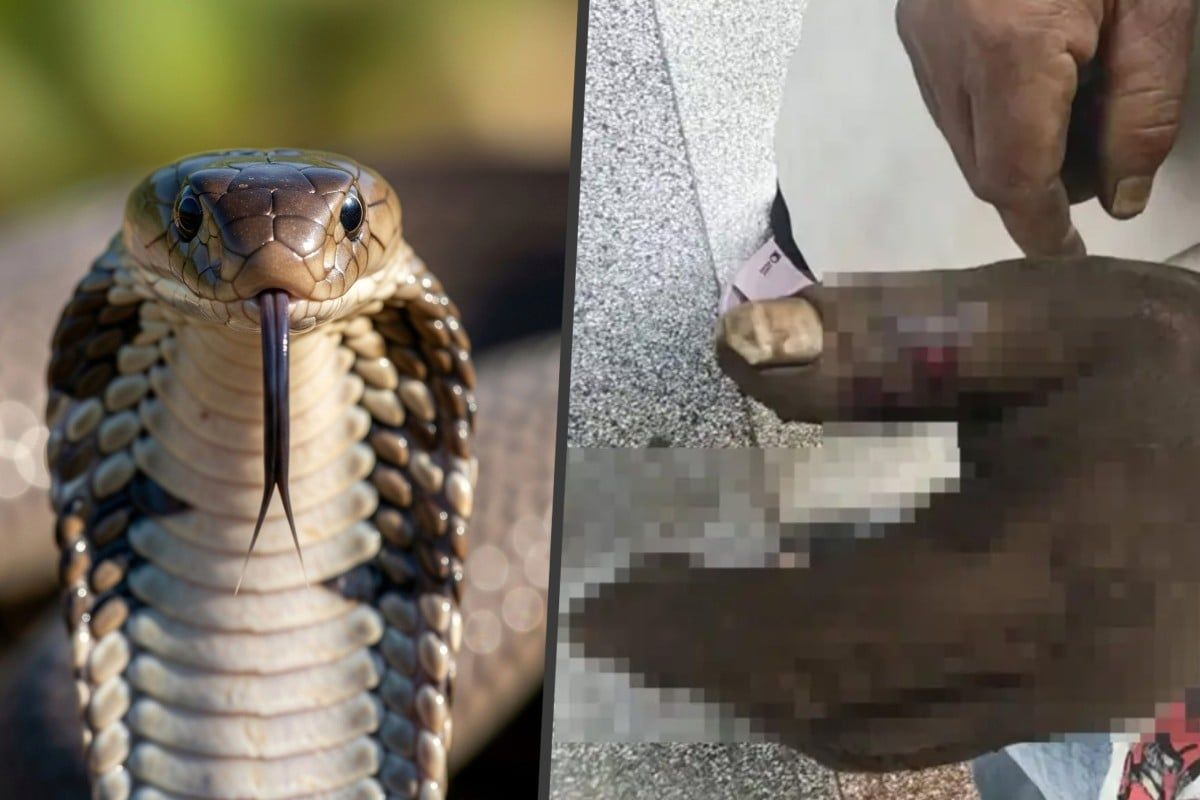
A farmer in southwestern China's Yunnan province fell victim to one of the most persistent myths in snake-bite treatment when his wife attempted to save him using a method she had learned from television, only to end up poisoned herself. The incident, which occurred in Yuanyang county, underscores how folk remedies and dramatized scenes from entertainment media continue to mislead people in medical emergencies, even as modern medical knowledge contradicts these approaches.
The farmer was working his field when a cobra bit his finger, causing rapid swelling and symptoms of systemic poisoning including dizziness and weakness. Seeing her husband's deteriorating condition, his wife made a split-second decision that seemed logical based on what she had observed in television dramas: she placed her mouth directly over the wound and sucked hard to extract the venom. She applied no protective measures whatsoever, treating her own oral cavity as a vacuum pump for toxins.
While her husband was transported to hospital and eventually recovered after receiving antivenom serum and supportive care, his wife's condition took a dramatic turn within hours. She began experiencing numbness spreading through her mouth, tongue, face and limbs. By the following day, profound fatigue had set in, forcing her family to bring her to Honghe Prefecture No 3 People's Hospital. Medical staff there confirmed that cobra venom had entered her bloodstream through her oral mucosa, poisoning her just as severely as her husband had been poisoned through the snake bite itself.
Doctors at the Yunnan facility used this case as a teaching moment to explain the fundamental problems with the suction method, which remains surprisingly common in rural areas despite being comprehensively discredited by medical science. The human mouth and throat contain an extraordinarily dense network of capillaries—tiny blood vessels designed for nutrient absorption. When snake venom, a complex cocktail of proteins and enzymes designed to destroy living tissue, comes into contact with these delicate mucous membranes, it is absorbed into the bloodstream with alarming speed. For the rescuer, this means they have effectively introduced poison directly into their circulatory system.
Beyond the vascular absorption problem, doctors emphasized that the physical nature of snake bites makes extraction virtually impossible. Contrary to popular imagination, a cobra bite does not leave a visible gash or puncture wound with venom pooling on the surface. Instead, the fang marks are tiny pinholes—barely visible entry points. The venom immediately begins seeping into the subcutaneous tissue beneath the skin and into the bloodstream within seconds, traveling through the victim's body before any suction method could physically retrieve it. The venom is already distributed throughout the body by the time a rescuer could reasonably attempt extraction.
The medical team also cautioned against several other dangerous interventions that remain disturbingly common in China's rural communities. Cutting into the wound to induce bleeding, another technique occasionally attempted in snake-bite scenarios, can accelerate blood loss and introduce infection into an already compromised site. Applying heat through burning or cauterizing the wound can cause severe tissue damage without neutralizing venom. Even ice application, sometimes believed to slow venom spread, merely causes localized damage without providing therapeutic benefit. These folk remedies persist because they offer the illusion of action during a frightening situation—they make rescuers feel they are doing something concrete, even when that action worsens outcomes.
The correct response to a snake bite, according to physicians at the hospital, requires discipline and restraint rather than dramatic intervention. The priority should be contacting emergency medical services immediately. The victim must remain as still as possible, because movement increases the rate at which venom circulates through the body. Immobilization of the bitten limb reduces the pumping action of muscles that would otherwise accelerate toxin distribution. If the snake can be safely identified or photographed, this information proves invaluable to hospital staff in selecting the appropriate antivenom serum, as different snake species require different antivenoms.
The Yunnan case resonated widely on Chinese social media, with observers noting that television dramas and action films have created a false impression of how to manage medical emergencies. One online commenter reflected that the incident demonstrated the unreliability of dramatized medical responses shown in entertainment media. Another observation focused on the wife's devotion to her husband, noting that her willingness to risk herself highlighted the genuine emotional stakes involved in such terrifying moments, even if her response was medically counterproductive.
This case is not isolated in China's recent public health discourse. In May of this year, a 14-year-old student in Guangdong province experienced a near-fatal snake-bite incident after being struck by an unidentified reptile on his school campus. The boy initially downplayed the injury because the bite was painless and he had not clearly seen his attacker. Only after several hours, when numbness and vision impairment set in, did he report the incident to school authorities. Doctors who administered serum treatment noted grimly that a delay of just one to two additional hours would have resulted in respiratory failure and death. The teenager's case illustrated how snake-bite symptoms can be insidious, with victims often not immediately recognizing the severity of their situation.
Both the Yunnan farmer's case and the Guangdong student's case highlight a critical gap between public knowledge and medical reality in China's rural and semi-rural regions. While urban populations with ready access to internet resources and modern medical facilities may quickly learn current best practices, communities in agricultural areas often rely on transmitted folklore and entertainment media as their primary sources of medical information. The persistence of suction-based venom extraction despite decades of medical evidence against it demonstrates how firmly such myths become embedded in cultural memory.
For readers across Southeast Asia, the implications extend beyond China's borders. Snake encounters are common throughout the region, from Malaysia's humid peninsulas to Thailand's rural provinces. Misinformation about first-aid responses spreads readily across social media platforms, transcending national boundaries. The prevalence of these myths suggests a broader need for public health campaigns specifically addressing snake-bite management in Southeast Asian countries, designed to reach rural populations who may lack regular access to medical education resources.
Both the farmer and his wife eventually recovered fully after several days of hospital treatment, discharged once their conditions stabilized. Their ordeal, though resolved positively through modern medicine, serves as a stark reminder that good intentions combined with misinformation can transform a medical crisis into a compound tragedy. The lesson extends beyond snake bites: in any medical emergency, verification of treatment methods through current medical guidance—rather than reliance on dramatized entertainment or transmitted folklore—can literally mean the difference between recovery and permanent harm.

