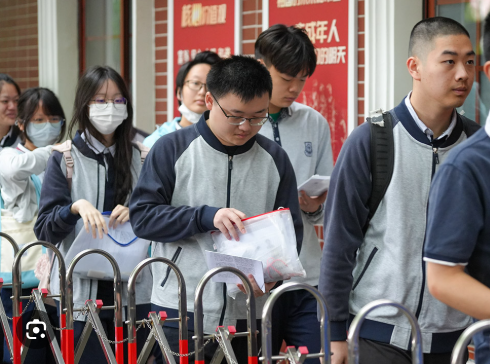
Facing an unprecedented surge in high-tech examination fraud, China's higher education institutions are implementing sweeping restrictions on smart wearables and electronic devices in testing venues. Multiple universities across the country have issued formal notices prohibiting candidates from bringing smart glasses, fitness trackers, wireless earbuds, smartwatches and other connected devices into examination halls, following the discovery of numerous students attempting to circumvent security measures through increasingly sophisticated technology.
The problem has become acute enough that South China Agricultural University in Guangdong province issued a comprehensive ban on July 1, explicitly citing multiple recent incidents where students attempted to use electronic devices to gain unfair advantages during assessments. University authorities made clear that any device capable of communication, storage, photography or transmission—regardless of whether it is powered on or actually deployed—will be treated as cheating and result in automatic failure for the subject combined with a demerit that bars students from receiving awards, scholarships or Communist Party membership. More severe disciplinary measures may also apply depending on circumstances.
The sophistication of available technology has elevated concerns among education administrators. A December 2025 project by researchers at Hong Kong University of Science and Technology demonstrated the vulnerability: modified commercial smart glasses connected to the GPT-5.2 artificial intelligence model enabled a test wearer to complete a Computer Network Principles examination in just 30 minutes while scoring 92.5 per cent, with answers simply displayed on the lens. This proof-of-concept has alarmed educators across the region, revealing that the gap between detection capabilities and cheating methodology is widening rapidly.
Other institutions have reported similar incidents that prompted their own enforcement actions. Xuchang University in Henan province disclosed on June 29 that five students had engaged in device-related cheating, with three carrying electronics loaded with examination materials and two using information-transmitting capabilities to receive answers remotely. Hubei University of Technology announced a 10-month demerit for a student caught bringing an electronic device containing exam materials into a final English examination. Zhongnan University of Economics and Law in Hubei issued a specific warning about smart glasses on June 26, noting their capacity to wirelessly transmit answers, store reference materials and photograph examination papers—functions that place them squarely in the prohibited category.
To combat these threats, universities are deploying artificial intelligence-powered proctoring systems that monitor examination halls in real time, capable of flagging suspicious behaviour patterns including unidentified objects, passing of items between students, excessive head movements and hands positioned below desk level. This technological countermeasure represents an escalating arms race between security measures and cheating methods, though experts suggest the advantage continues shifting toward those developing new evasion techniques.
China's Ministry of Education has reinforced institutional crackdowns through formal policy directives. Under national regulations governing misconduct in education examinations, transporting devices with transmission or reception capabilities into a testing venue constitutes cheating per se, and violations result in invalidation of all examination results for the affected student. The ministry issued a specific advisory on June 2 ahead of the 2026 gaokao national college entrance examination, reminding candidates that bringing smart devices into examination venues—for any stated reason or regardless of actual usage—automatically constitutes a violation.
Industry observers point to a fundamental disconnect between regulatory frameworks and technological development. Lin Che, a product manager with extensive experience in smart eyewear manufacturing, explained to China Newsweek that university examination policies have not kept pace with advances in wearable capabilities, creating vulnerability particularly in final assessment periods. He noted that as smart glasses continue shrinking and increasingly resemble conventional eyewear, visual identification by proctors becomes progressively more challenging. Lin advocated for manufacturers to incorporate more conspicuous design elements—such as visible camera indicators—that would assist examination administrators in distinguishing prohibited devices from legitimate glasses.
For Malaysian and Southeast Asian observers, these developments carry important implications. The region's own higher education systems face similar pressures as access to consumer wearable technology expands and AI capabilities advance. Universities across Malaysia, Singapore, Thailand and Vietnam may need to anticipate comparable challenges within coming years and begin establishing clearer protocols before widespread cheating incidents occur. The Chinese experience suggests that reactive policymaking proves insufficient once technology-enabled cheating becomes established practice.
The escalating measures also reflect broader questions about examination integrity in an age of ubiquitous connectivity. Traditional proctoring methods designed for an era of paper-based assessment increasingly struggle against devices that can wirelessly transmit information or access cloud-based resources. Educational institutions face pressure to invest in technological countermeasures while simultaneously grappling with the reality that determined actors can usually stay one step ahead of detection capabilities. This dynamic raises uncomfortable questions about whether conventional examination formats remain viable as testing mechanisms in environments where powerful computing technology is routinely accessible.
The Chinese crackdown demonstrates institutional determination to preserve examination credibility, but also reveals the fundamental tension between accessibility to advanced technology and maintenance of assessment standards. As smart wearables become more affordable and more seamlessly integrated into daily life, distinguishing between legitimate device use and examination fraud becomes increasingly difficult. The long-term solution likely requires reconceptualizing how educational institutions approach assessment itself—potentially moving toward formats that either fully embrace technological tools or more deliberately separate candidates from all electronics in physically isolated testing environments.

