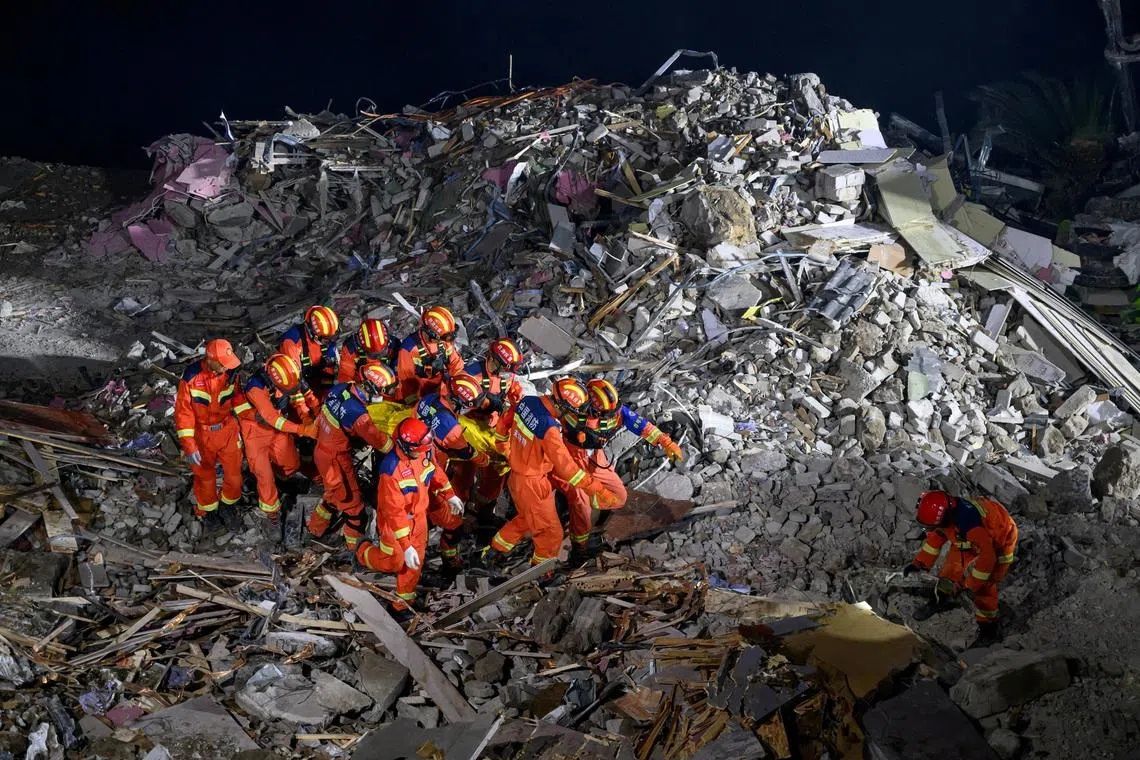
Rescue teams in southwestern China have deployed explosives to blast through massive boulders hampering their efforts to reach 34 people unaccounted for since a catastrophic landslide struck during intense rainfall three days ago. The operation, which entered what authorities described as a "deep rescue phase", targeted the geological obstacles blocking the path to trapped victims in Penghui county, situated approximately 270 kilometres from Chongqing's urban core. State media footage captured the moment rescuers detonated charges that fractured a substantial boulder, symbolizing the intensifying urgency of the mission as the window for locating survivors narrows.
The disaster claimed at least eight lives when the mountainside collapsed on Friday, underscoring the severe consequences of China's vulnerability to landslide events. The country's topography, with mountains, hills, and plateaus comprising roughly two-thirds of its total landmass, creates an inherent susceptibility to such incidents. This geographical reality, combined with other risk factors including torrential summer rainfall patterns and intensive construction activities, positions China among the world's most landslide-prone nations. For Malaysian and regional observers, the incident offers sobering parallels, as Southeast Asia faces similarly challenging terrain and increasingly unpredictable monsoon patterns that heighten vulnerability to catastrophic geological events.
President Xi Jinping personally intervened to direct operations, emphasizing the need for scientifically rigorous search and rescue methodologies alongside a comprehensive investigation into the landslide's underlying causes. This high-level engagement reflects the political significance Beijing attaches to disaster response, particularly in regions where infrastructure and human settlements sprawl across precarious hillside terrain. The presidential directive has galvanized coordination between multiple agencies tasked with both immediate rescue operations and longer-term risk assessment across the affected zone.
The Penghui county area, home to approximately 500,000 residents, presented significant challenges to rescue workers. Many communities in the region are precariously situated on steep slopes overlooking the Wujian river, a geographical arrangement that amplifies disaster risk during heavy precipitation events. When the mountainside gave way, a substantial portion of the collapsed terrain cascaded directly into the river, severing the main thoroughfare serving the narrow, hillside township and effectively isolating survivors from rapid access routes.
Authorities responded by evacuating more than 1,100 people from surrounding areas as a precautionary measure, recognizing the potential for secondary disasters to trigger in the days and weeks following the initial collapse. Specialized geological investigation teams have been dispatched to map hidden hazards and implement continuous monitoring systems designed to detect warning signs of additional slope failures. This layered approach to risk management demonstrates how China's disaster response infrastructure has evolved following decades of experience with similar catastrophes.
Weather forecasts predicted continued heavy to torrential rainfall across multiple provinces through the rescue period, complicating recovery efforts and raising the specter of further geological instability. The meteorological threat prompted authorities to intensify preventive measures in high-risk zones characterized by abundant groundwater accumulation and extensive construction that has weakened natural slope stability. Officials issued expanded safeguard directives targeting vulnerable communities in mountainous provinces where seasonal flooding compounds landslide risks.
The scale of current flooding extended beyond Penghui county. On the day of the rescue operation, eight small and medium-sized rivers across Yunnan, Guangxi, Guangdong, Anhui, and Shanghai had risen above official flood warning thresholds. This broader hydrological disturbance reflected the intensity and geographic extent of the rainfall system affecting southwestern and central China, conditions that created cascading hazards across multiple watersheds simultaneously.
Geologists and disaster management specialists attribute China's recurring landslide crises to a convergence of natural and human-induced factors. Intense seasonal rainfall patterns, accelerated by climate variability, saturate slopes and reduce soil cohesion. Rapid urbanization has fundamentally altered drainage patterns and vegetation cover, removing natural stabilizing elements. Construction activities, from infrastructure projects to residential development, frequently destabilize slopes through excavation and material loading. Additionally, China's position along active tectonic zones produces seismic activity that fractures bedrock and compromises slope integrity. These overlapping pressures create a perpetual crisis environment across mountainous regions.
Historical data underscores the magnitude of China's landslide challenge. Over the preceding decade, documented landslide events nationwide claimed approximately 294 lives across at least five major incidents. The deadliest occurred in December 2015, when a massive accumulation of construction debris at an industrial park in Shenzhen, the southern technology hub, collapsed catastrophically and killed more than 70 people. That incident illustrated how human activities—in that case, uncontrolled waste accumulation—can transform ordinary geological features into lethal hazards. Each such disaster has prompted policy reviews and stronger safety protocols, yet the fundamental vulnerabilities persist.
For Malaysian policymakers and regional planners, the Penghui incident carries instructive lessons. Southeast Asia's own mountainous terrain, particularly in highland areas of Malaysia, Indonesia, and the Philippines, faces comparable risks. Rapid development pressures, often prioritized over comprehensive geological surveys and slope stability assessments, mirror patterns that have proven catastrophic in China. The integration of scientific rescue methodologies, advanced monitoring technology, and rigorous building code enforcement represents a necessary evolution for the region. Furthermore, the frequency and severity of such events underscore the urgency of addressing climate adaptation alongside disaster preparedness in national planning frameworks.

