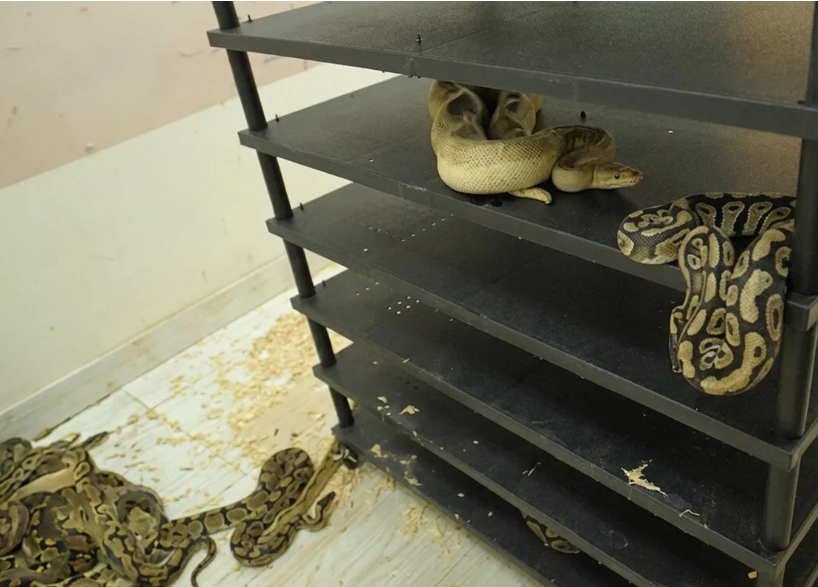
A resident of eastern China has been handed a prison sentence for running an extensive illegal operation breeding over 300 pythons in his residential flat, marking a significant enforcement action against wildlife trafficking in the country. The case, which authorities characterised as posing "serious" harm to rare and endangered species, came to light when state broadcaster CCTV reported the incident in late June, highlighting how environmental crimes can be exposed through mundane utility records and community vigilance.
The investigation began in March 2024 when a senior citizen in Taizhou, Zhejiang province, encountered a large python near the base of a mountain and alerted the authorities. The discovery of the reptile—described as being as thick as an adult's arm and displaying a tawny coloration—struck the resident as unusual, since the species is not native to the region. Police investigators reasoned that the snake had likely escaped from a captive breeding facility rather than existing naturally in the wild, particularly given that snakes typically remain dormant during March in that part of China.
The breakthrough in tracking the operation came through environmental regulation compliance data. A professional snake handler consulted by police explained that pythons demand carefully controlled warm and humid conditions to thrive, requiring breeders to maintain temperatures between 20 and 30 degrees Celsius. This specialised infrastructure requirement would necessarily consume substantial quantities of electricity. Using this insight, investigators systematically examined electricity consumption records for nearby residents, eventually narrowing their focus to a solitary man surnamed Guo who lived alone and showed no formal employment.
Further investigation revealed suspicious patterns around Guo's residence. Officers observed that another individual, identified as Di, made frequent visits to the flat. These visits consistently coincided with Di collecting parcels from courier services, parcels that contained small white mice purchased online. When police contacted the online retailers supplying these mice, the vendors confirmed they specialised in selling rodents to customers maintaining reptile collections. The digital trail extended to social media, where Guo had posted photographs of snakes and made veiled references to selling pythons to interested parties.
Transactional evidence provided additional confirmation of commercial activity. Financial records showed that Di had brokered the sale of two pythons to a third party for 1,000 yuan, equivalent to approximately US$150. This pattern of indirect sales suggested the operation extended beyond simple personal collection into a profit-generating venture. With sufficient evidence accumulated, law enforcement moved against both Guo and Di, conducting coordinated arrests and searches.
When officers entered Guo's apartment, they encountered a scene that staggered their expectations. Nearly all available residential space had been converted into a serpent breeding facility. Plastic storage boxes were stacked vertically throughout the rooms, each container housing individual pythons. Guo had squeezed his own living quarters into a single bedroom, sacrificing the other two bedrooms and the entire living area to his reptile collection. In total, investigators seized 309 pythons from his residence, later transferring them to a local zoological facility.
Guo's personal motivation for the operation emerged during questioning. He explained that he had harboured a long-standing fascination with snakes, claiming complete absence of fear toward the species. His involvement in python breeding stretched back to 2014, when he initially acquired four specimens. Over the subsequent decade, he invested considerable time in studying breeding techniques and genetics, expressing satisfaction in his ability to cultivate pythons displaying diverse colour variations. In what appeared to be a moment of reflection, Guo described his role as that of a "creature creator," suggesting he viewed the operation as an extension of creative interest rather than criminal enterprise.
The investigation expanded beyond Guo's operation when authorities identified additional individuals involved in the breeding and distribution chain. A shop owner named Deng, who had sold four pythons to Guo in 2014 that initiated his breeding programme, was also apprehended. Police discovered that Deng maintained 47 pythons at his own residence, indicating a separate but connected breeding operation. Di, the courier associate, faced charges alongside both Guo and Deng, having participated in the distribution of captive-bred snakes to external buyers.
In terms of scale and financial magnitude, the consolidated investigation proved far more extensive than Guo's operation alone suggested. Across all three defendants, authorities identified approximately 436 pythons in total, with valuations exceeding 30 million yuan, equivalent to roughly US$4.4 million. The significant monetary assessment underscores that python breeding, though technically illegal without permits, generates substantial economic incentives for participants willing to circumvent wildlife protection regulations.
Pythons hold protected status under China's environmental legislation, classified as Grade Two protected animals. This designation prohibits purchase, sale, breeding, and transportation of the species without explicit government authorisation. The regulatory framework exists to preserve biodiversity and prevent exploitation of endangered fauna, particularly given that wild python populations face pressure from habitat loss and poaching. Violating these restrictions exposes offenders to substantial criminal penalties, with China's Criminal Law permitting sentences of up to five years imprisonment for Grade Two protected animal crimes.
While the specific prison terms assigned to Guo, Di, and Deng were not detailed in official disclosures, their sentencing confirms judicial enforcement of these protection statutes. The case illustrates how modern data collection and investigative techniques—combined with citizen vigilance—can expose environmental crimes operating in plain sight within residential neighbourhoods. The high electricity consumption signature proved decisive, demonstrating that unauthorised biological operations create distinctive digital footprints accessible to authorities equipped with appropriate expertise and legal authority to conduct such analysis.
For Malaysia and Southeast Asia more broadly, the case provides instructive perspective on wildlife trafficking enforcement challenges and opportunities. The region faces endemic problems with illegal wildlife trade, with authorities frequently struggling to identify and intercept smuggling operations. However, the Chinese investigation demonstrates that innovative investigative approaches—examining unusual utility usage, tracking purchasing patterns for animal feed, and monitoring social media references—can complement traditional enforcement methods. Similar techniques adapted to local contexts could strengthen regional capacity to combat illegal breeding and trafficking of protected species across Southeast Asia.