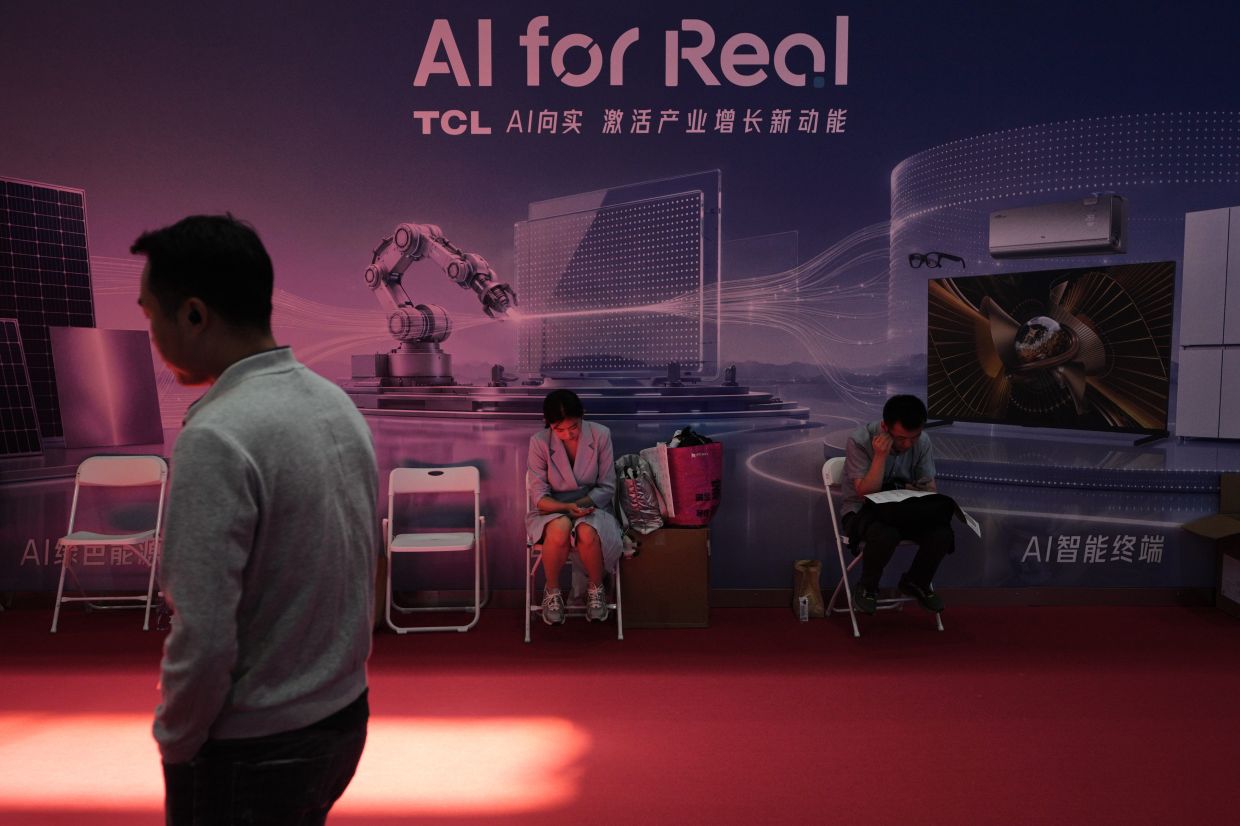
China's labour market is undergoing a profound transformation as artificial intelligence becomes embedded across economic sectors, supported by government initiatives that are reshaping work in ways both profound and unsettling for millions of ordinary workers. The rapid proliferation of AI technologies—from software development and content creation to logistics and manufacturing—is displacing workers and generating widespread anxiety about job security, yet remarkably, public sentiment in China appears less resistant than in Western nations, according to observers tracking workplace sentiment across the country.
The scale of AI integration in China's economy has become strikingly evident in recent industrial statistics. More than forty-seven per cent of Chinese industrial enterprises now employ AI models and automated agents in their operations, a dramatic leap from just under ten per cent only a year earlier, according to market analysis firm IDC. This explosive growth reflects deliberate government strategy: under the "AI Plus" initiative and five-year development plans extending to 2030, Beijing is systematically pushing organisations across manufacturing, services, and creative industries to adopt AI applications. The stated objective involves maintaining technological superiority in competition with the United States, yet the domestic employment consequences remain inadequately addressed in policy discussions.
Unlike the vocal resistance to automation prevalent in some Western democracies, Chinese workers and observers appear to accept AI integration with surprising equanimity. According to Shujing He, a senior analyst at Beijing-based research firm Plenum, sentiment tends toward positivity or neutrality rather than opposition. Workers displaced or threatened by automation frequently channel their energy into launching AI-enabled businesses and independent ventures rather than opposing the technology itself. This pragmatic adaptation reflects both cultural factors and limited institutional channels for labour protest, yet it masks genuine economic anxiety about future employment prospects and income stability.
The impact manifests vividly in specific sectors. Programming, once considered a secure technical profession, exemplifies this transformation. Mid-level coders now face replacement by AI systems that, while imperfect, have achieved sufficient capability to perform routine coding tasks. Fei, a forty-year-old programmer, represents this precarious new reality: while sceptical that AI could fully replicate programming work, he acknowledges that mid-level positions are "essentially replaceable" and that workers must adopt AI tools simply to remain competitive. He has since shifted to creating short-form video content, a field itself threatened by generative AI but offering temporary sanctuary from direct algorithmic replacement.
Translation work presents another cautionary tale. Du Qinchun, a part-time translator in Chengdu, has paradoxically found more work by training AI translation systems, yet this temporary arrangement masks a fundamental industry restructuring. Translator compensation has collapsed by more than half compared to previous years as AI-powered tools proliferate. This deterioration has triggered visible educational consequences: prestigious university programmes in foreign languages are experiencing declining enrolment as students recognise that AI capabilities have fundamentally devalued specialised linguistic training.
Creative and cultural industries face equally severe disruption. Generative AI now dominates content creation, production, and distribution across China's lucrative short drama sector, which produces vertical video content optimised for mobile consumption. Production of live-action short-form series plummeted approximately seventy-five per cent in the first quarter of this year compared to the preceding twelve months, representing an industry-wide contraction driven largely by AI substitution. Wang Zhicheng, a scriptwriter for educational animation productions, experienced this firsthand when his employer laid off roughly half its writing staff. Though he initially used AI for brainstorming and fact-checking, he discovered that generated scripts felt formulaic and repetitive, ultimately choosing to resign and establish an independent studio producing illustrated children's books.
Physical and service sector employment faces equally transformative pressures. Humanoid robots increasingly perform tasks from parcel sorting in postal facilities to traffic direction and food preparation, though deployment remains limited in scale. More significantly, autonomous food delivery robots are proliferating across Chinese cities, directly threatening the livelihoods of millions in the delivery sector—a labour-intensive field that has historically provided accessible employment for less-educated workers. These technological transitions occur with minimal institutional protections or retraining programmes for affected workers.
International research underscores that disruption affects workers unequally. The International Labour Organization has documented that women face disproportionate employment risk from AI adoption, as they concentrate in manufacturing roles involving electronics assembly and other tasks readily amenable to automation, whilst remaining underrepresented in technology and science fields where new employment opportunities concentrate. This gender dimension adds structural inequality to the employment challenges emerging from rapid AI diffusion.
The broader economic implications trouble analysts observing China's macroeconomic trajectory. Consumer spending has already weakened partly because workers fear job losses, compounding existing problems stemming from prolonged housing market deterioration that has diminished household wealth. Eswar Prasad, a Cornell University economist specialising in trade policy, warns that whilst AI may enhance productivity across sectors, it could simultaneously unleash severe employment disruption that worsens China's already problematic job creation outlook and potentially undermines social stability. China's overall urban unemployment hovers around five per cent, yet youth unemployment for those aged sixteen to twenty-four excluding students reaches roughly triple that rate—a dangerous imbalance indicating future labour market stress.
China's technology giants have amplified these pressures through their own restructuring. Major firms have eliminated or reorganised tens of thousands of positions, partly attributing these reductions to AI implementation. These corporate actions, mirroring behaviour by American technology companies, signal that private sector actors view AI as a labour-reducing technology rather than a jobs-creation mechanism, despite government aspirations for broader economic benefits.
Yet a counterintuitive demographic reality may eventually reshape employment calculations. China's population of 1.4 billion is rapidly ageing and contracting, creating unprecedented labour shortage pressures. By 2050, China is projected to support each retiree with fewer than two working-age adults, compared with more than 2.5 in the United States. This demographic inversion could paradoxically render automation less disruptive, since AI systems might partially compensate for workforce shrinkage rather than creating pure unemployment. Xuenan Cao, a San Francisco Bay University researcher focused on technology and society, suggests that automation could become a solution to demographic challenges rather than a purely negative employment shock.
Meanwhile, some workers demonstrate adaptive resilience in navigating this turbulent transition. Wang Zhicheng, having left scriptwriting, now treats AI as an instrumental tool comparable to word-processing software—useful for specific tasks but subordinate to human creative decision-making and direction. This reframing, wherein AI functions as an assistive technology rather than a replacement, may eventually become normalised across sectors, though such adaptation requires workers to possess sufficient education, capital, and professional flexibility to successfully transition between roles. For millions of less-educated Chinese workers in routine positions, such adaptation proves far more challenging, raising fundamental questions about whether China's AI-led economic transformation can be managed in socially sustainable ways.

