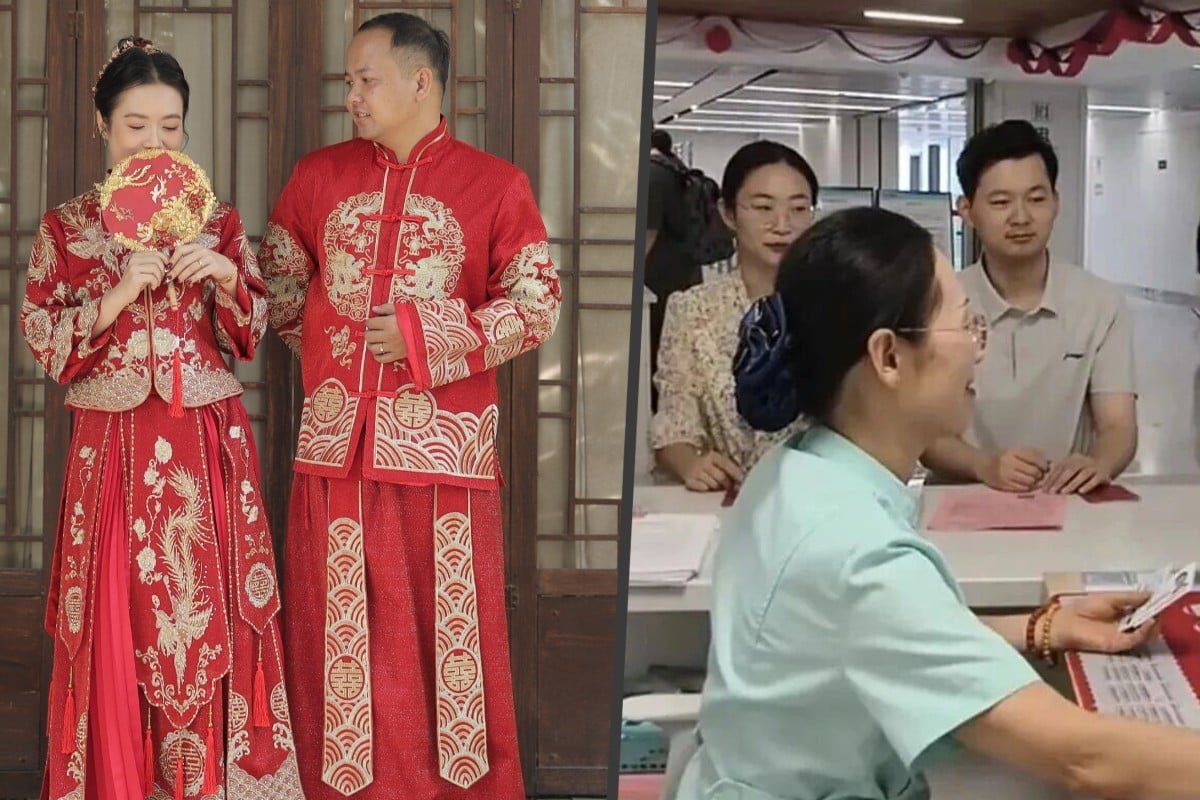
China's marriage crisis has become so acute that authorities are attempting to solve it by making wedding registration as convenient and accessible as possible—even if that means holding ceremonies in hospitals and nightclubs. The Maternal and Child Health Hospital of Linzi District in Zibo City, Shandong province, joined the Postal Savings Bank of China and numerous other unconventional venues this year in offering marriage registration services, signalling a government-led initiative to address one of the nation's most pressing demographic challenges.
The proliferation of unusual marriage registration locations reflects the scale of China's declining marriage problem. What began as an experiment with temples and tourist attractions has mushroomed into a nationwide phenomenon. By May this year, China had established over 500 marriage registration sites outside traditional civil affairs bureaus, with more than 1,300 additional outdoor locations partnering with authorities to issue marriage certificates. This represents a dramatic expansion since May last year, when the government loosened marriage registration requirements to allow couples to marry outside their household registration location and eliminated the need to present physical hukou booklets. The regulatory change was intended to remove practical barriers to marriage, but the government's subsequent strategy reveals deeper concerns about whether convenience alone would suffice.
The venues chosen for these services tell an interesting story about how officials perceive young Chinese couples' aspirations and lifestyles. Guangzhou Baiyun International Airport became the nation's first airport to issue marriage certificates while offering couples free access to its observation deck. Shanghai authorities partnered with a nightclub to hold special certification ceremonies within the venue itself. Temples in Beijing and Nanjing permit couples to marry in traditional attire, while Hefei's metro station became the first transport facility in the country to offer the service. These choices suggest that policymakers believe young people value experience, convenience, and lifestyle compatibility when considering marriage—a recognition that marriage is increasingly competing with other life priorities in the decisions of Chinese youth.
Initially, the strategy appeared to show promise. In the third quarter of last year, 1.61 million couples registered their marriages nationwide, representing a 22.5 per cent year-on-year increase compared to the previous quarter. For the year overall, China recorded 6.76 million marriage registrations, up 657,000 from the previous year. These figures suggested that removing procedural barriers and adding appealing venues might genuinely influence marriage decisions. However, this optimism proved short-lived. In the first half of this year, the trend reversed sharply, with marriages dropping 7.5 per cent year-on-year and only 3.28 million couples tying the knot. The volatility in these numbers raises uncomfortable questions about whether any of the government's initiatives address the fundamental reasons young Chinese are avoiding marriage.
Public reaction to the expansion of marriage registration venues has ranged from amusement to profound skepticism. Online users quickly mocked the pairing of hospitals and marriage services, with some joking that only a financial institution could surpass such an unusual combination—a prediction that was swiftly fulfilled when banks joined the effort. Social media commentators turned their humour toward questioning the entire premise of the initiative. One user pointedly asked whether people were genuinely avoiding marriage simply because they could not locate a registration office, implying that convenience was not the actual barrier. Another sarcastically suggested the civil affairs bureau establish divorce services atop Mount Everest, mocking the increasingly absurd expansion of locations.
Beneath the sarcasm lay more serious concerns about what genuinely discourages marriage among Chinese young people. Several commentators argued that procedural convenience was entirely beside the point. One observation held that young people feared the financial burdens, family conflicts, and loss of personal freedom that marriage entails. Another noted a cultural shift whereby marriage is no longer viewed as a necessary life milestone, a fundamental reimagining of the institution's role in Chinese society. These critiques suggest that expanding marriage registration to hospitals and nightclubs addresses symptoms rather than causes. The obstacles to marriage appear rooted in economic anxiety, changing values, and shifting life priorities—challenges that no amount of venue proliferation can overcome.
For Malaysia and Southeast Asia, China's marriage crisis offers instructive parallels and warnings. Declining marriage and birth rates represent a gathering concern across the region, with younger generations prioritizing education, career advancement, and financial security over early family formation. The success or failure of China's creative approach to boosting marriage rates will likely influence how other governments in the region consider their own demographic challenges. If convenience alone proves insufficient to reverse marriage decline despite China's considerable resources and government commitment, it suggests that regional policymakers must look beyond procedural solutions toward deeper economic and cultural interventions.
The asymmetry in how Chinese authorities treat marriage and divorce services within these new venues also warrants attention. While streamlined marriage registration has expanded dramatically, many outdoor sites explicitly do not provide divorce services, citing the need for more extensive documentation. This selective approach reflects an official preference to facilitate the formation of marriages while maintaining procedural friction around their dissolution—a policy choice that sits uncomfortably with the market-driven reality that younger couples are increasingly willing to forgo marriage entirely if it becomes too economically risky or personally constraining.
China's marriage registration expansion ultimately reveals the limits of institutional tinkering when confronting structural economic and social challenges. A hospital offering marriage services alongside premarital examinations and preconception guidance may streamline logistics, but it cannot address the reality that many young Chinese couples cannot afford housing, fear economic instability, or question whether marriage aligns with their evolving life goals. The strategy reflects official anxiety about demographic decline but may also demonstrate a disconnect between government priorities and the actual concerns of young people making the most consequential decisions of their lives.

