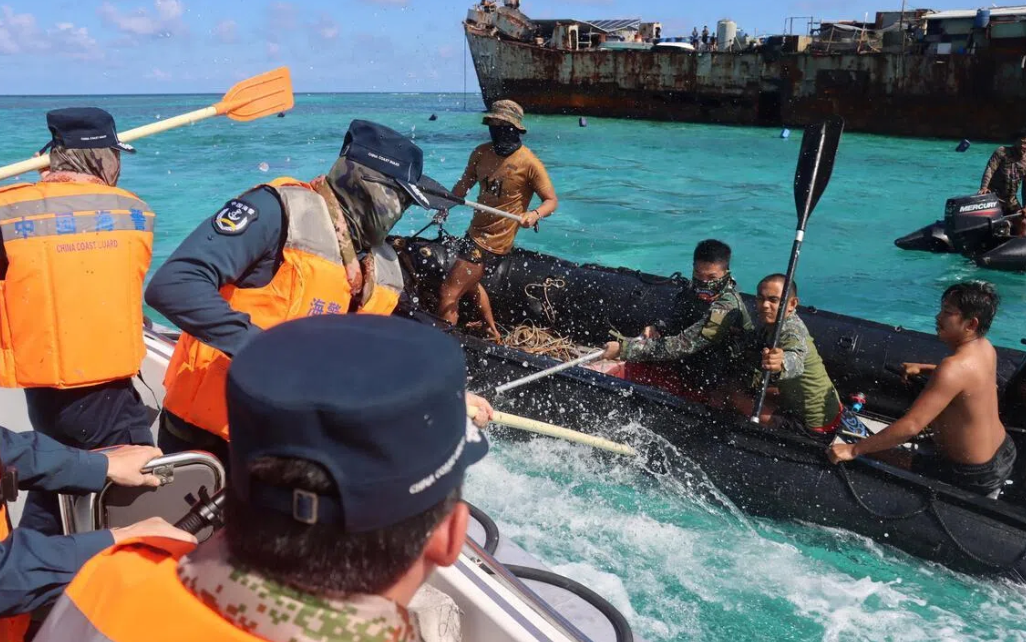
China's diplomatic response to a violent confrontation in the contested South China Sea has intensified regional tensions, with Beijing summoning Manila's ambassador on Tuesday to register formal complaints against what it characterises as Philippine provocation. The incident, occurring on Monday at Ren'ai Reef—also known internationally as the Second Thomas Shoal—marks another flashpoint in the strategically vital waterway that has become a lightning rod for geopolitical competition and military posturing among competing claimants.
The Philippine military alleges that personnel from the China Coast Guard wielded batons to strike a Filipino sailor as vessels approached a grounded ship that has functioned as a long-standing Philippine military outpost. This account of physical violence triggered immediate diplomatic protests from Washington and allied capitals, underscoring how localised maritime incidents now carry outsized significance in broader great-power calculations. China's foreign ministry, responding through an official statement, rejected Manila's narrative entirely, insisting instead that the Philippine side initiated the confrontation and subsequently distorted facts to manufacture international sympathy.
Beijing's sweeping claim to nearly the entire South China Sea remains one of the most contentious territorial disputes in the Indo-Pacific region, despite a 2016 international arbitration ruling that invalidated its historical nine-dash-line assertion. The practical effect of this unresolved dispute is that multiple nations—including the Philippines, Vietnam, Malaysia, and Brunei—maintain overlapping maritime claims, creating a congested zone where military and paramilitary forces operate in close proximity. This structural condition ensures that minor incidents can rapidly metastasise into diplomatic crises when filtered through the lens of great-power competition.
The Second Thomas Shoal occupies particular importance within this broader dispute because it represents a tangible expression of Philippine sovereignty claims and military presence. The grounded vessel serving as a garrison demonstrates Manila's long-term commitment to maintaining jurisdiction, making the site politically sensitive for both the Philippines and China. When clashes occur at such symbolic locations, they reverberate beyond immediate military concerns into questions about which nation can effectively project power and protect its interests in contested waters.
The United States wasted no time in condemning what it characterised as Beijing's dangerous and aggressive conduct. This swift American response reflects Washington's strategic commitment to maintaining freedom of navigation rights through the South China Sea, one of the world's most economically vital shipping corridors. US Secretary of State Marco Rubio, who arrived in Manila on Tuesday for an Association of Southeast Asian Nations summit, used an opinion piece in Philippine media outlets to underline Washington's dedication to protecting regional autonomy. His argument carried an implicit warning about the consequences of allowing any single power to monopolise control over these waters, framing the issue not merely as a bilateral Philippines-China matter but as fundamentally affecting the sovereignty and economic futures of all Southeast Asian nations.
Australian Foreign Minister Penny Wong added her country's voice to international criticism, labelling China's actions as destabilising and dangerous. Australia's participation in the condemnation reflects how South China Sea disputes have become entangled with broader Indo-Pacific security architecture, drawing in major powers from beyond the immediate region. Canberra's willingness to comment publicly indicates that regional allies view these incidents as test cases for whether international norms around freedom of navigation will be preserved or whether coercive behaviour can succeed without consequence.
Rubio's presence in Manila for the Asean summit creates an opportunity for high-level diplomatic engagement at a moment when tensions are elevated. Although no public confirmation exists regarding planned bilateral talks between Rubio and Chinese Foreign Minister Wang Yi—who is also attending the gathering—both officials have demonstrated a pattern of dialogue during Asean meetings. Their previous encounters in Kuala Lumpur last year and Munich in February suggest channels remain open even amid escalating incidents. The summit setting offers a structured environment where competing powers can engage with the full Asean membership, potentially constraining escalatory rhetoric while creating space for negotiated solutions.
The deeper significance of this incident lies in what it reveals about the fragility of the status quo in Southeast Asian waters. Despite decades of diplomatic effort and numerous agreements nominally designed to prevent militarisation, incidents like the clash at Ren'ai Reef demonstrate how easily friction can emerge between claimants whose military forces operate in overlapping zones. The allegation of a sailor being struck with a baton—a form of direct physical violence—marks an escalation from purely verbal or procedural confrontations, suggesting that risk management mechanisms may be deteriorating.
For Malaysia and other Southeast Asian nations not directly involved in this particular incident, the clash underscores the collective vulnerability of the region to great-power competition. Malaysia itself maintains territorial claims in the South China Sea and has experienced its own confrontations with Chinese vessels. The pattern of incidents—occurring with apparent regularity—creates an environment of uncertainty that complicates maritime commerce, fishing operations, and military planning. Regional nations must navigate between maintaining relationships with both China and the United States while protecting their own interests, a balancing act that becomes increasingly difficult as incidents multiply.
China's diplomatic response, characterised by accusation and counter-accusation, reflects Beijing's strategy of resisting external criticism of its conduct while delegitimising the Philippines' accounts. By framing the incident as Philippine provocation that was subsequently misrepresented internationally, Beijing seeks to deny the narrative space that would otherwise favour the weaker party. This rhetorical approach, while potentially effective domestically, does little to de-escalate tensions or address the underlying structural conditions that generate these confrontations.
The path forward remains uncertain, with the Asean summit providing a diplomatic venue but no guarantee of resolution. Whether Rubio and Wang Yi will meet, and what such a meeting might accomplish, remains to be seen. What is clear is that the South China Sea continues to generate incidents that test regional stability and attract great-power attention in ways that exceed the immediate geographic scale of the disputes themselves. For Malaysia and other Southeast Asian nations, navigating these waters—both literally and diplomatically—requires sustained attention to how regional disputes intersect with global strategic competition.

