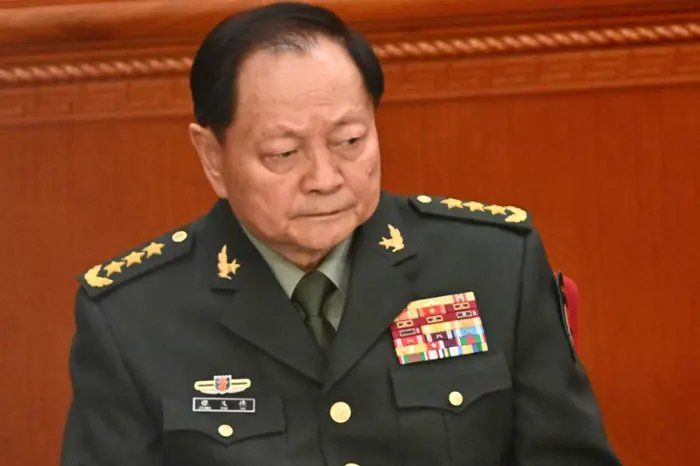
China's leadership has formally removed Zhang Youxia, the country's highest-ranking military officer, from his position as vice chairman of the Central Military Commission, marking a significant shake-up in the upper echelons of the People's Liberation Army. The decision, announced through state media on Friday following a parliamentary standing committee meeting, concludes a corruption investigation that began in January when authorities first disclosed that Zhang faced allegations of "serious violations of discipline and the law"—the standard terminology Beijing employs when referring to graft and related misconduct.
Zhang's departure carries substantial symbolic weight within China's military hierarchy. As the more senior of two vice chairmen serving on the Central Military Commission, he held the highest rank achievable for a general officer, positioning him as the nation's paramount military figure beneath the civilian leadership. His removal therefore represents not merely a routine bureaucratic reshuffle but rather a purge of one of the institution's most powerful figures, signalling the willingness of President Xi Jinping's administration to enforce accountability at the highest levels regardless of seniority or perceived political proximity.
The timing of Zhang's fall from grace seven months after the initial investigation announcement underscores the methodical nature of China's anti-corruption machinery. Rather than swift public dismissal, authorities conducted a prolonged inquiry that allowed for the assembly of evidence and the completion of administrative procedures. This deliberate pace reflects the structured manner in which the Communist Party conducts internal discipline cases, particularly when senior officials are involved. The extended timeline also suggests the complexity and sensitivity surrounding investigations targeting figures of Zhang's stature and apparent closeness to Xi.
Concurrently, another senior military official, Liu Zhenli, faced removal from his post. Liu served as chief of staff of the Central Military Commission's joint staff department, the entity responsible for overseeing combat planning and operational strategy across the entire armed forces. His dismissal alongside Zhang indicates that the corruption investigation potentially uncovered networks of misconduct extending beyond a single individual, pointing to possible collusion or systemic issues within the military's highest command structure.
The cases represent the continuation of Xi Jinping's expansive anti-corruption campaign, a defining characteristic of his presidency that has persisted across more than a decade in power. This sustained drive against graft has reached into virtually every sector of Chinese governance and the military, toppling numerous officials and reshaping institutional hierarchies. What distinguishes the Zhang Youxia case is the sheer rank of the target—few military figures of comparable stature have faced such public removal, making his fall notable even within the context of an administration known for aggressive anti-corruption enforcement.
Observers of Chinese politics registered surprise at Zhang's downfall, not merely because of his seniority but because he was perceived to maintain a close working relationship with Xi. The perception that Zhang enjoyed personal favour from the president made his eventual investigation and removal counterintuitive to many analysts. This development suggests that no degree of political proximity provides immunity from investigation once allegations of serious misconduct surface, reinforcing the message that Xi's anti-corruption apparatus operates according to institutional logic rather than factional loyalty.
The military implications of reshuffling its top command merit careful consideration across the Asia-Pacific region and beyond. The Central Military Commission represents the apex of the PLA's organizational structure, and changes at this level can signal shifts in military doctrine, personnel management philosophy, and strategic priorities. The removal of two senior officers simultaneously creates opportunities for Xi to install replacements aligned with his strategic vision, potentially accelerating modernization initiatives or refocusing institutional priorities.
For Southeast Asian nations and global observers monitoring China's military development, these personnel changes occur against a backdrop of sustained PLA modernization and increased operational activity in disputed maritime regions. The timing of such high-level removals can influence military planning cycles and decision-making processes within the command structure, potentially affecting the trajectory of regional security dynamics. Any leadership vacuum, however briefly, may prompt adjustments in operational postures or strategic initiatives.
The opaque nature of Chinese military investigations means that the precise allegations against Zhang and Liu remain undisclosed to the public. References to "serious violations of discipline and the law" encompass a broad spectrum of potential infractions ranging from financial corruption to abuse of authority or security breaches. Without access to specific charges, external analysts must rely on contextual signals and historical patterns to assess the nature and scope of the alleged misconduct. This information asymmetry, characteristic of Chinese governance, limits transparency and invites speculation about underlying institutional dynamics.
Looking forward, the removal of Zhang and Liu creates an opening for institutional renewal within the Central Military Commission. Xi's ability to place trusted subordinates in these vacated positions strengthens his control over military structures and ensures alignment between his policy directives and military implementation. The purge thereby functions as both a corruption-fighting measure and a consolidation mechanism, combining institutional discipline with political advancement of favoured figures.
The international dimension of these developments warrants attention. Major military powers, particularly the United States, monitor shifts in China's command structure for signals regarding strategic intentions and decision-making authority. Personnel changes at the CMC level can influence bilateral and regional interactions, as new leaders bring different perspectives and operational philosophies. The manner in which Xi handles the succession in these critical posts will reverberate across strategic calculations throughout the Indo-Pacific.
China's leadership has demonstrated through the Zhang Youxia case that institutional accountability supersedes factional considerations even at the highest military levels. Whether this reflects genuine anti-corruption commitment or strategic repositioning, the practical effect reinforces Xi's consolidation of power and ensures that military leadership remains subordinate to his authority. As the search commences for replacements to fill these senior positions, the contours of China's military future will gradually become discernible through the personnel selections made in coming weeks.

