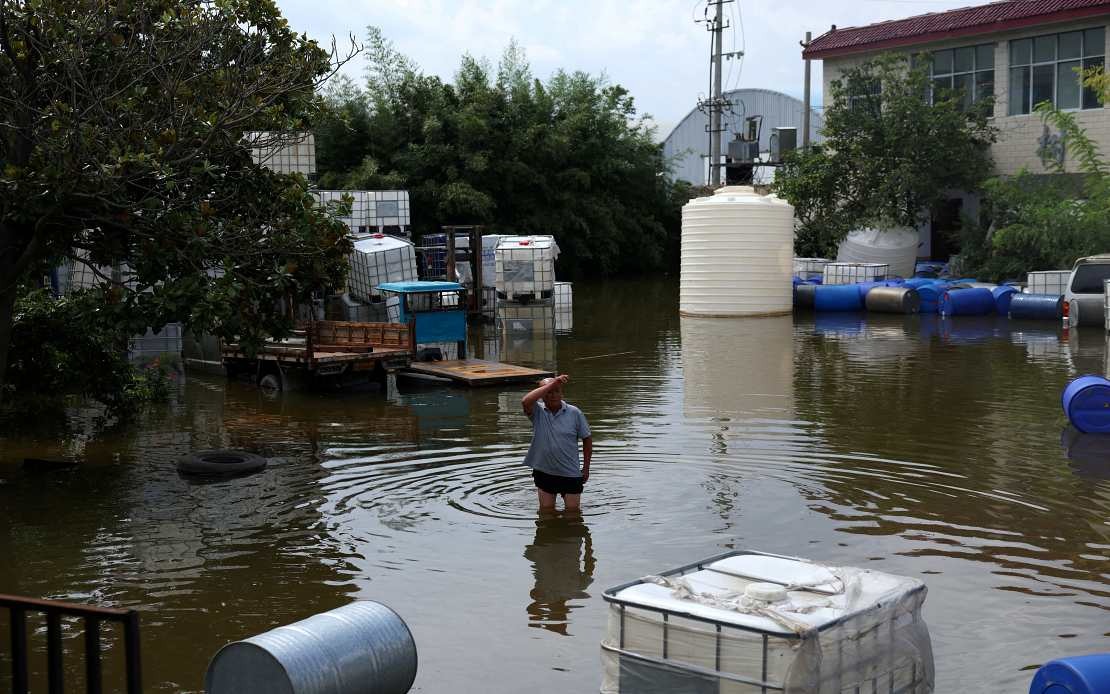
China's government response to catastrophic flooding in central Henan Province has mobilized significant emergency resources following the breaching of a critical levee in Zhoukou City. The Ministry of Emergency Management announced on Friday that rescue operations had commenced after heavy rainfall accompanying Typhoon Dolphin, the year's 13th typhoon system, triggered the structural failure shortly after 11 pm on Thursday evening. This deployment represents a coordinated national effort to manage one of the season's most destructive weather events across the region.
The rescue contingent dispatched to the affected area comprises 200 specialized engineering personnel drawn from China Anneng Group, complemented by 110 units of large-scale engineering equipment capable of managing water management and emergency infrastructure repair. These teams arrived on site Friday to integrate with ongoing local emergency operations, bringing technical expertise and machinery essential for containing flooding and managing the aftermath of the levee rupture. The rapid mobilization underscores Beijing's capacity to coordinate specialized rescue resources across provincial boundaries in response to infrastructure emergencies of this magnitude.
The National Commission for Disaster Prevention, Reduction and Relief formally escalated the situation by activating a Level-IV national disaster relief emergency response specifically for Henan Province. This classification reflects the severity of Typhoon Dolphin's impact on the province and signals that central authorities are treating the situation as a matter requiring coordinated national intervention. Such escalation typically triggers predetermined protocols for resource allocation, inter-agency coordination, and enhanced monitoring of affected communities across multiple jurisdictions.
Beyond immediate rescue operations, China's disaster management apparatus has directed substantial material support toward affected populations. The central government has allocated 30,000 items comprising essential relief supplies distributed to Zhoukou, Xuchang, and surrounding affected localities. These provisions include folding beds for temporary shelter arrangements, summer quilts for vulnerable populations, and comprehensive family emergency kits containing medical supplies and survival essentials. This logistical support addresses both immediate humanitarian needs and the longer-term resettlement challenges facing displaced residents.
The coordination of relief supply distribution reflects the integration of multiple state agencies in managing the catastrophe's humanitarian dimensions. The National Commission for Disaster Prevention, Reduction and Relief's office, the Ministry of Emergency Management, and the National Food and Strategic Reserves Administration jointly oversaw the Friday dispatch of relief materials. This tri-agency approach demonstrates how China's central bureaucracy compartmentalizes disaster response across specialized institutions, with each organization contributing sector-specific capabilities to the broader relief effort.
For Malaysian and Southeast Asian observers, this incident illustrates the escalating vulnerability of large infrastructure systems to extreme weather events amplified by changing climate patterns. Typhoon Dolphin's remnants, while weakened upon reaching inland Henan, retained sufficient intensity to generate rainfall volumes capable of overwhelming century-old levee infrastructure. The levee breach at Zhoukou carries broader implications for how regional governments assess the adequacy of aging water management systems designed for historical precipitation ranges rather than contemporary climate extremes.
The incident also highlights the critical importance of real-time disaster monitoring and rapid institutional response mechanisms. The identification of the levee breach, official notification to central authorities, and deployment of specialized rescue teams within hours of the failure demonstrates the infrastructure of disaster response coordination that more developed Asian economies have constructed. For countries in Southeast Asia with comparable flood vulnerabilities and aging infrastructure, the Chinese model offers both cautionary lessons and potential frameworks for enhancing emergency preparedness.
Typhonn Dolphin's penetration inland to trigger structural failures in Henan reflects changing atmospheric circulation patterns that regional meteorologists and emergency planners have been documenting. The frequency with which weakened tropical cyclones deposit substantial rainfall hundreds of kilometers from coastal zones suggests that historical precedent may inadequately guide contemporary infrastructure design standards. Communities across Southeast Asia, many of which depend on levee systems for agricultural protection and flood management, face similar reassessment requirements regarding infrastructure resilience in light of evolving climate conditions.
The relief supply allocation also underscores how modern disaster response incorporates pre-positioned emergency inventories rather than relying entirely on post-event procurement. China's maintenance of centralized reserves of folding beds, blankets, and medical kits reflects lessons learned from previous major disasters. This strategic stockpiling approach allows governments to transition displaced populations into temporary accommodation within hours rather than days, reducing exposure to weather and disease in the immediate aftermath of disasters. This logistical innovation represents an evolution in disaster management practice that neighboring countries are gradually adopting.
The activation of a Level-IV national response, rather than a higher-tier emergency classification, suggests that while Zhoukou's levee breach represents a serious local crisis requiring intensive intervention, central authorities assessed the situation as manageable through coordinated provincial-level response mechanisms supplemented by national resource deployment. This calibrated classification approach permits China to maintain flexibility in its emergency response architecture, reserving the most elevated alert levels for situations posing threat to multiple provinces or critical national infrastructure. Such tiered systems require sophisticated assessment capabilities and established protocols that typically take years to develop effectively.

