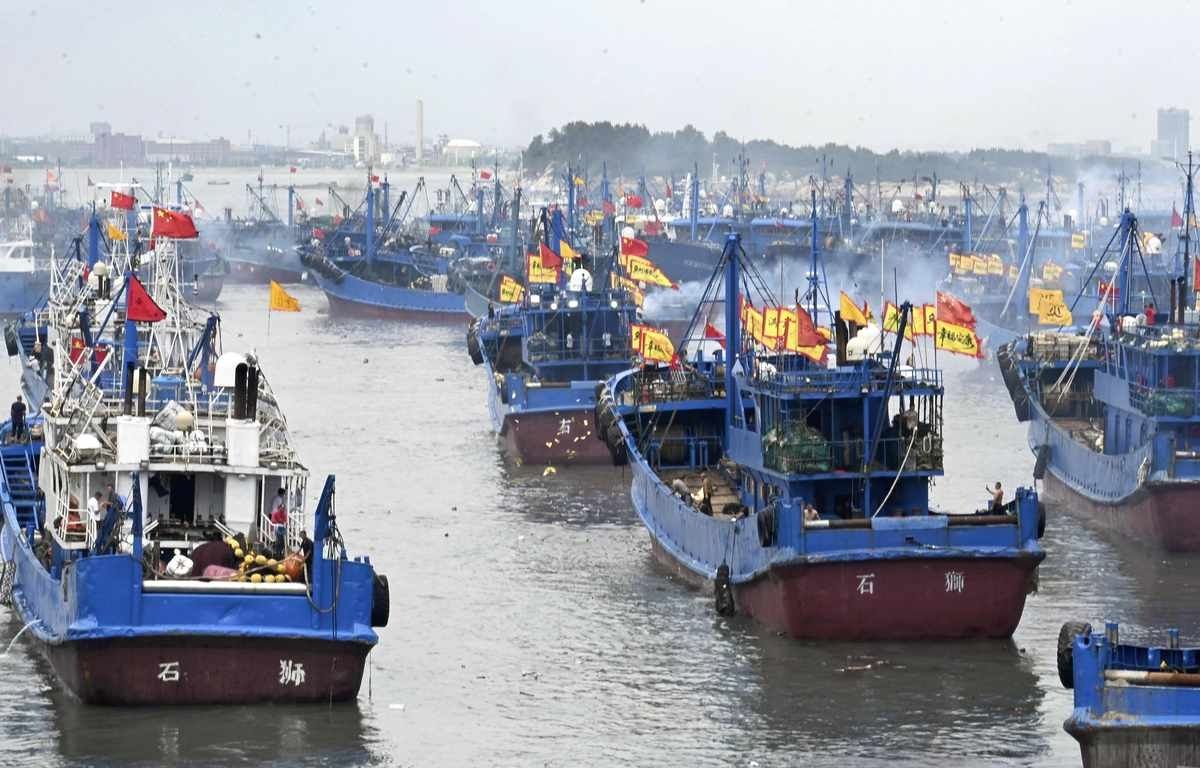
The resumption of Chinese fishing activities in the East China Sea marks a potential flashpoint in an already fraught relationship between Beijing and Tokyo. When the seasonal moratorium expired on Saturday, August 15, Chinese fishing vessels immediately began departing from ports in Fujian Province, with the city of Shishi alone dispatching 654 boats on the following morning. Many of these vessels displayed traditional Chinese symbols—national flags alongside red and yellow banners signifying hopes for safety and abundant harvests—while firecrackers sounded from departing boats. The lifting of the ban encompasses sensitive waters around the Senkaku Islands, which Japan administers but China claims, as well as the Taiwan Strait, underscoring Beijing's assertion of maritime claims in contested areas.
Historical precedent demonstrates the volatility inherent in this seasonal cycle. In August 2016, a coordinated surge of Chinese Coast Guard vessels and between 200 to 400 fishing boats swept into waters near the Senkaku Islands, with documented incursions into Japanese territorial waters. The apparent coordination between official maritime enforcement and civilian fishing fleets suggested a deliberate strategy to project Chinese presence and test Japanese response capabilities. Japan lodged stern diplomatic protests, characterizing the actions as unilateral escalation designed to alter the regional status quo. Many analysts at the time interpreted these maneuvers as a calculated response to The Hague Tribunal's July 2016 ruling, which rejected China's sweeping historical claims across the South China Sea—a verdict Tokyo explicitly supported and demanded Beijing accept.
Recent years have witnessed a visible effort by Chinese authorities to manage the potential for confrontation. Local government bodies in Fujian Province have issued directives discouraging fishermen from operating in what officials euphemistically term "sensitive waters," reflecting official anxiety about uncontrolled incidents that could further damage bilateral relations already strained by territorial disputes, military posturing, and competing strategic interests. This restraint has produced measurable results: warnings issued by the Japan Coast Guard to Chinese fishing vessels entering Senkaku territorial waters plummeted from 81 in 2021 to just four in 2025, suggesting either reduced incursions or improved compliance with unspoken boundaries.
Yet recent shifts in Beijing's official messaging suggest a subtle recalibration of policy that warrants careful scrutiny. The Chinese government traditionally issues regulatory notices governing maritime activities around May, typically including explicit language concerning "sensitive waters" belonging to neighbouring nations. Last year's notice explicitly referenced South Korea, North Korea, and Japan, warning that cross-border fishing in these jurisdictions would be prevented. This year's notice, issued on April 30, underwent a conspicuous revision: while maintaining strict prohibitions on operations in the interim measures area between China and South Korea, the specific reference to Japan has been conspicuously omitted. Diplomatic observers interpret this deletion as potentially significant, suggesting either reduced official concern about Japanese reactions or, more concerning, tacit permission for expanded operations in previously off-limits waters.
The ambiguity appears deliberate, creating operational space for fishermen while maintaining official deniability. A fisherman interviewed on the day the ban lifted articulated the precarious balance fishermen navigate. He acknowledged the exceptional richness of fishing grounds around the Senkaku Islands while noting that Chinese surveillance authorities monitor "sensitive waters" to prevent crews from approaching too closely to Japanese-administered territory. Crucially, he observed that no explicit prohibition has been issued against fishing in these areas, merely intensified official oversight. This distinction between informal guidance and formal prohibition creates a grey zone where fishermen can pursue economically rational decisions while authorities maintain plausible distance from direct incitement of confrontation.
The timing of this ban's expiration intersects with broader deterioration in Tokyo-Beijing relations. Beyond territorial disputes, the two nations have clashed repeatedly over military buildups, technology competition, and strategic alignment with the United States. Japan's explicit support for Taiwan, Chinese military exercises near Japanese airspace, and competing visions for regional order have created persistent friction. Against this backdrop, China's control over its fishing fleet becomes not merely an economic matter but a tool of statecraft. The ability to deploy hundreds of civilian vessels to assert presence in contested waters provides plausible deniability compared to direct military deployment, while simultaneously testing Tokyo's resolve and response capabilities.
Japan's challenge lies in calibrating its response to prevent incidents while avoiding actions that could be portrayed as capitulation or disrespect for Chinese sovereign prerogatives. The dramatic reduction in Coast Guard warnings suggests a policy of restraint designed to avoid escalation spirals. However, this approach risks creating an impression of tacit acceptance of Chinese fishing activities in disputed waters, potentially establishing precedent for further encroachment. The coming weeks and months will reveal whether the omission of Japan from this year's official notice represents a genuine policy shift or merely bureaucratic oversight that diplomatic channels will quietly clarify.
Southeast Asian nations, while not directly party to these disputes, maintain significant interests in their peaceful resolution. The Senkaku Islands controversy, though bilateral, occurs within a broader context of maritime tensions affecting the entire region. China's assertiveness in the East China Sea parallels its actions in the South China Sea, where numerous Southeast Asian claimants face similar pressures. How Japan responds to any escalation involving civilian fishing vessels may establish precedents affecting regional stability more broadly. Many in the region view Japan as a stabilizing force and hope Tokyo can manage these tensions without allowing either accommodation of Chinese claims or tit-for-tat escalation that could destabilize the entire regional order.
The coming weeks will prove revealing. If Chinese fishing activity increases substantially around the Senkaku Islands without corresponding Japanese escalation, it might suggest either quiet negotiations between the nations or a fundamental shift in Japanese policy. Conversely, any coordination between fishing boats and Chinese official vessels similar to the 2016 pattern would signal intentional escalation and likely provoke sharper Japanese responses. The international community, particularly in Southeast Asia, will watch closely for signals about whether the world's second and third-largest economies can manage territorial disputes through restraint and dialogue, or whether nationalism and strategic competition will continue driving periodic confrontations that risk broader destabilization.

