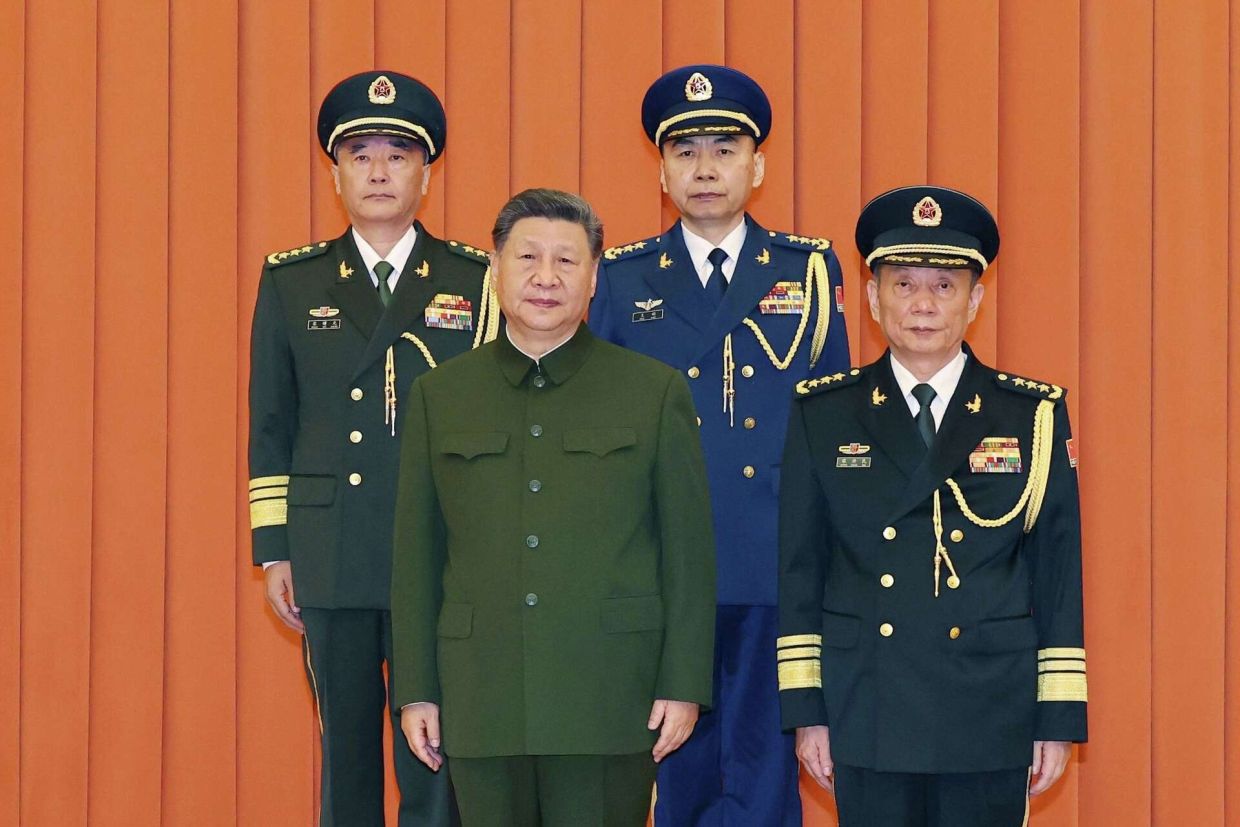
China's military establishment has elevated two senior officers to the rank of general in what analysts view as a significant step toward consolidating control within the defence apparatus following a protracted anti-corruption campaign that has fundamentally altered the composition of top military leadership. The promotions of Zhang Shuguang and Wang Gang, the commander of the air force, were formally announced by Xi Jinping at a ceremony on July 3, underscoring the paramount leader's direct involvement in senior military appointments and his continued prioritisation of loyalty within defence ranks.
The timing and nature of these elevations suggest they may form part of a broader reorganisation of China's highest military decision-making body. The Central Military Commission, which sits at the apex of China's defence hierarchy and comprises seven members, has been severely depleted by the ongoing anti-corruption investigations that have claimed several prominent figures. This attrition has created vacancies that the promotions of Zhang and Wang appear positioned to address, though their formal assignment to commission seats has not yet been confirmed.
Xi Jinping's role in personally presenting the promotion orders emphasises the intensely personalised nature of Chinese military governance. As both the nation's supreme leader and the military's commander-in-chief, Xi has leveraged the anti-corruption drive to reshape defence institutions in alignment with his vision of party supremacy and centralised authority. The purge has effectively removed or sidelined several high-ranking officials, including previous vice chairs of the commission and the military's former top general, fundamentally altering the leadership landscape that Xi inherited when he consolidated power.
Zhang Shuguang's simultaneous appointment as head of the Central Military Commission's corruption investigation division places him at the crucial nexus of power and oversight. This dual responsibility grants him extraordinary influence over both the commission's operations and the investigation process itself, a concentration of authority that reflects Xi's preference for individuals of proven loyalty. The position effectively allows Zhang to shape the narrative around the purge while simultaneously overseeing further investigations that could extend or redirect the anti-corruption campaign as deemed necessary by the party leadership.
The commission's current functional capacity presents a striking picture of institutional hollowing. With only Xi as chair and Zhang Shengmin as vice chair actively serving, the body that ostensibly oversees China's 2.3 million-strong military operates with minimal representation. This skeletal structure cannot be permanent; the absence of sufficient members undermines the commission's collective decision-making capacity and its ability to represent the diverse interests and regions that China's military traditionally balances. The promotions of Zhang and Wang represent the beginning of a process to restore the body to functional levels.
China's defence establishment follows a structured renewal cycle, with the current commission's term scheduled to conclude in late 2022. Chinese officials have signalled that a comprehensive restructuring of the commission will occur following this deadline, providing a natural inflection point for introducing newly elevated officers into formal positions. This timeline suggests that the anti-corruption investigations, while ostensibly about rooting out wrongdoing, simultaneously serve the practical purpose of clearing space for Xi's preferred personnel to assume positions of unprecedented influence within the military hierarchy.
The anti-corruption campaign itself merits scrutiny as an instrument of political consolidation. While genuine malfeasance within the military may exist, the selective targeting of individuals has coincided precisely with Xi's efforts to eliminate potential sources of resistance within defence institutions. This pattern, observed repeatedly across Chinese governance, illustrates how anti-corruption rhetoric provides political cover for actions that would otherwise appear as straightforward purges of rivals or ideological opponents. Military officers removed in the campaign have typically belonged to factions associated with Xi's predecessors or represented regional power bases outside his direct control.
For Southeast Asian observers, these developments carry significant implications. China's military modernisation and assertiveness in regional waters depend substantially on internal cohesion and the swift implementation of strategic directives from the civilian leadership. A military apparatus reshaped explicitly around loyalty to Xi rather than institutional checks or regional representation may prove more responsive to aggressive foreign policy initiatives, as it removes internal bureaucratic or collegial constraints on unilateral action. The concentration of authority within the military mirrors trends visible in China's broader governance structure.
The promotions also reflect generational transition within China's defence establishment. Wang Gang, as air force commander, represents the modern generation of officers shaped by Xi's military reforms and modernisation agenda. His elevation suggests continued confidence in the air force's trajectory and the technological investments China has made in aerial capabilities, areas where the nation has achieved notable advances in recent years. Zhang's background and career trajectory similarly reflect the institutional preferences of the current leadership cohort.
The anticipated announcement of a restructured commission in late 2022 will reveal whether the current promotions represent merely incremental adjustments or signal a more comprehensive transformation. The individuals appointed to fill remaining vacancies will demonstrate whether Xi intends to broaden representation across military regions and service branches or further concentrate authority within a narrower circle of confidants. The answers to these questions will substantially influence the military's operational culture and its receptiveness to civilian oversight during the commission's next five-year term.
China's military governance ultimately reflects the Communist Party's broader approach to power consolidation. The anti-corruption campaign simultaneously serves the practical purposes of removing institutional rivals, establishing personal loyalty networks, and creating vacancies filled by trusted personnel. For regional powers monitoring China's strategic trajectory, understanding these internal military dynamics proves essential to anticipating policy shifts and assessing the reliability of diplomatic commitments, as military institutions increasingly determine implementation of party decisions regarding territorial assertions and strategic expansion.

