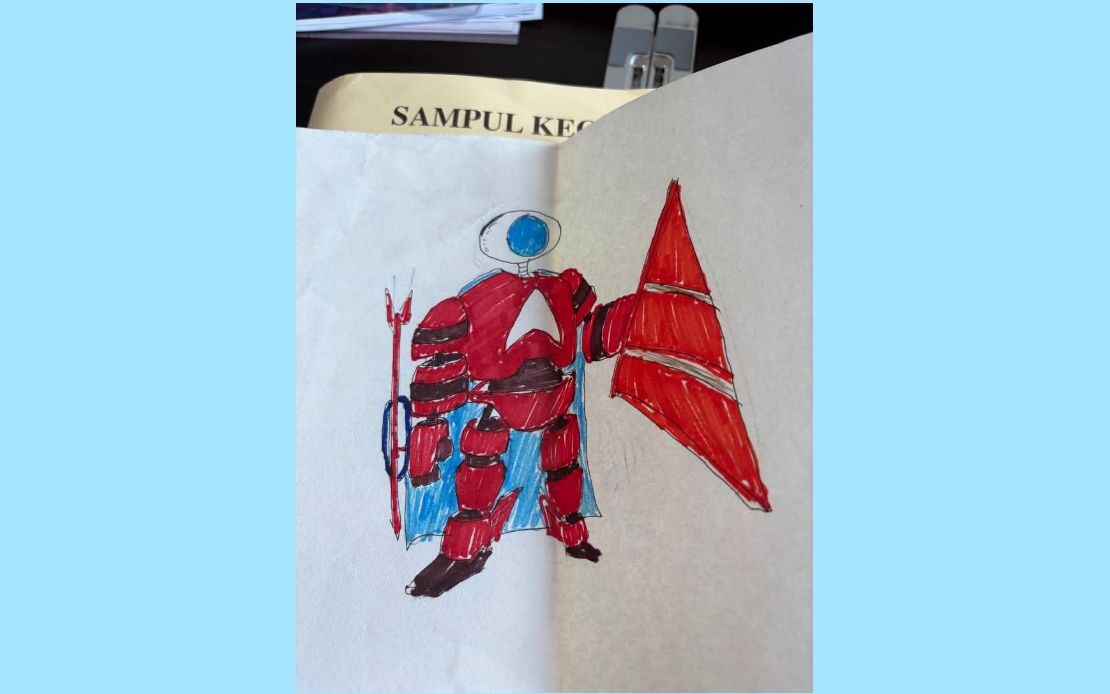
Prime Minister Datuk Seri Anwar Ibrahim has expressed his deep appreciation for a drawing gifted to him by a child with special needs during a recent Temu Anwar programme in Negeri Sembilan, highlighting a touching moment that underscores the value he places on interactions with everyday Malaysians from diverse backgrounds and circumstances.
Sharing the memory through a Facebook post, Anwar recalled the precise moment when the artwork was placed into his hands by the young artist, who was being held by his father during the engagement. The spontaneous gesture moved the Prime Minister, who described the piece as a particularly meaningful and cherished keepsake that he continues to treasure. Such personal exchanges, though brief, often carry symbolic weight in political life, representing connections that transcend formal protocol.
The drawing itself depicts a robot character rendered in striking red and blue armour, clutching a staff-like instrument in its left hand. The artistic choice of a powerful mechanical guardian figure may reflect the child's imagination and creativity, offering an intriguing window into how young minds envision strength and protection. For Anwar, the piece serves not merely as an object of sentimental value but as a tangible reminder of his commitment to engaging with citizens of all ages and abilities.
Temu Anwar, the platform through which this exchange occurred, functions as a structured avenue for direct dialogue between Malaysia's highest office and members of the public spanning all demographic segments and socioeconomic backgrounds. These sessions represent an effort to maintain accessibility and responsiveness at the highest levels of government, creating spaces where ordinary Malaysians—including families with children facing special needs—can interact with their prime minister in relatively informal settings. The programme reflects a governance philosophy that values listening and personal connection alongside formal policy-making.
The gesture of presenting a handmade gift during such encounters carries particular significance in Malaysian culture, where reciprocal respect and acknowledgment form important social bonds. For a parent accompanying a special needs child to a public event, the opportunity for their child to present something personally created to the nation's leader represents a validation of their child's abilities and participation in civic life. Anwar's public recognition of this moment amplifies that validation, sending a broader message about inclusion and the value placed on all citizens regardless of circumstance.
In recent years, Malaysian political leaders have increasingly utilised social media platforms to share personal moments from their public engagements, humanising political office and demonstrating accessibility. By posting about this encounter, Anwar continues a trend of using such platforms to communicate directly with voters and demonstrate the softer, more relational aspects of leadership. The post functions simultaneously as a genuine expression of gratitude and as a form of political communication that resonates with voters who value empathy and human connection in their leaders.
Negeri Sembilan, where this particular Temu Anwar session occurred, has historically been an important political ground, and direct engagement programmes there carry strategic as well as humanitarian significance. Such grassroots interactions help political leaders maintain contact with communities beyond urban centres and remind voters in state-level constituencies that they remain on the national government's radar. For residents of Negeri Sembilan, seeing their state chosen as a venue for prime ministerial dialogue reinforces the principle that engagement spans the entire nation.
The incident also highlights broader questions about inclusion and representation in Malaysian society. Children with special needs and their families often encounter barriers to full participation in public life and civic events. When such children are welcomed at prime ministerial engagements and their contributions—however small—are publicly acknowledged and valued, it sends important cultural messages about belonging and worth. The gesture suggests a vision of Malaysian public life that extends beyond able-bodied citizens.
For parents and caregivers of children with disabilities, moments like this carry resonance beyond the immediate personal experience. Media coverage and social sharing of such inclusive interactions can influence how broader society perceives individuals with special needs, potentially fostering greater acceptance and normalisation of their participation in community and political spaces. Political leaders' willingness to acknowledge and celebrate such moments contributes to shifting cultural narratives around disability and inclusion.
Moving forward, the episode serves as a small but meaningful reminder of the importance of human-centred governance and the ways that seemingly minor interactions between leaders and citizens can carry symbolic significance extending far beyond the moment itself. For Anwar and for the child and family involved, the drawing represents a tangible connection between the highest office in the land and ordinary Malaysians navigating daily life with resilience and dignity. Such moments, while not dominating policy headlines, form part of the texture of leadership and contribute to public perceptions of accessibility and values within government.

