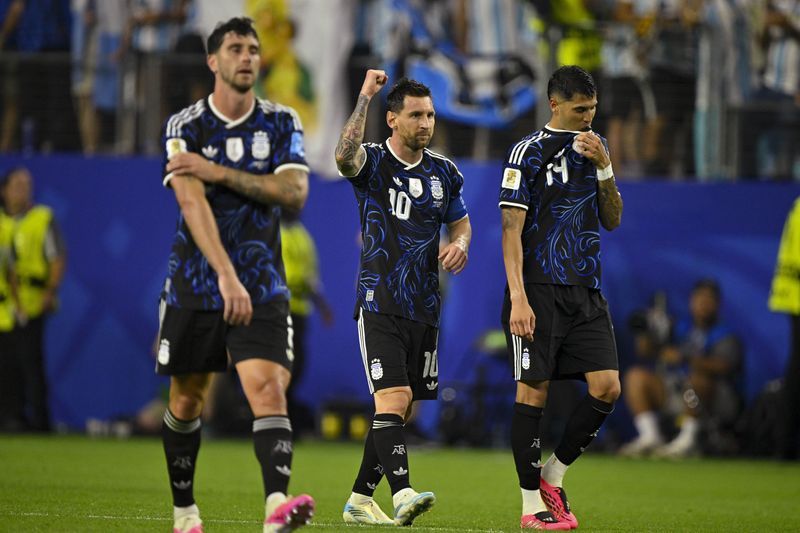
Cape Verde's head coach Bubista declared his team's determination to spring a major upset by eliminating Argentina from the World Cup, brushing aside the overwhelming odds stacked against the African nation in their first-ever appearance at football's greatest tournament. Speaking at Miami Stadium on Thursday, ahead of Friday's round-of-32 encounter, Bubista reinforced a message he has maintained consistently throughout the campaign: Cape Verde will compete with tactical discipline, organisational rigour, and unshakeable self-belief rather than reverence for their illustrious opponents.
The tactical philosophy underpinning Cape Verde's campaign has already yielded tangible results that validate Bubista's approach. The island nation, ranked 67th globally when the tournament began, emerged from the group stage undefeated in terms of results, securing three draws against Spain, Uruguay, and Saudi Arabia before progressing as runners-up in their section. For a team making their inaugural World Cup appearance, this trajectory represents a remarkable achievement that has fundamentally altered expectations within the squad and beyond. Bubista's insistence that Cape Verde earned their place on merit through both qualification and group-stage performance reflects a growing confidence that transcends the vast gap in FIFA rankings and tournament experience separating them from Argentina.
Bubista's framing of the knockout encounter as a chance to continue pursuing an ambitious dream rather than merely accepting defeat speaks to the psychological foundation he has constructed. He emphasised that regardless of external doubters, Cape Verde's trust in their working methods and tactical identity has not wavered. This unwavering conviction becomes particularly significant given the disparity in global stature between the teams. Argentina arrive as defending world champions with Lionel Messi leading a squad packed with elite talent and championship experience, yet Bubista's repeated assertion that his team deserves recognition suggests he views this match as something far more than a ceremonial appearance.
The coach's remarks about respect cutting both directions hint at a deeper narrative about football's hierarchy and the presumption of victory that often accompanies tournaments' elite participants. By insisting that Cape Verde have demonstrated their competitive credentials through on-field performance rather than reputation, Bubista subtly challenged the notion that Argentina's status automatically guarantees progression. His declaration that if others failed to respect Cape Verde, that represented their oversight rather than a factual shortcoming, contains an implicit rebuke of condescension while maintaining the diplomatic tone expected of World Cup coaches.
When questioned about Cape Verde's approach to neutralising Messi, arguably the tournament's most influential individual talent, Bubista pivoted away from player-specific defensive assignments toward a team-oriented perspective. This strategic deflection reveals sophisticated tactical thinking: rather than constructing an entire game plan around containing one opponent, Cape Verde intends to maintain their defensive shape and organisational discipline while remaining true to their identity. The preference for collective cohesion over marked-man surveillance also mitigates the risk of tactical imbalance that often accompanies overly individualised defensive schemes.
Bubista's assertion that Cape Verde approached each group-stage match with realistic ambitions of victory rather than survival-focused mentality demonstrates the psychological framework enabling their competitive performances. This mindset proves crucial when facing established powerhouses. Teams that enter matches against superior opposition already resigned to defeat often confirm that expectation through conservative, reactive football. Cape Verde's demonstrated willingness to pursue positive results, as evidenced by their draws with Spain and Uruguay, suggests they possess both the tactical sophistication and mental fortitude to trouble Argentina despite the formidable challenge ahead.
The broader context of Cape Verde's World Cup participation holds particular significance for African football. Despite the continent's passionate embrace of the sport and its considerable talent pool, African nations have rarely achieved comparable success in recent World Cups. Cape Verde's emergence as a serious competitive presence, even if their run ends against Argentina, potentially signals shifting dynamics in global football. The tournament has already demonstrated that traditional hierarchies remain fluid, with various underdogs performing creditably against expected favourites. For emerging African nations observing Cape Verde's campaign, the example of uncompromising ambition combined with tactical discipline offers a template beyond the defeatist approach that sometimes characterises lower-ranked nations' World Cup campaigns.
Bubista's repeated emphasis on humility alongside courage presents an interesting psychological balance. He recognised the absolute quality of Argentina and coach Lionel Scaloni while simultaneously refusing to subordinate Cape Verde's aspirations to that acknowledgment. This equilibrium—respecting opponents without surrendering belief—represents the delicate mental equilibrium required for underdogs to perform at their peak against superior opposition. Teams that lose either component, sliding into either arrogance or self-doubt, typically underperform their actual potential.
The knockout-stage context adds another layer to Cape Verde's challenge and opportunity. Group-stage draws represented acceptable outcomes that allowed progression; in the knockout round, only victory matters. This binary framework actually suits Cape Verde's declared mentality. Their coach has explicitly stated that advancing represents the singular objective, suggesting the team understands that cautious, possession-oriented play designed merely to avoid defeat would likely prove insufficient against Argentina's quality. The match therefore demands precisely the aggressive, organised football that has characterised Cape Verde's tournament so far, where they competed positively throughout rather than absorbing pressure.
Since World Cup qualification in their own right—not as beneficiaries of expanded tournament formats—Cape Verde has already secured one major accomplishment. Whether they progress past Argentina or not, they have already established that their presence at world football's showcase event represents genuine achievement rather than peripheral participation. Bubista's conviction that Cape Verde's journey continues based on their own merits and ambitions, rather than Argentina's superiority, encapsulates the psychological approach that occasionally allows underdogs to produce tournament shocks.

