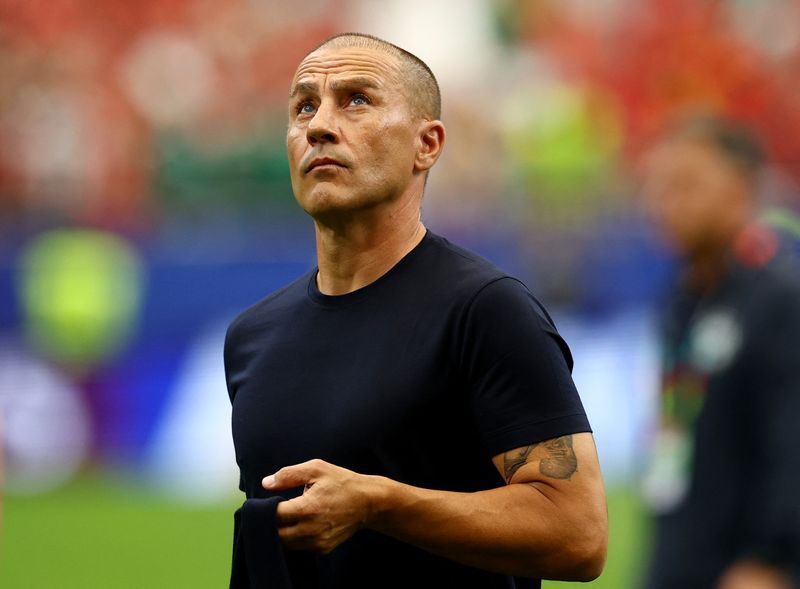
Uzbekistan's maiden World Cup campaign has taken a devastating turn following their 5-0 capitulation to Portugal in Group K on Tuesday, though their Italian coach Fabio Cannavaro has sought to frame the humiliating defeat as a learning opportunity for a young team still finding their footing on football's biggest stage. Speaking to reporters in Houston, the 2006 World Cup winner with Italy demonstrated the experience and composure expected of a manager who has navigated elite competitions throughout his career, firmly placing the onus of responsibility on his own tactical decisions rather than attempting to deflect blame toward his players.
The scale of the defeat has left Uzbekistan in a precarious position in their debut World Cup appearance. Following an earlier 3-1 loss to Colombia, the Central Asian side now sits at the bottom of Group K with only a final match against the Democratic Republic of Congo remaining on Saturday. Mathematically, Uzbekistan require a victory to maintain any realistic hope of advancing to the knockout rounds, though the path forward has become considerably narrower after consecutive heavy defeats. The accumulation of setbacks has transformed what began as a historic opportunity into a fight for survival in the tournament's group stage.
Cannavaro's measured response to the Portuguese rout reflects his stature within the sport. Rather than offering excuses or criticising his squad's performance, he articulated a philosophy of developmental football that emphasises long-term growth over short-term results. He told assembled media that his players had given maximum effort despite the scoreline, expressing particular pride in their commitment to the task. This approach stands in contrast to the immediate disappointment that typically accompanies such comprehensive defeats, suggesting a coach determined to extract value from an otherwise catastrophic result.
The former Parma and Juventus defender drew on his extensive experience at the highest level to justify his tactical approach. Cannavaro emphasised that he had explicitly encouraged his players to take risks, attempt ambitious passes, and embrace a courageous style of play rather than retreating into defensive conservatism. In his view, this mandate to be brave and experiment represents an investment in the team's future development, even if it resulted in vulnerability against superior opponents. He argued that building confidence and fostering a learning mindset would ultimately benefit Uzbekistan's evolution as an international unit.
A crucial turning point in the match came when Azizjon Ganiev had what appeared to be a well-executed goal disallowed for a foul committed during the build-up to the strike. Cannavaro identified this moment as particularly damaging to his team's psychological state during the contest. The decision, whether correct or not, seemed to deflate the squad's enthusiasm and confidence in their approach. Having started boldly and competed with reasonable intensity, the disallowance appeared to shift momentum decisively toward Portugal, and Uzbekistan's subsequent collapse accelerated markedly in its wake.
Cannavaro's insistence that he bore personal responsibility for the heavy defeat carries weight given his stature in international football. As a World Cup-winning captain and renowned centre-back during his playing days, he is acutely aware of the demands and pressures inherent in tournament football. His willingness to accept accountability for tactical decisions, selection choices, and strategic direction demonstrates a commitment to professional integrity that may resonate positively with supporters despite the result. Such candour from a high-profile manager offers a refreshing contrast to blame-shifting or deflection.
The Uzbekistani contingent's participation in this World Cup represents a historic moment for a nation that has invested significantly in developing its football infrastructure and talent base. The experience of competing against elite sides like Portugal and Colombia, regardless of the outcomes, provides invaluable exposure and learning opportunities for players and coaching staff alike. Cannavaro appears determined to harvest whatever development gains are possible from this inaugural tournament appearance, emphasising that growth as a team and as individuals constitutes a valid objective alongside the pursuit of victories.
Looking toward the final group match against the Democratic Republic of Congo, Cannavaro has implicitly ruled out abandoning the principles that guided Uzbekistan's approach against Portugal. His message to his squad emphasises continued belief and the importance of playing without fear, even though the mathematical path to qualification has narrowed significantly. This consistency in philosophy, despite the consequences on the pitch, suggests that institutional development and the cultivation of a progressive playing culture remain central to the Uzbekistani Football Federation's longer-term strategy.
For Southeast Asian football observers, Uzbekistan's experience offers instructive lessons about competing at the World Cup level. The Central Asian nation's rapid development as a footballing power—culminating in this maiden World Cup qualification—demonstrates what sustained investment and professional coaching can achieve. However, their struggle against established European sides also underscores the significant gap between developing football nations and the sport's traditional powerhouses, a reality that resonates across the region as countries like Thailand, Vietnam, and Malaysia pursue their own qualification dreams. Cannavaro's framing of defeat as a developmental milestone rather than a disaster may influence how other emerging footballing nations approach their own tournament experiences.