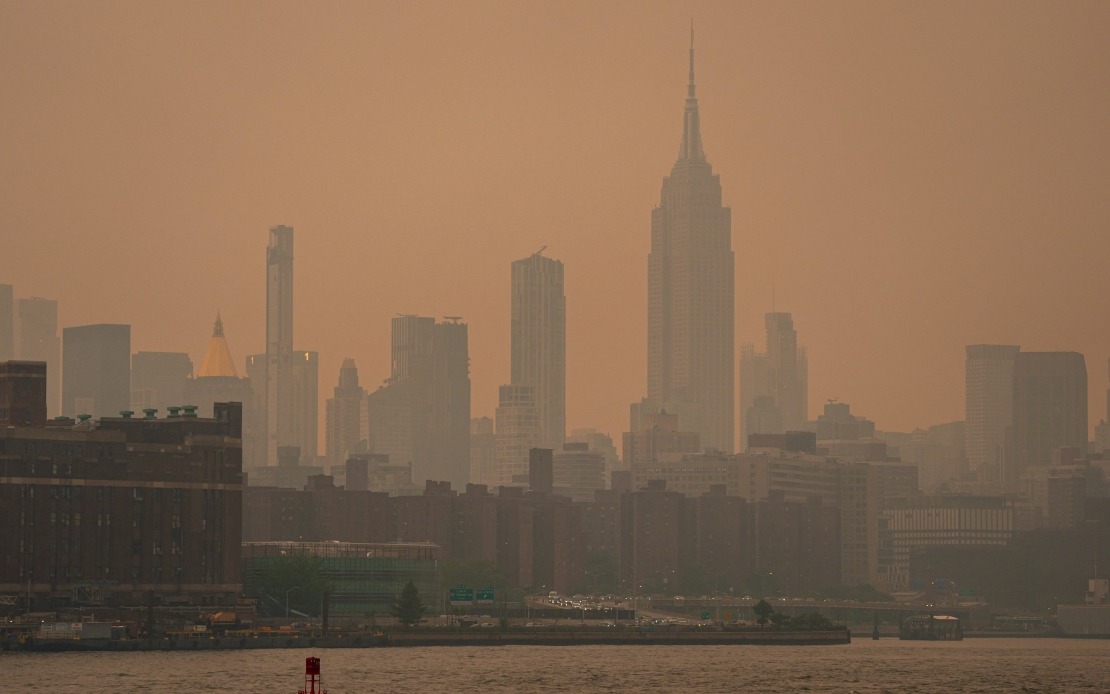
Mexican President Claudia Sheinbaum encountered significant disruption to her travel schedule this weekend when deteriorating air quality over New York forced the cancellation of her scheduled flight from Cancún, as smoke from raging Canadian wildfires blanketed the northeastern United States. The initial two-hour delay on Saturday eventually became a complete cancellation, leaving the Mexican government to arrange alternative transport for the president to reach East Rutherford, New Jersey, where she was invited to witness the World Cup final between Argentina and Spain.
The situation highlights the increasing impact of environmental and climate-related disruptions on high-level diplomatic travel. New York's air quality degraded substantially due to smoke transported southward from wildfires burning across Canadian provinces in recent days, creating hazardous conditions that extended beyond a single region and affected major transportation hubs across the northeastern corridor. Such circumstances, while typically unforeseen, underscore the vulnerability of long-distance air travel to environmental factors that can cascade across borders and affect international engagements at short notice.
Responding to the crisis, Mexico's Defence Ministry mobilised one of its military aircraft to transport President Sheinbaum overnight into Sunday, ensuring her timely arrival despite the commercial flight cancellation. This arrangement demonstrates the logistical resources that government administrations maintain for critical diplomatic movements, though it also reflects the extraordinary measures sometimes required to honour international commitments when standard civil aviation channels prove unusable. The overnight journey would have tested the president's schedule, compressed though the timeline was.
The World Cup final invitation itself carried diplomatic significance beyond sporting spectacle. U.S. President Donald Trump extended a surprise invitation to Sheinbaum to attend the match, positioning the event as a trilateral gathering of leaders from all three host nations. The presence of Canadian Prime Minister Mark Carney alongside Sheinbaum was intended to underscore the collaborative framework governing the tournament, which rotates matches across Mexico, Canada, and the United States under a joint hosting arrangement that required unprecedented coordination among the three countries.
The timing of Sheinbaum's attendance acquired particular meaning given the broader context of Mexico-United States relations. Trade disputes and security concerns have created friction between the neighbouring countries, complicating diplomatic interactions that might otherwise proceed more smoothly. This invitation from Trump to Sheinbaum represented a notable gesture toward engagement on neutral ground, using the World Cup as a platform for presidential-level interaction outside the traditional bilateral framework that often proves contentious.
Prior to this World Cup final, the two leaders' only previous meeting in the context of the tournament had occurred during the draw ceremony in Washington last December. That December encounter would have been relatively brief and formal, constrained by the ceremonial nature of the event. Sunday's match invitation provided an extended opportunity for the leaders to interact in a more relaxed environment, though smoke disruptions and hasty travel arrangements may have tempered the diplomatic setting.
For Malaysian and Southeast Asian observers, the incident offers instructive lessons about the intersection of climate-related environmental disruptions and high-level geopolitics. The region faces its own challenges with transboundary haze episodes, particularly during burning seasons in Indonesia and Malaysia, which periodically affect air quality across multiple countries and can similarly disrupt transportation and commerce. The Mexican situation demonstrates how even economically developed nations with sophisticated air travel infrastructure face real constraints when environmental conditions deteriorate beyond safe operating parameters.
The broader World Cup hosting arrangement itself merits consideration from a regional perspective. Malaysia and other ASEAN nations have observed the logistics of the tri-national tournament as a model for potential future collaborative sporting events. The coordination required to manage matches across three countries involves complex diplomatic, logistical, and administrative frameworks that demand sustained cooperation despite bilateral tensions. The Canadian wildfire disruption, while ultimately manageable through alternative arrangements, illustrates one category of challenge that such multi-national events must accommodate.
Canadian Prime Minister Mark Carney's participation alongside Sheinbaum underscored the formal structure of the trilateral arrangement, though the Canadian wildfires that disrupted Mexican travel also originated in Canadian territory. This circumstance carried a degree of irony—Canada's environmental crisis inadvertently complicated the attendance of leaders from co-host nations. Environmental accountability and transboundary atmospheric impacts have become unavoidable dimensions of international relations, affecting not only bilateral relations but also multinational collaborative frameworks.
The resolution of Sheinbaum's travel dilemma through military aircraft deployment proved efficient, if unconventional for an international sporting event. The decision reflected Mexico's institutional capacity to respond rapidly to diplomatic imperatives, mobilising state resources to ensure the president's participation despite infrastructure failures in the civilian sector. Such adaptive responses are increasingly necessary as unpredictable environmental factors intersect with scheduled international commitments.
The World Cup final would proceed with all three host nations' leaders present, despite the complications surrounding Sheinbaum's journey. Her attendance, secured through alternative means, symbolised the commitment to the trilateral framework even when standard procedures fell short. The event thus encapsulated both the potential and the fragility of multinational cooperation—ambitious in scope but vulnerable to environmental and logistical challenges that demand creative problem-solving from governments and institutions alike.

