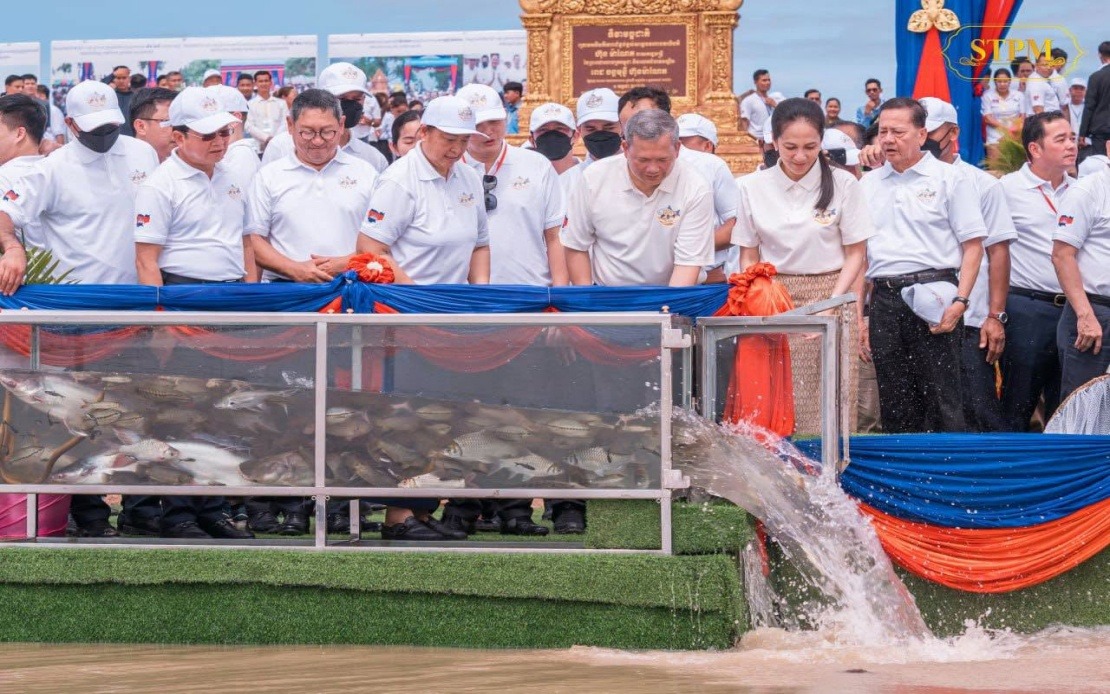
Cambodian Prime Minister Hun Manet has escalated his government's fight against illegal fishing, issuing direct orders to local authorities to intensify enforcement operations in critical fish breeding grounds across the kingdom. The initiative, unveiled during National Fish Day celebrations in Svay Rieng Province, represents a significant policy shift aimed at preserving Cambodia's marine and freshwater resources, which remain fundamental to the nation's food security and rural livelihoods.
Hun Manet emphasised the existential importance of Cambodia's aquatic ecosystems, particularly the iconic Tonle Sap lake, which sustains hundreds of thousands of fishermen and their families. The prime minister acknowledged that without urgent intervention, continued depletion of fish stocks would undermine both immediate food security and the long-term viability of fishing communities across Cambodia. His remarks reflected growing recognition in Southeast Asia that uncontrolled resource extraction threatens not only environmental stability but also the economic survival of vulnerable rural populations dependent on traditional fishing methods.
Under the new directive, military units stationed throughout the Tonle Sap region have been authorised to mobilise enforcement operations against illegal fishing activities. This strategy represents Cambodia's attempt to address a critical gap in resource protection capacities. Hun Manet explicitly noted that civilian law enforcement agencies lack the specialised training and personnel numbers needed to effectively combat sophisticated illegal fishing networks, which frequently operate across borders and employ industrial-scale equipment designed to maximise catches regardless of ecological consequences.
The prime minister also signalled an important limitation on military expansion, stating that the government wants to reduce its long-term dependence on armed forces for civilian law enforcement functions. This acknowledgment suggests Cambodia recognises the need to develop dedicated environmental and fisheries protection services, shifting away from a militarised approach toward more sustainable institutional structures. However, the immediate reality remains that trained conservation officers are in short supply throughout the kingdom, forcing reliance on military capacity while institutional development proceeds.
One specific target of Hun Manet's enforcement campaign is large-scale clam dredging, a practice he identified as particularly destructive to fishing communities. Industrial clam harvesting operations, whether conducted legally or illegally, devastate the seafloor ecosystems that support fish breeding and the broader food chain. He ordered an immediate cessation of such activities, acknowledging that the economic interests of a small number of operators cannot justify the widespread damage to fisheries that support entire regions.
The prime minister positioned Cambodia's agricultural and fisheries sectors as complementary pillars sustaining national food security. In his characterisation, agriculture constitutes the nation's foundational nutrition base—the stomach that keeps Cambodia fed—while fisheries function as the primary source of essential proteins, particularly for rural and lower-income populations. This framing underscores why resource depletion in either sector carries serious consequences for national welfare and stability, making enforcement action not merely an environmental concern but a matter of economic survival.
Protecting fish populations during spawning seasons emerged as a central component of Hun Manet's strategy. Many fish species have critical breeding periods when they congregate in predictable locations, making them vulnerable to concentrated fishing pressure. Industrial fishing operations often target spawning aggregations precisely because they offer the highest catch volumes, but such activities can devastate recruitment of the next generation and rapidly collapse fish populations. Restricting fishing access during these sensitive periods is thus essential for population recovery and long-term sustainability.
To demonstrate commitment to aquatic ecosystem restoration, authorities released 1.5 million fish and other aquatic organisms into the Vai Ko River in Svay Rieng Province as part of the National Fish Day observance. While such restocking initiatives offer symbolic and modest practical value, they cannot substitute for addressing the underlying drivers of overexploitation. Nevertheless, such programs can support population recovery in depleted areas and represent visible government investment in fisheries management that resonates with affected communities.
For Southeast Asian readers, Cambodia's struggle resonates across the region. Thailand, Vietnam, Indonesia, and other nations face identical pressures from illegal fishing networks, transnational smuggling operations, and industrial vessels that violate territorial waters and conservation regulations. The governance challenges Hun Manet confronts—inadequate enforcement capacity, cross-border complications, and balancing economic interests against environmental limits—represent shared regional problems. Cambodia's decision to mobilise military resources while planning institutional alternatives offers a case study in how developing nations are attempting to reclaim control over marine commons increasingly threatened by commercial overharvesting and the displacement of traditional fishing communities.
Hun Manet's initiatives also highlight the political economy of resource protection. Industrial fishing and clam dredging operations generate quick profits and often involve politically connected actors resistant to enforcement. Traditional fishermen, by contrast, lack political influence despite their numerical strength and economic importance. The prime minister's willingness to directly challenge industrial operators signals either genuine commitment to protecting fisheries or sophisticated political messaging—or both. Sustained follow-through will determine whether these orders represent meaningful policy change or temporary announcements forgotten once media attention shifts elsewhere.
The sustainability of Cambodia's aquatic ecosystems remains fundamentally precarious. Tonle Sap, one of the world's most productive freshwater fisheries, has experienced documented fish stock declines over the past two decades. Illegal fishing, habitat destruction, upstream dam construction in neighbouring countries, and climate-driven hydrological changes all contribute to mounting pressures. Hun Manet's enforcement drive addresses one component of a multifaceted problem, but genuine recovery will require international cooperation with upstream nations, investment in ecosystem restoration, and possibly difficult restrictions on overall fishing capacity—changes that extend far beyond military patrols.

