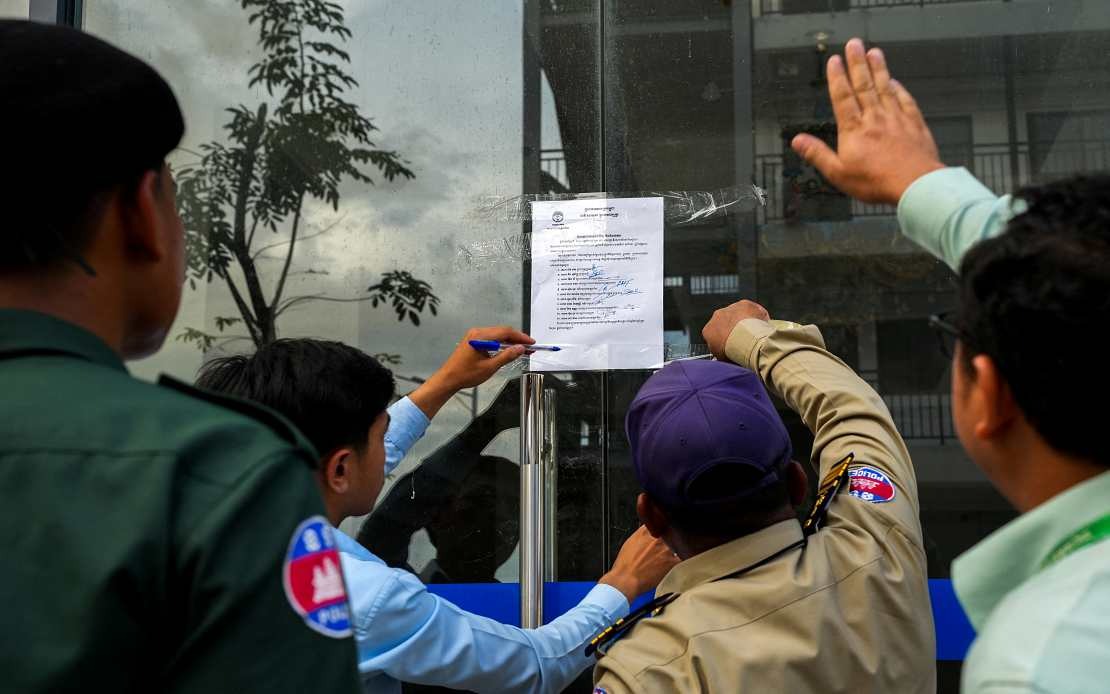
Cambodia has expelled more than 16,000 foreign nationals suspected of involvement in online scams during the opening half of 2026, according to Police Lieutenant General Sok Veasna, the director general of the General Department of Immigration. This significant enforcement action represents part of a broader deportation initiative that saw the kingdom remove over 45,000 foreign citizens during the same period, underscoring a sharp escalation in immigration enforcement targeting criminal elements that have long plagued the Southeast Asian nation.
The surge in deportations reflects a deliberate policy shift by Cambodian authorities to intensify their response to cybercrime networks that have flourished within the country's borders. Since the beginning of January, operational teams have conducted widespread raids and investigations into suspected fraud operations, resulting in the removal of individuals flagged as key players in online scamming enterprises. Officials stated during a mid-year review meeting that those deported face a permanent prohibition on re-entry into Cambodia, signaling the government's determination to sever links between these criminal networks and Cambodian territory.
The timing and scale of these deportations coincide with Cambodia's passage of the Law on Combating Online Scams in April 2026, legislation that established severe penalties for online operation leaders and architects of fraud schemes. This legal framework provides law enforcement with stronger tools to prosecute and punish individuals engaged in cybercrime, whether they operate from within Cambodia or exploit the country as a base for international scamming operations. The law represents a formal acknowledgment of the severity of the problem and signals the kingdom's intention to address what has become a significant governance and reputational challenge.
For Malaysia and other Southeast Asian nations, Cambodia's aggressive approach carries both strategic implications and cautionary lessons. The region has increasingly become a hub for transnational cybercrime operations, with criminal networks exploiting porous borders, limited cybersecurity infrastructure, and inadequate coordination between law enforcement agencies. Cambodia's situation reflects a pattern visible across multiple ASEAN states, where international criminal organizations have established operational bases that target victims globally, including numerous Malaysians who have fallen prey to online fraud schemes originating from Cambodia and neighbouring countries.
However, experts caution that mass deportations, while symbolically important and operationally disruptive, address only the symptom rather than the disease underlying the persistence of these networks. Thong Mengdavid, deputy director at the China-ASEAN Studies Centre of the Cambodia University of Technology and Science, emphasized that true victory against cybercrime requires targeting the commanding officers and dismantling the domestic protection infrastructure that enables these operations to flourish. His analysis highlights a critical gap between enforcement theatre and substantive institutional reform—a distinction that applies equally across the region.
The protection networks Mengdavid referenced involve complicit elements within Cambodia's security apparatus, local officials, and facilitators who provide operational cover for scamming enterprises in exchange for financial compensation. These corrupt relationships create a permissive environment where criminal operations can expand despite periodic crackdowns. Without addressing the corruption and institutional weaknesses that allow such networks to persist, deportation campaigns risk becoming cyclical exercises in which new scammers simply replace those removed, perpetuating the underlying criminal ecosystem.
Cambodia's predicament also intersects with regional human trafficking concerns, as Mengdavid noted. Many individuals arrested or deported for involvement in online scams are themselves victims of trafficking, coerced labour, or debt bondage, recruited through false employment promises and then forced to participate in fraud operations. This dimension adds complexity to enforcement responses and suggests that solutions requiring purely punitive approaches will prove incomplete. Addressing the human trafficking component demands cooperation with origin countries, improved victim identification protocols, and rehabilitation pathways that distinguish between perpetrators and exploited individuals.
The international reputation damage Cambodia has suffered due to the proliferation of cybercrime operations has prompted this unprecedented enforcement campaign. The kingdom's image as a safe, stable destination for investment and tourism has been affected by widespread reports of scamming networks operating with apparent impunity. Reversing this perception requires sustained commitment to enforcement coupled with demonstrable progress in eliminating the structural advantages that have made Cambodia attractive to criminal syndicates in the first place.
Regional security analysts observe that cybercrime operations frequently operate across ASEAN borders, with command centres in one country directing fraud schemes targeting victims in multiple nations simultaneously. Cambodia's unilateral enforcement actions, therefore, have limited long-term effectiveness without coordinated regional approaches. Malaysia, Thailand, Indonesia, and other ASEAN states face similar challenges and would benefit from enhanced intelligence sharing, joint task forces, and harmonized legal frameworks addressing cybercrime jurisdiction and extradition.
The Law on Combating Online Scams signals Cambodia's recognition that cybercrime requires specialized legal tools distinct from conventional criminal law. The emphasis on severe penalties for ringleaders reflects an understanding that disrupting command structures and eliminating profit incentives represents a more effective deterrent than processing lower-level operatives. This approach aligns with best practices emerging from other jurisdictions that have successfully degraded organized cybercrime capacity, though implementation remains dependent on prosecutorial capacity and judicial consistency.
Looking ahead, Cambodia's multi-pronged strategy must evolve beyond deportations and new legislation to encompass institutional strengthening, corruption reduction, and victim support mechanisms. The kingdom's government has indicated awareness of these requirements through rhetoric about addressing the root causes, but translating awareness into systemic change will determine whether this campaign represents a turning point or merely a temporary disruption of networks that will eventually reconstitute themselves. For Malaysian readers and policymakers, Cambodia's experience offers both a model of decisive action and a cautionary tale about the limits of enforcement without institutional reform.

