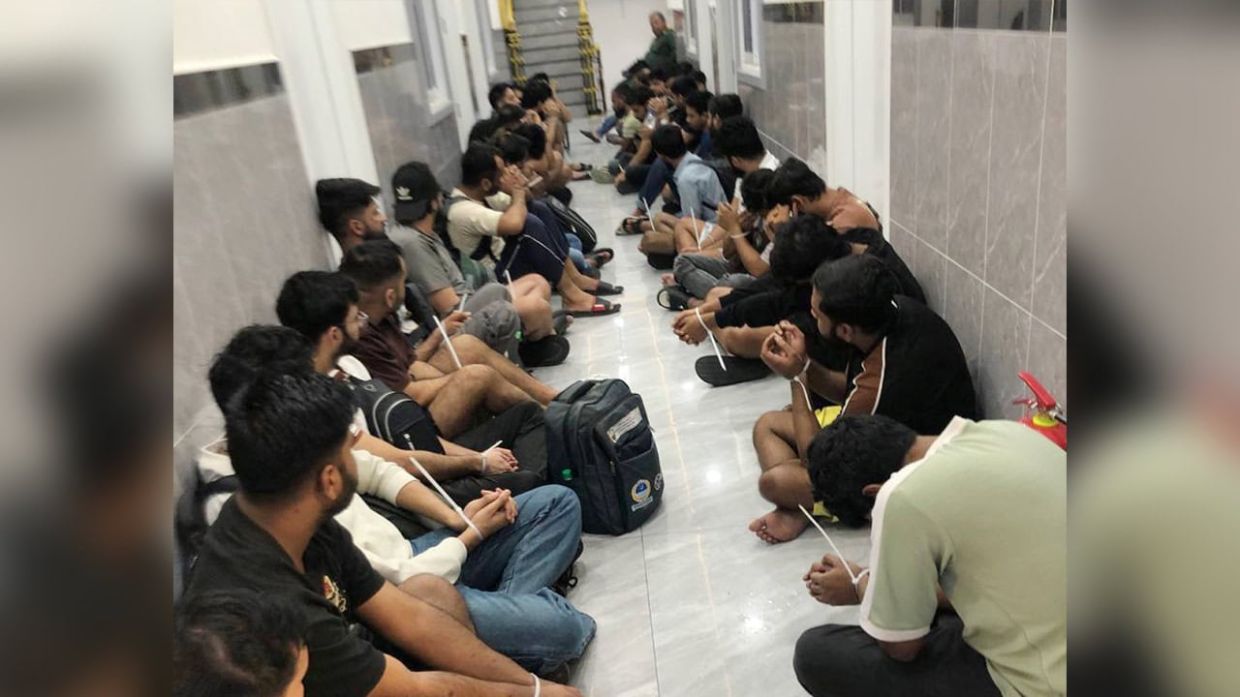
Cambodia's law enforcement agencies have substantially escalated their assault on transnational fraud operations, shutting down more than 200 scam sites across Banteay Meanchey province and processing tens of thousands of foreign detainees over the past seven months. Yet even as officials trumpet these enforcement victories, provincial leadership has candidly acknowledged that the border town of Poipet—historically synonymous with online gambling and fraud hubs in Southeast Asia—continues to harbour criminal networks despite intensive crackdowns.
Governor Oum Reatrey of Banteay Meanchey disclosed the scale of the operation during recent remarks on the provincial unified command committee's ongoing campaign against technology-enabled fraud. The joint task force has coordinated sweeps across multiple districts, apprehending both foreign nationals orchestrating scam infrastructure and Cambodian nationals complicit in these schemes. The volume of foreign suspects identified reflects the international dimension of these criminal enterprises, which typically involve recruitment networks spanning Vietnam, China, Indonesia, Thailand, and beyond.
The processing of detainees has strained the immigration and judicial systems. Reatrey explained that among the foreign nationals captured, many have already been expelled through the General Department of Immigration, with deportations funnelled back to their source countries via the Poipet International Border Checkpoint. Others remain incarcerated as legal proceedings unfold, creating a backlog that underscores both the scale of criminal activity and the resource constraints facing Cambodia's courts. The mixed outcomes—deportation versus detention pending trial—suggest varying degrees of culpability and jurisdictional complexity.
The operational scale of individual scam compounds reveals the industrial nature of online fraud rings in the region. Some raided locations have yielded merely a handful of suspects, while the largest operations have harboured as many as 2,000 individuals working in coordinated shifts. These figures indicate highly organised criminal enterprises with sophisticated logistical networks, rather than scattered amateur fraudsters. The compounds operate with the characteristics of call centres or back-office operations, suggesting permanent infrastructure rather than temporary encampments.
Reatrey's assessment of geographic progress within the province provides nuance often absent from sweeping claims of victory. While authorities have declared operational success in Malai and Svay Chek districts, implying near-complete dismantling, the governor adopted more measured language regarding Ou Chrov, suggesting ongoing operations persist despite major sites being neutralised. Poipet town, however, received no such qualified optimism—Reatrey straightforwardly stated that the border municipality has not yet been completely cleared of scam activity. This candour, while refreshing, also hints at the structural difficulties of policing a town that straddles Cambodia and Thailand, where jurisdictional boundaries and porous borders complicate law enforcement.
The broader context of Cambodia's anti-scam campaign extends well beyond Banteay Meanchey. Immigration director-general Sok Veasna reported that the first half of 2026 saw more than 45,000 deportations nationally, with over 16,000 individuals removed specifically from scam detention sites. Veasna's observation that this figure surpasses the total number of foreigners deported during the entire previous decade underscores both the severity of the fraud problem and the political priority now assigned to combating it. For Southeast Asian and international observers, the statistics signal that Cambodia has repositioned itself from being perceived as permissive territory for online crime to actively prosecuting transnational fraud networks.
Yet the sheer volume of deportations raises questions about the sustainability and efficacy of these enforcement approaches. High deportation numbers may reflect successful interdiction operations, but they may equally suggest that criminal networks possess sufficient redundancy and recruitment capacity to rapidly replace expelled operatives. The revolving-door phenomenon—whereby deported individuals attempt re-entry or are replaced by colleagues—remains largely undiscussed in official statements. For countries in the region that receive deportees, Cambodia's aggressive expulsion policies create their own complications, potentially returning individuals to origin countries without rehabilitation or intelligence-sharing that might prevent them from joining alternative criminal ventures.
Recent operational reports reinforce this picture of sustained but incomplete enforcement. During the first two weeks of July alone, authorities conducted 40 coordinated operations spanning Phnom Penh and seven provinces, detaining 636 individuals from 21 nations. Interior Ministry deputy spokesman Touch Sokhak noted that of this cohort, only nine suspects from three countries faced prosecution charges, while the remaining 627 await investigation outcomes. This disparity reflects investigative bottlenecks and the complexity of building prosecutable cases against individuals whose culpability may range from high-level organisers to low-wage operators.
The multinational composition of detainee populations—regularly cited as evidence of Cambodia's role as a convergence point for international organised crime—also illustrates the transnational architecture underpinning online fraud ecosystems. Scam operations recruiting from Vietnam, China, and Southeast Asia itself represent sophisticated human trafficking and labour exploitation alongside fraud itself. The victims of these schemes typically extend across Asia, North America, and beyond, with reported losses running into billions of dollars annually. From a regional security perspective, Cambodia's crackdown affects not only Cambodian interests but also crime prevention efforts across Southeast Asia and globally.
For Malaysian policymakers and security officials, Cambodia's ongoing struggle offers instructive lessons. While Malaysia has experienced less visible scam hub concentration than Cambodia, Malaysian authorities remain alert to similar risks, particularly in border regions and urban centres. The Poipet example suggests that border towns and jurisdictional friction zones require sustained, coordinated enforcement beyond standard police operations—potentially involving military cooperation, immigration integration, and cross-border intelligence sharing. The seven-month intensity of Cambodia's campaign, while producing measurable results, has not eliminated the problem, indicating that technological crime requires continuous adaptation rather than discrete enforcement campaigns.
Governor Reatrey's acknowledgement that Poipet remains uncleared, despite months of intensive operations, reflects operational realism rather than failure. Criminal enterprises operating in border zones benefit from redundancy, political protection, and institutional gaps that single-country enforcement struggles to overcome. The continued presence of scam operations in Poipet—Cambodia's primary crossing point to Thailand and the region—underscores that transnational organised crime treats borders as administrative inconveniences rather than genuine barriers. For Cambodia and its neighbours, sustained progress likely requires deeper integration of law enforcement, intelligence sharing, and prosecution frameworks that currently remain compartmentalised along national lines.

