Cambodia's Information Minister Neth Pheaktra has fundamentally reframed the longstanding border dispute with Thailand by invoking independent international observers as witnesses to what he describes as systematic territorial encroachment. Speaking on August 24, Pheaktra directly countered assertions made by Thailand's Air Chief Marshal Prapas Sornchaidee, who had dismissed Cambodian allegations that Bangkok is expanding military control through road construction, fortifications and physical infrastructure in contested areas. Rather than engage solely in the familiar back-and-forth of competing claims, Pheaktra shifted the conversation toward what he presented as objective verification by neutral third parties—a strategic pivot that seeks to depoliticise the dispute by introducing witnesses beyond the two governments themselves.
The Thai position, articulated through the Joint Information Center, maintains that no invasion or occupation policy exists and that military activities serve legitimate defensive purposes intended to protect troops, civilians and what Bangkok considers its sovereign territory. Prapas acknowledged that military presence alone cannot determine international boundaries, a concession that technically aligns with Cambodia's own stated position that the frontier must be resolved through legal mechanisms, historical documents and the Joint Border Commission rather than through facts established by force or occupation. This narrow agreement on principle, however, masks a profound disagreement about the current situation: while both sides nominally support legal resolution, Cambodia contends Thailand is using security justifications as cover for creating irreversible physical control of disputed land.
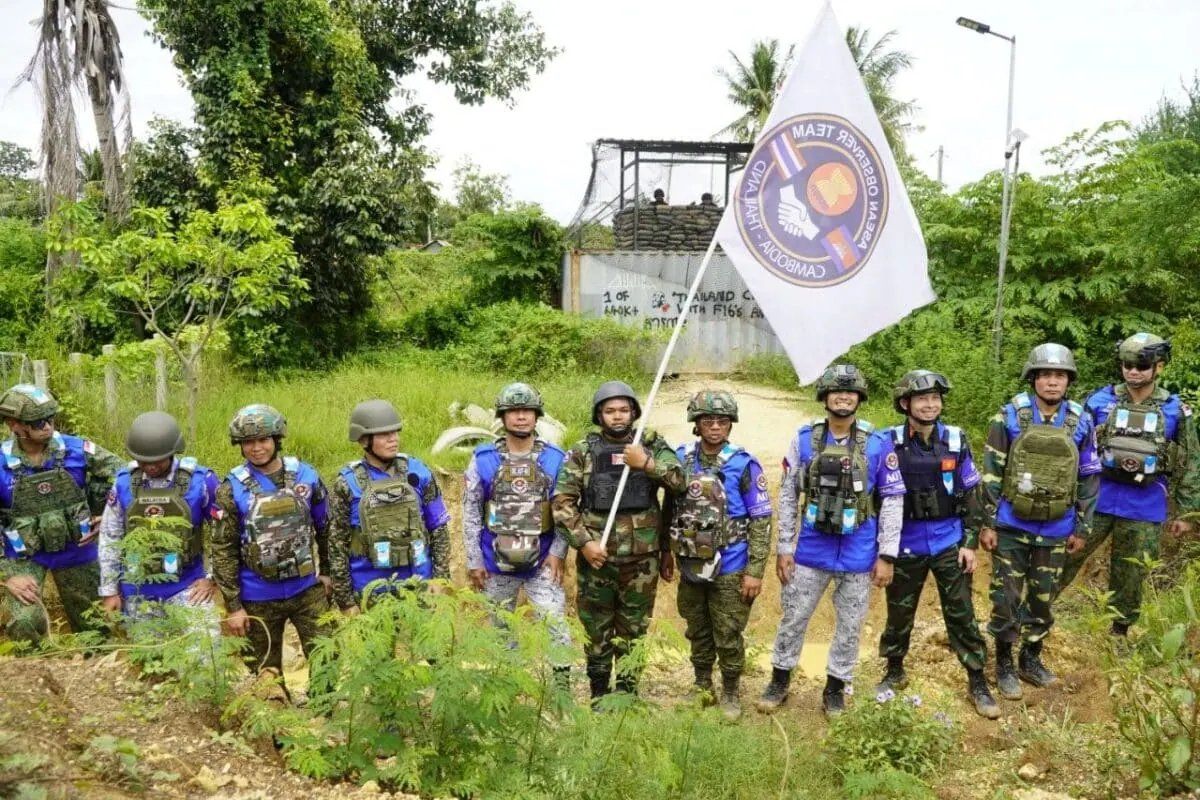
Pheaktra's strategic innovation lies in emphasising that the situation has fundamentally changed through international monitoring. He pointed to recent inspections by the Asean Observer Team in Cambodia, which is mandated to verify ceasefire compliance following the December 2021 conflict agreement. During visits to three locations in Banteay Meanchey province, the team documented 116 shipping containers placed across 24 different positions, which Cambodia says physically prevent approximately 13,259 civilians—including over 3,400 children—from returning to their homes. At Boeung Trakuon alone, observers verified 44 containers at 14 locations that Cambodia claims are blocking return of 7,873 people displaced from 1,869 families. The Asean presence, led by the Philippine head of mission, transforms what was previously a Cambodian assertion into an internationally documented fact.
Beyond regional monitoring mechanisms, Pheaktra cited observations from the UN Special Rapporteur on human rights in Cambodia, Tom Andrews, who visited affected border communities during a July mission. Andrews subsequently reported that approximately 650,000 Cambodians were displaced during the conflict, with more than 20,000 remaining unable to return to homes in areas he described as occupied by Thai security forces. His official observations and public statements calling for safe return of displaced persons add diplomatic weight and international human rights authority to Cambodia's narrative. For Pheaktra, the convergence of Asean monitoring, UN human rights documentation and bilateral diplomatic visits creates a third-party evidentiary record that cannot be dismissed as merely Phnom Penh's perspective.
However, the significance of these international observations must be contextualised within their actual mandates and limitations. The Asean Observer Team's role is restricted to verifying ceasefire conditions rather than determining sovereignty, while the UN rapporteur's mandate concerns human rights violations rather than territorial disputes. Critically, neither international presence has authority to adjudicate which country legally possesses disputed territory—a determination that remains formally reserved for the Joint Border Commission and settled through treaties, historical maps and boundary agreements. Pheaktra's invocation of third-party observers therefore operates in a carefully constructed grey zone, leveraging their credibility to establish that physical obstruction exists without overreaching into claims these bodies have ruled on sovereignty itself.
Cambodia's position rests fundamentally on historical and legal instruments. Pheaktra emphasised that the boundary must be determined through the Franco-Siamese treaties and conventions, historical cartographic records, the 2000 Cambodia-Thailand Border Memorandum of Understanding, the 2003 Terms of Reference for boundary demarcation, and ultimately through the Joint Border Commission process. This framework reflects Cambodia's preference for dispute resolution grounded in law and historical precedent rather than military deployments or physical possession. Thailand's counter-argument—that neither country can determine sovereignty through unilateral public declarations—is formally correct but somewhat tangential to Cambodia's actual complaint, which is not about declarations but about concrete infrastructure being installed in what Phnom Penh maintains is its territory.
The dispute fundamentally hinges on a clash of competing justifications for physical control. Thailand maintains it is protecting its own territory and personnel through security measures that are proportionate and necessary. Cambodia argues that regardless of Thailand's stated protective intentions, the installation of containers, razor wire, trenches and other barriers in areas Cambodia claims as sovereign constitutes de facto occupation and the creation of irreversible facts on the ground. Pheaktra crystallised this tension with memorable metaphors: shipping containers are not border markers, barbed wire is not a treaty, trenches are not boundary maps, and planting a flag is not a title deed. The rhetorical force of these statements lies not in legal argument but in the simple observation that physical infrastructure cannot substitute for legitimate territorial claim.
Linked to this territorial dimension is the humanitarian and ceasefire dimension. Cambodia invokes Point 4 of the December 27, 2021 ceasefire agreement, which stipulates that affected civilians shall be permitted to return to their homes on their respective sides without obstruction, in safety and dignity. The ongoing presence of containers and barriers preventing civilian return, Cambodia argues, constitutes a violation of this ceasefire provision and represents evidence that the post-conflict settlement remains incomplete. For Pheaktra, the ceasefire agreement cannot be permitted to become a permanent freeze on the status quo—a licence, in his words, to create new facts on the ground that then harden into de facto territorial control.
The role of international observers in this dispute carries particular significance for Southeast Asia and the broader rules-based international order. Cambodia's strategy of emphasising third-party documentation reflects a sophisticated understanding that international credibility, not military strength, ultimately determines the trajectory of border disputes in the region. By inviting Asean monitors, welcoming UN rapporteurs and highlighting diplomatic visits, Cambodia is implicitly appealing to international norms against unilateral territorial expansion and the creation of irreversible facts through military means. Thailand's counter-position, that it will continue protective measures regardless of Cambodian demands or international observation, suggests Bangkokintends to maintain its current posture regardless of external pressure.
For Malaysia and other regional states, the Cambodia-Thailand border dynamics illustrate persistent vulnerabilities in Asean's conflict-resolution mechanisms. While the observer team functions and international monitors operate, their observations do not automatically translate into binding dispute settlement. The Joint Border Commission, the formal mechanism for resolving the boundary, has struggled with slow progress on demarcation. The convergence of military infrastructure, displaced civilian populations, and unresolved territorial claims creates conditions for renewed instability, particularly if either government faces domestic pressure to demonstrate resolve on sovereignty issues. The reliance on third-party observation, while strategically valuable for Cambodia, ultimately cannot substitute for direct bilateral negotiation or formal commission processes that produce legally binding outcomes.
The ongoing standoff reflects deeper questions about how Southeast Asian states resolve territorial disputes in an era when military occupation is diplomatically costly but legal settlement remains slow and contentious. Cambodia's emphasis on third-party witnesses is an attempt to leverage international norms and diplomatic pressure when military force is unavailable. Thailand's insistence on continuing protective measures signals that Bangkok does not regard international observation as sufficient to alter its position. Unless both governments can move beyond competing narratives toward substantive engagement with the Joint Border Commission and the legal instruments that purportedly govern the boundary, the physical situation on the ground will likely persist as a chronic irritant in Asean affairs, one in which containers and observers become permanent fixtures of an unresolved frontier.

