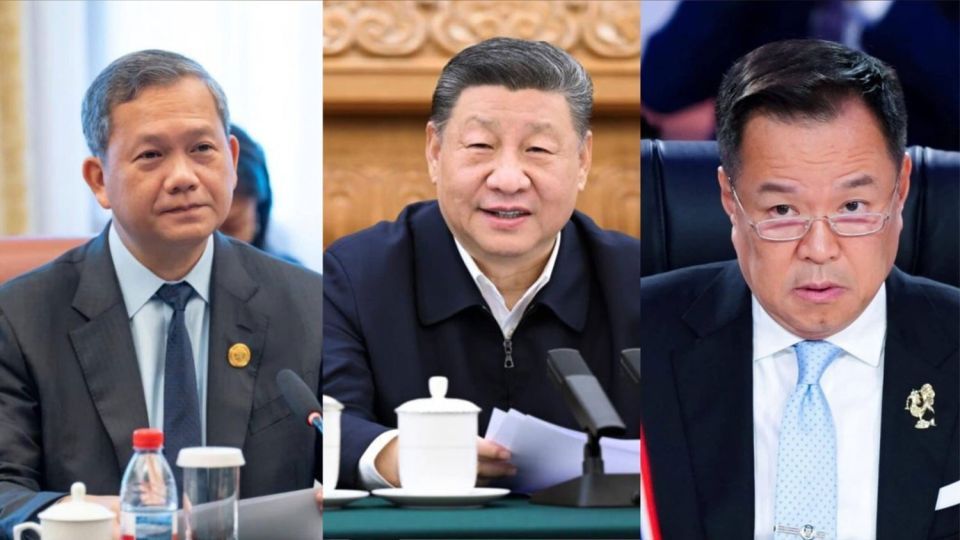
Cambodian Prime Minister Hun Manet and Thai Prime Minister Anutin Chanvirakul are set to convene in Shanghai next month for the opening of the World AI Conference 2026, following separate invitations from Chinese President Xi Jinping. The gathering on July 17 marks a significant diplomatic occasion, though observers are closely watching whether Beijing will attempt to broker progress on the two nations' long-standing territorial disagreements that have remained frozen since their last negotiation in December.
Mamet's delegation, travelling from July 15-17, will comprise a high-level contingent including Foreign Minister Prak Sokhonn, Defence Minister Tea Seiha, and Sun Chanthol, the first vice-chairman of the Council for the Development of Cambodia. Thailand's representation will similarly emphasize governmental seniority, with Foreign Minister Sihasak Phuangketkeow accompanying Anutin. Both premiers are scheduled for individual audiences with Xi and Premier Li Qiang, signalling the importance China places on bilateral engagement with each nation.
Cambodia's foreign ministry framed the visit as an opportunity to deepen the kingdom's relationship with Beijing, emphasizing the advancement of their Comprehensive Strategic Partnership and the Diamond Cooperation Framework. The statement referenced efforts to build an "all-weather Cambodia-China Community with a Shared Future," language that underscores Phnom Penh's commitment to leveraging the partnership as a cornerstone of its regional strategy. Thailand issued similarly warm rhetoric about strengthening its own China partnership, suggesting both governments view the Shanghai encounter primarily through an economic and strategic lens rather than as a venue for resolving bilateral tensions.
The Shanghai meeting follows a choreographed but unproductive encounter between Manet and Anutin at the ASEAN Future Forum in Hanoi during early June. While photographers captured the two leaders shaking hands, the photograph served largely ceremonial purposes, with substantive discussions on their border dispute notably absent. This pattern of superficial engagement reflects the complexity underlying Cambodia-Thailand relations, where symbolic gestures obscure deeper institutional and structural obstacles to progress.
International observers increasingly view China's economic weight and diplomatic influence as potentially crucial to unlocking negotiations. As the principal trading partner for both Cambodia and Thailand, Beijing possesses leverage that few other external actors can match. However, the effectiveness of Chinese mediation hinges on whether Beijing is willing to exert this influence and whether both nations genuinely desire resolution, questions that remain open.
According to Kin Phea, director of the Royal Academy of Cambodia's International Relations Institute, Thailand's internal power dynamics present the most formidable obstacle to progress. Phea contends that while Thailand's civilian government has signalled willingness to negotiate, the Thai military establishment has failed to implement agreed commitments and continues to conduct unilateral actions within Cambodian territory. This disconnect between civilian diplomatic intentions and military implementation reflects broader governance challenges in Bangkok, where the armed forces retain considerable autonomy in security matters regardless of civilian leadership preferences.
"The Thai military has not implemented the measures that their civilian government agreed with their Cambodian counterparts," Phea explained, identifying a structural impediment that mere dialogue cannot overcome. He argued that military actors in Thailand "allow the military to arbitrarily carry out their actions, including encroaching on Cambodian sovereign territory," suggesting that constraining military behaviour requires institutional reforms beyond the scope of bilateral diplomacy alone.
Phea called upon China to assume a more forceful mediation role, positioning Beijing as an arbiter capable of enforcing compliance with the Fuxian Consensus reached in December 2025 through Chinese-brokered discussions. Under this framework, both nations ostensibly committed to resolving their differences through peaceful, legally-grounded diplomatic channels. Phea advocated for China to leverage its position to compel Thailand to "withdraw their troops from occupied areas, return to the negotiating table, and work with the Joint Boundary Commission without further delay." Such demands implicitly acknowledge that voluntary compliance has proven insufficient.
The human cost of prolonged border tensions remains substantial. Approximately 20,000 Cambodian civilians remain displaced from their homes in areas under Thai occupation, representing a humanitarian dimension often eclipsed by diplomatic language and strategic calculations. These communities exist in a state of indefinite limbo, unable to access property or rebuild lives while their governments engage in measured exchanges that yield minimal tangible progress.
For Malaysia and Southeast Asian nations more broadly, the Cambodia-Thailand border situation carries strategic implications beyond bilateral concerns. Unresolved territorial disputes within the region create uncertainty and consume diplomatic energy that might otherwise address collective challenges including climate adaptation, economic integration, and responses to external great-power competition. The Shanghai conference presents an opportunity for China to demonstrate whether it genuinely seeks stability throughout Southeast Asia or whether it prefers maintaining low-level tensions that perpetuate dependency relationships among regional partners.
The architecture of the Shanghai gathering itself—framed around artificial intelligence conference participation rather than explicit border negotiations—reflects diplomatic caution from all parties. Neither Cambodia nor Thailand appears eager to allow border issues to dominate a high-profile international occasion, preferring instead to compartmentalize discussions. Yet this compartmentalization arguably perpetuates the stalemate, allowing substantive disagreements to persist beneath layers of ceremonial engagement and partnership rhetoric that characterize contemporary Southeast Asian diplomacy.

