Twelve American states, led by California, have escalated their challenge to one of the entertainment industry's most ambitious consolidation efforts, filing a federal lawsuit in Oakland to block Paramount's proposed acquisition of Warner Bros Discovery for approximately $110 billion. The legal action, initiated by Democratic attorneys general from across the country, directly confronts CEO David Ellison's strategy to reshape Paramount into a formidable competitor against streaming giants Netflix and Disney. The lawsuit signals that opposition to the merger persists despite federal regulatory approval granted by the US Department of Justice last month, threatening to impose significant delays and financial costs on the deal's progression.
The core argument advanced by the states rests on market concentration fears and consumer protection grounds. According to their court filing, the combined entity would command extraordinary control over American entertainment distribution, capturing more than 27 percent of the theatrical film distribution market, 30 percent of blockbuster film releases, and 27 percent of basic cable programming. The states contend that for every dollar generated through wide-release theatrical releases and basic cable channels nationwide, the merged company would retain more than twenty-five cents, a proportion the attorneys general characterize as the emergence of a "media behemoth." This level of market dominance, they argue, would enable the company to manipulate pricing structures favoring itself while disadvantaging theatrical chains and cable television distributors, ultimately burdening ordinary consumers with elevated entertainment costs.
Paramount has contested these allegations as misapplications of settled antitrust doctrine, maintaining that the merger would actually expand its content production capacity. The company projects that consolidating redundant operations—eliminating $6 billion in overlapping infrastructure, marketing expenditures, and corporate overhead—would paradoxically increase rather than diminish film output. CEO David Ellison has publicly committed to releasing approximately 30 films annually from the combined studio operations, framing the acquisition not as a mechanism for market extraction but as a necessary strategic repositioning. However, the states remain unconvinced, arguing that such production commitments lack enforceability and that even sustained output promises would not prevent the newly consolidated entity from raising prices and degrading content quality once it achieves dominant market positioning.
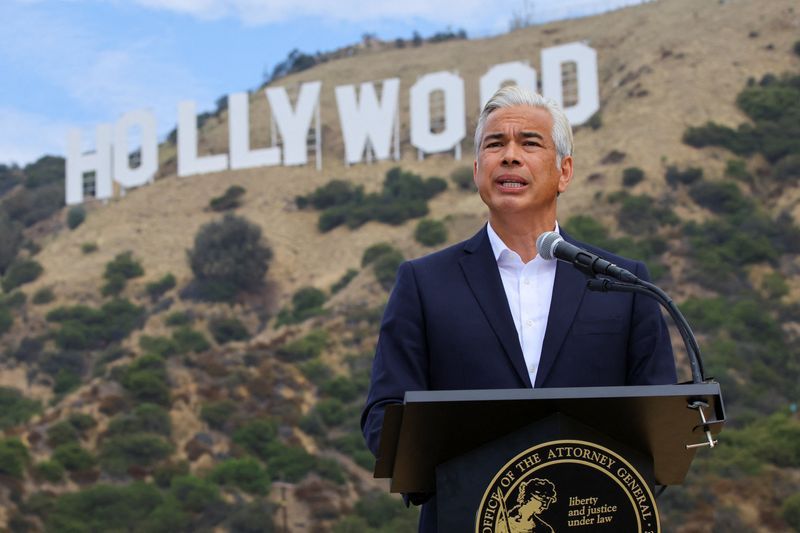
The political dimensions of this antitrust challenge deserve scrutiny, as they illuminate shifting patterns in American regulatory enforcement. All twelve state attorneys general involved in Monday's lawsuit identify as Democrats, while critics of the merger have suggested that Paramount's federal approval reflects political favoritism rather than rigorous competitive analysis. They point specifically to the Ellison family's Republican connections—billionaire Oracle co-founder Larry Ellison, David's father, has cultivated prominent relationships with President Donald Trump—as having potentially facilitated the Justice Department's clearance. California Attorney General Rob Bonta explicitly framed the states' legal action as a counterweight to what he characterizes as the Trump administration's permissiveness toward corporate consolidation, highlighting other major antitrust settlements he views as inadequate. This positioning demonstrates how antitrust enforcement has become increasingly intertwined with partisan politics, as Democratic officials weaponize merger challenges to address frustration over corporate concentration and rising consumer costs.
Notably, the lawsuit reflects a curious partisan fragmentation within the attorney general community, as several Republican state officials have conspicuously declined to join what Bonta described as a bipartisan effort. Republicans had previously cooperated with California's office on antitrust matters involving concert promoter Live Nation and broadcaster Nexstar's acquisition of Tegna, yet remained absent from this entertainment consolidation challenge. Bonta expressed public disappointment at their non-participation, noting that the legal window remained open for additional state involvement. This selective engagement underscores how antitrust has become a contested political territory where partisan calculations sometimes override traditional bipartisan commitments to competition enforcement, a dynamic particularly evident given Republican administration connections to the Ellison family.
The merger's implications extend throughout entertainment industry ecosystems, affecting distinct stakeholder groups with divergent concerns. Hollywood creative workers—writers, actors, and production crews—have vocally opposed the transaction, fearing accelerated workforce reduction as the combined entity eliminates positions to realize promised cost savings. Theater owners have articulated parallel anxieties, worried that reduced competition between Paramount and Warner Bros for premium release dates and screen allocations would diminish theatrical film volume and consequently visitor traffic. Television cable operators and their subscribers face separate competitive concerns, as the two companies presently vie for favorable placement of channels including CNN, MTV, HGTV, Cartoon Network, and Nickelodeon. The states contend that consolidating these competitive relationships would grant the merged enterprise extraordinary leverage to demand higher carriage fees from distributors, costs ultimately transmitted to subscribers through elevated cable bills.
The financial implications of prolonged legal proceedings represent perhaps the most immediate pressure on Paramount's deal timeline. The company has committed to paying Warner Bros Discovery shareholders approximately $650 million quarterly in break-up fees should the transaction fail to close before October, creating powerful incentives for rapid resolution. Simultaneously, protracted litigation could force Paramount to renegotiate the deal's debt financing structure, introduce uncertainty affecting the company's stock valuation, or ultimately render the entire transaction economically unviable. Historical precedent suggests cause for concern: Reuters' analysis of recent federal merger litigation reveals that judges typically require approximately eight months to issue determinations on consolidation challenges. Should the Oakland court follow similar timelines, the deal's financing provisions and strategic assumptions could deteriorate substantially, potentially triggering renegotiation or abandonment entirely. Paradoxically, the market initially responded positively to the lawsuit's filing, with Paramount shares advancing 2.9 percent and Warner Bros Discovery shares rising 2.6 percent, possibly reflecting investor relief that regulatory uncertainty was being transparently addressed through transparent judicial processes rather than lingering in indefinite limbo.
The lawsuit's trajectory carries significance extending beyond Paramount and Warner Bros Discovery, establishing precedent for how Democratic-controlled state regulatory apparatus intends to exercise antitrust enforcement authority during Republican federal administration. Paolo Pescatore, analyst at PP Foresight, characterized the litigation as "arguably the most credible threat yet to Paramount's acquisition," signaling that state-level legal intervention possesses sufficient substantive merit to impose genuine consequences on corporate consolidation strategies. Even if Paramount ultimately prevails in litigation, the analyst noted, the accumulated costs—financial, operational, and strategic—would substantially undermine the transaction's intended benefits. This dynamic creates powerful incentives for either negotiated settlement or regulatory compromise, wherein Paramount might accept structural remedies such as divestiture of overlapping assets or enforceable limitations on pricing behavior in exchange for judicial clearance.
For Malaysian and Southeast Asian observers, this dispute illuminates broader global trends toward more aggressive antitrust enforcement and the increasingly politicized nature of merger review processes. Regional governments and companies monitoring international regulatory patterns should recognize that entertainment sector consolidation remains contested terrain, with state-level authorities prepared to challenge federal agency determinations through litigation. The case also demonstrates how entertainment market structure—particularly control over premium content distribution and theatrical release scheduling—translates into tangible pricing power affecting consumers across markets. As streaming services and content conglomerates expand globally, including throughout Southeast Asia, similar competitive concerns regarding market concentration and pricing manipulation may surface in regional regulatory forums, potentially constraining consolidation strategies that assume relatively frictionless merger approval.

