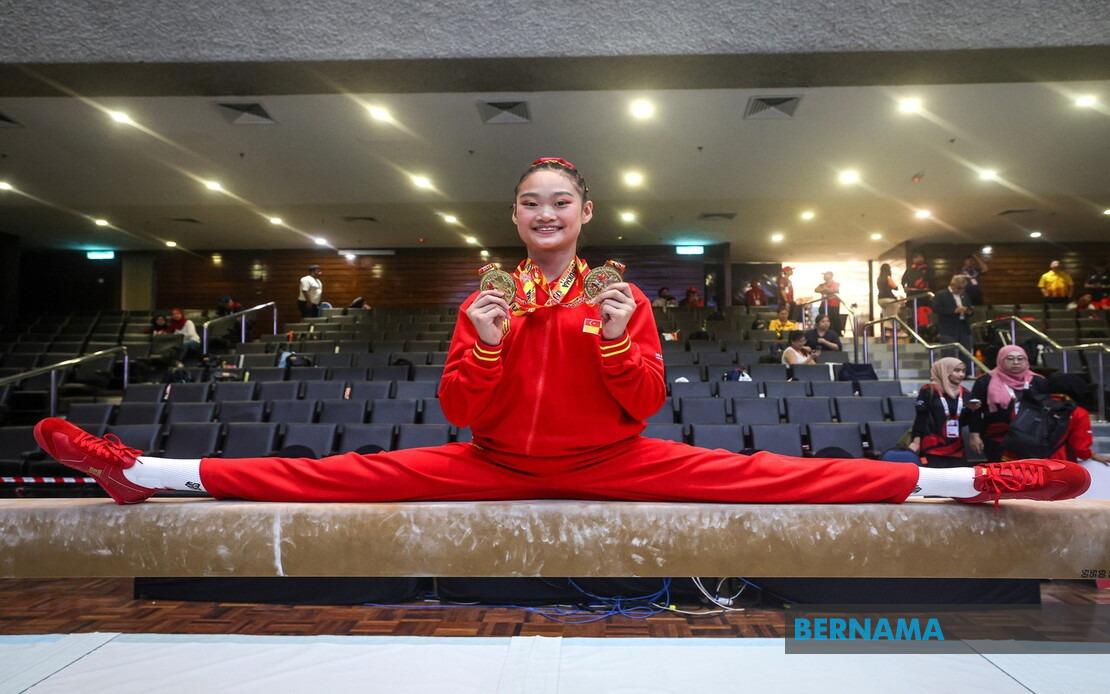
Selangor's rising gymnastics star Cadence Teh Zi Qi cemented her position as the nation's premier all-around gymnast by capturing a double gold haul at the Malaysia Games (SUKMA) 2026 held at Dewan Canselor Tun Abdul Razak (DECTAR) on the Universiti Kebangsaan Malaysia campus in Bangi. The 17-year-old successfully defended her women's individual all-around crown while simultaneously propelling her state to victory in the team event, showcasing the depth of Selangor's gymnastics programme and establishing herself as a formidable prospect for international competition.
Cadence's all-around victory came with an aggregate score of 48.550 points, demonstrating her well-rounded technical proficiency across all four apparatus. Her performance breakdown revealed particular strengths on balance beam, where she accumulated 13.350 points, and vault with 12.050 points, whilst her floor exercise garnered 11.750 points and uneven bars contribution was 11.400 points. The scoring pattern suggests a gymnast with genuine versatility rather than reliance on a single discipline, a quality essential for success at higher levels of international competition where consistency across all events separates champions from competitors.
The podium finishes reflected the competitive landscape of Malaysian women's artistic gymnastics. Sarawak's Aurin Zulkarnain secured the silver medal position with 44.500 points, a significant gap that underscored Cadence's dominance. The bronze medal was shared between Federal Territories' Annabelle Ho Syin Yee and Penang's Amanda Ching Lee Wern, both finishing at 42.250 points. The substantial point differential between first and second place indicates that Cadence operates at a noticeably elevated technical and execution level compared to her peers, a distinction that could prove decisive should she pursue opportunities in regional and world championships.
Beyond her individual accolades, Cadence was instrumental in Selangor's comprehensive team triumph. Alongside teammates Nicole Wong Ziyi, Airisha Zuraidi, Wong Zi Qi, Leong Yee Shean and Haifa Izzazi Mohd Faizul, she propelled the state to the women's team gold with a combined score of 169.300 points. This victory underscores Selangor's investment in developing competitive depth across multiple gymnasts rather than relying on a single star performer. Federal Territories finished as runners-up with 166.300 points, whilst Johor claimed the bronze medal position with 157.000 points, establishing a clear hierarchy in the sport's domestic competitive structure.
Despite her commanding final result, Cadence's journey through the all-around competition was not without adversity, providing insight into the mental and technical demands of artistic gymnastics at the elite level. The opening apparatus, uneven bars, presented unexpected challenges when she fell during her routine, an occurrence that immediately threatened momentum and psychological confidence early in competition. Her candid post-competition reflection revealed the technical struggles that precipitated the fall, specifically noting that nervousness undermined her body awareness and proprioceptive control on that particular apparatus.
Cadence's recovery strategy and resilience became evident in her subsequent performances. The balance beam apparatus, contested after the bars mishap, yielded markedly improved results, suggesting she successfully regrouped mentally and executed with greater precision and stability. Her floor exercise performance met her pre-competition expectations without significant deviation, whilst her vault routine reflected a calculated strategic decision rather than technical limitation. She deliberately reduced the difficulty rating to a Tsukahara pike, a choice that prioritised secure execution and point accumulation over attempting more challenging variants that carried heightened risk of deduction or failure.
Looking toward her remaining competitive obligations, Cadence identified specific developmental priorities that align with the trajectory of elite gymnastics careers. She has intentionally elevated the difficulty level of her balance beam routine to the specifications she is preparing for the 2026 Asian Games, a major international competition that will position her against regional powerhouses from China, Japan, and other gymnastics-advanced nations. This strategic progression in difficulty suggests she and her coaching staff are plotting a pathway toward international competitiveness rather than remaining content with domestic dominance.
Beyond technical advancement, Cadence articulated the importance of enhanced emotional regulation and concentration maintenance as critical areas requiring continued work. In the high-pressure environment of elite gymnastics competition, where microsecond timing and millimetre precision separate successful execution from costly deductions, the psychological dimensions of performance prove equally consequential as physical capability. Her acknowledgment of nervousness management reflects a mature understanding that sustained success requires integration of mental skills alongside physical conditioning and technical refinement.
Cadence's schedule at SUKMA 2026 extends beyond the all-around competition, with apparatus finals scheduled for the following two days. She is slated to compete in uneven bars, balance beam, and floor exercise apparatus-specific finals, occasions where gymnasts typically perform enhanced routines with increased difficulty targeting apparatus-specific prizes. These finals represent additional opportunities to strengthen her medal portfolio and potentially establish national records or benchmarks that could inform future international selections and competitions.
The significance of Cadence's performances at SUKMA 2026 extends beyond individual accolades for Selangor. Her dominance and competitive readiness at such a young age signal that Malaysian gymnastics possesses emerging talent capable of representing the nation credibly on continental and potentially global platforms. The depth demonstrated by Selangor's team victory suggests institutional capacity to develop multiple competitive gymnasts simultaneously, a structural strength that historically correlates with sustained international success in sports dependent on high technical training demands and extended development timelines.
Cadence's trajectory also carries implications for Malaysian sports development more broadly. Her success at 17 years old indicates that systematic talent identification and specialised coaching can produce world-class performers in technically demanding disciplines. As Southeast Asian nations compete for continental athletic supremacy, particularly heading toward the 2026 Asian Games that will showcase regional capabilities, gymnasts like Cadence represent tangible evidence of Malaysia's capacity to compete effectively in technical sports alongside the dominant players in regional competition.

