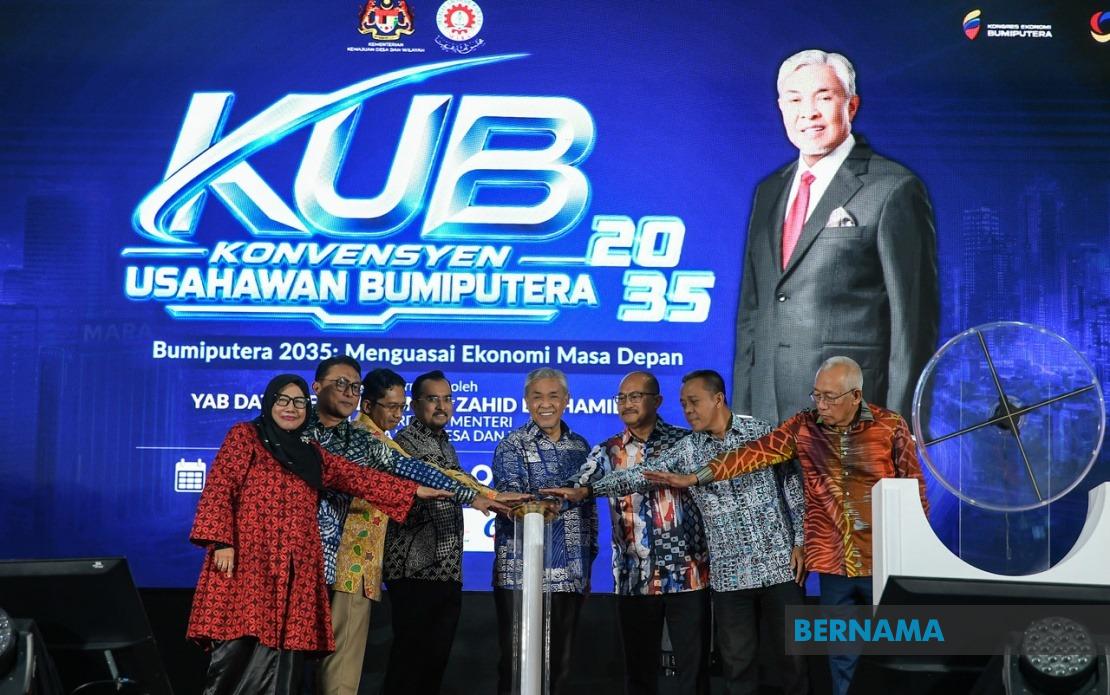
Deputy Prime Minister Datuk Seri Dr Ahmad Zahid Hamidi has called for a fundamental shift in how Bumiputera entrepreneurs operate within Malaysia's economy, arguing that the time has come to move beyond passive participation toward active ownership and meaningful control of key business sectors. Speaking at the closing ceremony of the Bumiputera Entrepreneurs Convention (KUB) 2035 Declaration in Alor Setar, Ahmad Zahid articulated a vision where Bumiputera business owners not only participate in economic value chains but actively shape them, establishing stronger competitive footing and greater influence over their respective industries.
The Deputy Prime Minister, who also holds the Rural and Regional Development portfolio, emphasized that while government support mechanisms will continue to facilitate growth opportunities, the onus ultimately rests on entrepreneurs themselves to demonstrate the boldness required to expand operations, engage in meaningful competition, and generate substantive value. This statement reflects a recognition within policymaking circles that decades of affirmative action and targeted assistance have created a foundation of participation, yet have not consistently translated into the deeper structural control that true economic empowerment demands. Ahmad Zahid's framing suggests a strategic inflection point in how the government conceptualizes its role in supporting this community.
The government has spent considerable time and resources establishing frameworks that allow Bumiputera entrepreneurs to enter various economic sectors and participate in supply chains and distribution networks. However, Ahmad Zahid's remarks indicate dissatisfaction with the current plateau, where participation without ownership risks remaining merely derivative of larger economic structures controlled by others. His call to "build ownership, scale up and create greater control" signals an intention to move beyond what critics argue has been an insufficient legacy of passive participation, toward a model where Bumiputera business owners hold meaningful stakes and decision-making authority within their industries.
To achieve this transition, Ahmad Zahid outlined three critical transformations the Bumiputera entrepreneurship ecosystem must undergo between now and 2035. The first pillar involves integrating the currently fragmented support infrastructure, which operates through disparate channels for financing, skills development, and market access. This fragmentation has historically meant that entrepreneurs must navigate multiple agencies, systems, and bureaucratic pathways to access different forms of support, creating inefficiencies and friction that drain resources and momentum. By consolidating these support mechanisms into a more cohesive framework, the government aims to reduce transaction costs and enable entrepreneurs to operate within a more streamlined, responsive environment.
The second major shift requires transitioning from an approach focused simply on producing entrepreneurs toward one that emphasizes growing and developing existing entrepreneurs. This distinction carries important implications for how resources are allocated and measured. Rather than treating entrepreneurship as a binary state—one either is or is not an entrepreneur—this approach recognizes that entrepreneurs operate along a spectrum, with different stages requiring different types of support. Emerging entrepreneurs need different assistance than those operating established enterprises seeking to expand regionally or internationally. This maturation of the support framework acknowledges that sustainable economic transformation requires nurturing businesses through multiple growth phases rather than celebrating entry into entrepreneurship as the primary objective.
The third component of this strategic realignment involves ensuring that national economic growth demonstrably strengthens local Bumiputera companies rather than inadvertently benefiting competitors or external interests. This addresses a persistent tension in Malaysian development policy: the question of whether pro-Bumiputera measures genuinely result in robust, self-sustaining enterprises or instead create artificial advantages that evaporate when protective frameworks are removed. Ahmad Zahid's emphasis on linking economic growth to local company strengthening suggests an effort to make the relationship between national development and Bumiputera business success more direct and measurable.
The fragmentation Ahmad Zahid identified reflects a systemic challenge that has long hindered the effectiveness of Malaysia's entrepreneurship ecosystem. Government agencies, financial institutions, and training providers operate according to different mandates, performance metrics, and timelines, creating gaps that entrepreneurs must often navigate without adequate guidance. A business owner seeking to scale operations might secure financing from one source while accessing training through another and market connections through a third, with little coordination between these support providers. This fragmentation imposes hidden costs through time spent navigating bureaucracy, missed opportunities for synergies, and suboptimal business decisions made in information silos.
The convention and its 2035 declaration represent an attempt to codify strategic direction at a critical juncture in Malaysia's economic development. As the country grapples with middle-income challenges and faces increasing regional competition from other Southeast Asian economies, policymakers recognize that Bumiputera economic empowerment—if structured effectively—could unlock significant growth potential. However, this requires moving beyond comfortable patterns established over decades and embracing more ambitious, performance-oriented frameworks that emphasize genuine control and scale rather than symbolic participation.
For Malaysia's broader economic strategy, Ahmad Zahid's pronouncements signal that policymakers are beginning to acknowledge that perpetuating participation without ownership may have reached diminishing returns. The 2035 timeframe suggests recognition that significant structural change requires sustained effort over more than a decade. This extended horizon provides opportunity for comprehensive ecosystem redesign but also suggests recognition that overnight transformation remains unrealistic. The emphasis on integration, developer nurturing, and linkage to national growth outcomes points toward a more sophisticated approach to affirmative action, one that moves beyond simple quota systems or reserved allocations toward systemic capability building and competitive positioning.

