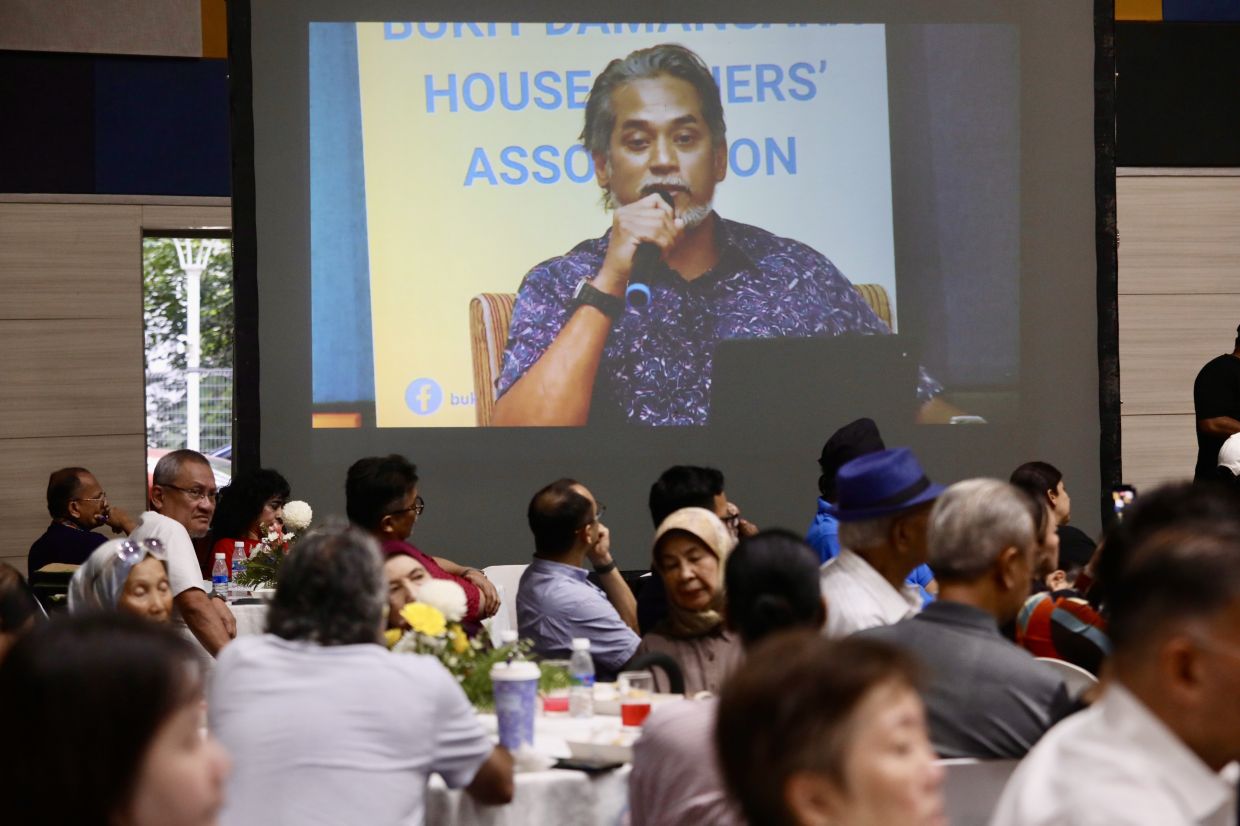
Roughly 400 residents of Bukit Damansara gathered at a community dialogue session to pressure Kuala Lumpur City Hall into cancelling a construction permit for a residential expansion project that has already generated significant neighbourhood friction. The town hall, held at Pusat Komuniti Bukit Damansara under the banner "Your Voice Matters", marked the inaugural engagement by newly elected Bukit Damansara Home Owners' Association president Khairy Jamaluddin, who took office in early August.
Central to residents' grievances is a semi-detached house undergoing transformation from a two-storey structure into a three-storey residence. City Hall approved the construction scheme in December 2025, though a stop-work order was subsequently issued in January 2026 after community pushback. However, just two months prior to the town hall, the municipal authority reversed course and granted the project fresh approval. Construction has advanced to approximately ten percent completion, with structural pillars now visible on site.
Resident A. Zakki, speaking on behalf of concerned neighbours, emphasised that the renovation fundamentally breaches the architectural harmony that defines the street. The uniform double-storey design of homes in that row forms part of Bukit Damansara's established character, he explained, and the addition of a third floor creates a visual and structural anomaly. More troublingly, Zakki noted that construction activities have already induced cracks in adjoining properties, a physical reminder of the works' disruptive impact on neighbouring residents.
The scale of opposition became apparent when Zakki revealed that a petition bearing signatures from nineteen neighbours demonstrates substantial resistance to the project. Yet despite this documented community sentiment, residents were not meaningfully consulted before the permits were granted or reissued. This disconnect between neighbourhood views and municipal decision-making highlighted the central complaint: that Kuala Lumpur City Hall proceeded without adequately engaging the affected community, a procedural shortcoming that has eroded trust in the approval process.
Khairy moderated the three-hour dialogue, which featured appearances by Rosli Nordin, the Planning Department's town planner executive director, and Brickfields deputy police chief Supt Ahmad Firdaus Mustafia Kamal, both present to address concerns and propose remedies. Rosli pledged that City Hall would take cognisance of the challenges residents face as construction continues, though he stopped short of committing to permit withdrawal—a central demand from the audience.
Beyond the headline issue, the town hall surfaced traffic complications affecting the Bukit Damansara precinct, particularly during peak school hours. Between 7 and 7.30 in the morning and again from 2 to 4 in the afternoon, congestion clusters around SK Bukit Damansara and Stella Maris International School Damansara. Supt Ahmad Firdaus indicated that police would address these concerns according to standard protocols, though specifics remained vague. SK Bukit Damansara's Parent-Teacher Association chairman, Ameirul Azraie Mustadza, acknowledged the school's repeated advisories against double-parking and disclosed that the association had contemplated engaging Rela, a volunteer civil defence corps, to manage traffic flow. Budget constraints forestalled that initiative, prompting the school to escalate requests for consistent police presence rather than sporadic enforcement.
Water infrastructure emerged as another persistent grievance. Residents pressed Air Selangor, the state water authority, to execute comprehensive inspections of the pipeline network serving Bukit Damansara after multiple burst incidents destabilised supply and caused localized flooding. An Air Selangor representative acknowledged the company's awareness of recurring failures and outlined intentions to systematically replace ageing pipes throughout the neighbourhood—a project that would require substantial capital expenditure and months of coordination.
The town hall represents a notable shift in how municipal governance is conducted at the neighbourhood level. Khairy characterised the exercise as a bridge between residents and decision-makers, designed to translate grassroots concerns into actionable steps. He pledged to follow up on the issues raised, leveraging his position to expedite problem resolution. For many attending, this direct access to both community leadership and municipal bureaucrats offered a rare opportunity to air frustrations and demand accountability.
The Bukit Damansara episode reflects broader tensions in Malaysian urban planning, where rapid development and individual property rights frequently clash with community preferences and established neighbourhood character. The semi-detached renovation dispute exemplifies how municipal authorities sometimes prioritise individual owner prerogatives over collective aesthetic and structural integrity concerns. The reversal of the stop-work order—itself a telling reversal of administrative judgment—suggests either internal inconsistency within City Hall or pressure from the property owner that overrode initial caution.
For residents, the impasse underscores the limited mechanisms available for meaningful community participation in land-use decisions. Petitions and town halls function as pressure valves, enabling frustration to be voiced but not necessarily translated into policy changes. Unless Kuala Lumpur City Hall demonstrates willingness to revoke the permit or impose stricter conditions—such as architectural modifications to reduce visual disruption—the dialogue may ultimately prove performative rather than substantive.
The outcome of this case will likely influence how other residential neighbourhoods in the Klang Valley approach similar disputes. If residents succeed in forcing a permit withdrawal or significant redesign, it could embolden other communities to challenge developments perceived as incompatible with local character. Conversely, if City Hall maintains its approval, it signals that neighbourhood consensus carries limited weight against approved development plans, a message unlikely to bolster public confidence in municipal consultation processes.

