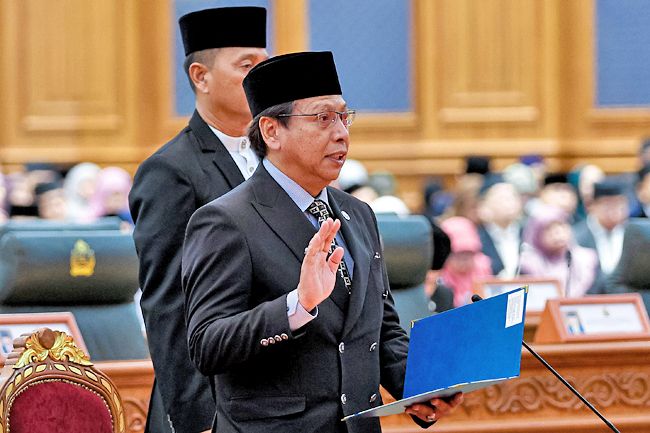
Brunei's governmental machinery underwent a routine but constitutionally significant refresh when four Cabinet ministers took their oaths before the Legislative Council on Monday, marking the opening day of the Second Meeting of the 22nd Legislative Council Session in Bandar Seri Begawan. The ceremony, overseen by LegCo Speaker Pehin Orang Kaya Seri Lela Datuk Seri Setia Awang Abdul Rahman Datuk Setia Mohamed Taib, proceeded according to provisions established in the 1959 Brunei Constitution governing the appointment of ex-officio members to the chamber.
The four individuals entering the Legislative Council represent some of the sultanate's most consequential administrative domains. Datuk Seri Setia Awang Sufian Sabtu assumes the position of Minister at The Prime Minister's Office (Security and Law), a role that places him at the intersection of national security policy and legal governance. His appointment reflects the ongoing centralisation of security matters under the Prime Minister's purview, a structural arrangement common across Southeast Asia that consolidates sensitive defence and law enforcement coordination within a single executive office.
Alongside him, Datuk Seri Setia Awang Mohamad Azmi Mohd Hanifah took the ministerial oath for the portfolio covering Energy, Upstream and Downstream operations. This appointment carries particular weight for a nation whose economic fortunes remain substantially dependent on petroleum and natural gas revenues. The distinction between upstream and downstream operations—from extraction to refining and distribution—signals official recognition of the entire value chain's strategic importance to Brunei's continued prosperity and fiscal stability.
The Religious Affairs portfolio passed to Pengiran Datuk Seri Setia Mohammad Tashim Pengiran Hassan, underscoring Islam's institutional position within Brunei's governance framework. As an Islamic absolute monarchy, Brunei allocates considerable constitutional and administrative resources to religious administration, making this ministry a key instrument through which the state maintains spiritual legitimacy and social cohesion among its predominantly Muslim population. The appointment of a royal family member to this sensitive position further emphasises its centrality to the nation's identity and governance philosophy.
Rounding out the quartet, Datuk Seri Setia Awang Mohammed Riza Datuk Paduka Mohammed Yunos stepped into the Transport and InfoCommunications ministry, a portfolio encompassing two increasingly intertwined domains. Contemporary transport policy across the region increasingly depends on digital infrastructure, data management systems, and telecommunications networks. By consolidating these responsibilities, Brunei signals an integrated approach to mobility and connectivity—recognising that modern logistics, from port operations to aviation and digital commerce, demands seamless coordination between physical and information systems.
The Legislative Council itself remains a hybrid institution within Brunei's political architecture. While possessing consultative and deliberative functions, it operates within the parameters of the sultanate's absolute monarchy system established under the 1959 Constitution. The chamber comprises appointed ex-officio members—including Cabinet ministers like those sworn in Monday—alongside other appointed representatives. This structure distinguishes Brunei from more democratic parliamentary systems, yet the Legislative Council fulfils important functions in policy review, legislative scrutiny, and providing an official forum for state deliberation.
The timing of these appointments and their formal integration into the Legislative Council reflects Brunei's commitment to constitutional procedure and orderly administration. By moving swiftly to seat new ministers at the opening of a fresh legislative session, the government ensures continuity in representation and maintains the institutional rhythm that characterises functioning governance. For Malaysian observers, this ceremonial precision may echo familiar patterns, given the shared constitutional inheritance across Southeast Asia and the protocols often observed in Westminster-influenced systems.
These ministerial appointments arrive amid ongoing efforts across Southeast Asia to recalibrate governance structures in response to contemporary challenges. Energy security, particularly for nations dependent on hydrocarbon revenues, remains a critical concern as global markets shift. Meanwhile, transport and communications infrastructure investments have become essential competitive factors in regional economic positioning. Security and law administration continue attracting high-level attention as nations navigate transnational challenges ranging from maritime concerns to cybersecurity.
For Brunei specifically, the emphasis on these four portfolios reflects both continuity and strategic adjustment. The sultanate's leadership appears committed to maintaining rigorous institutional frameworks while addressing modern governance demands. The presence of all four new ministers within the Legislative Council formalises their role in the chamber's deliberations, though their executive authority remains anchored within the Prime Minister's Office structure or their respective ministries. This arrangement preserves both the symbolism and practical function of cabinet participation in legislative processes.
Regionally, observers monitoring Southeast Asian governance structures will likely note Brunei's steady institutional course. While the sultanate maintains its distinct political system compared to its neighbours' more pluralistic arrangements, its commitment to constitutional procedure and formal governmental processes demonstrates continuity in administrative practice. The swearing-in ceremony, while routine, reinforces the institutional legitimacy upon which all governance—whether autocratic, democratic, or hybrid—ultimately depends.

