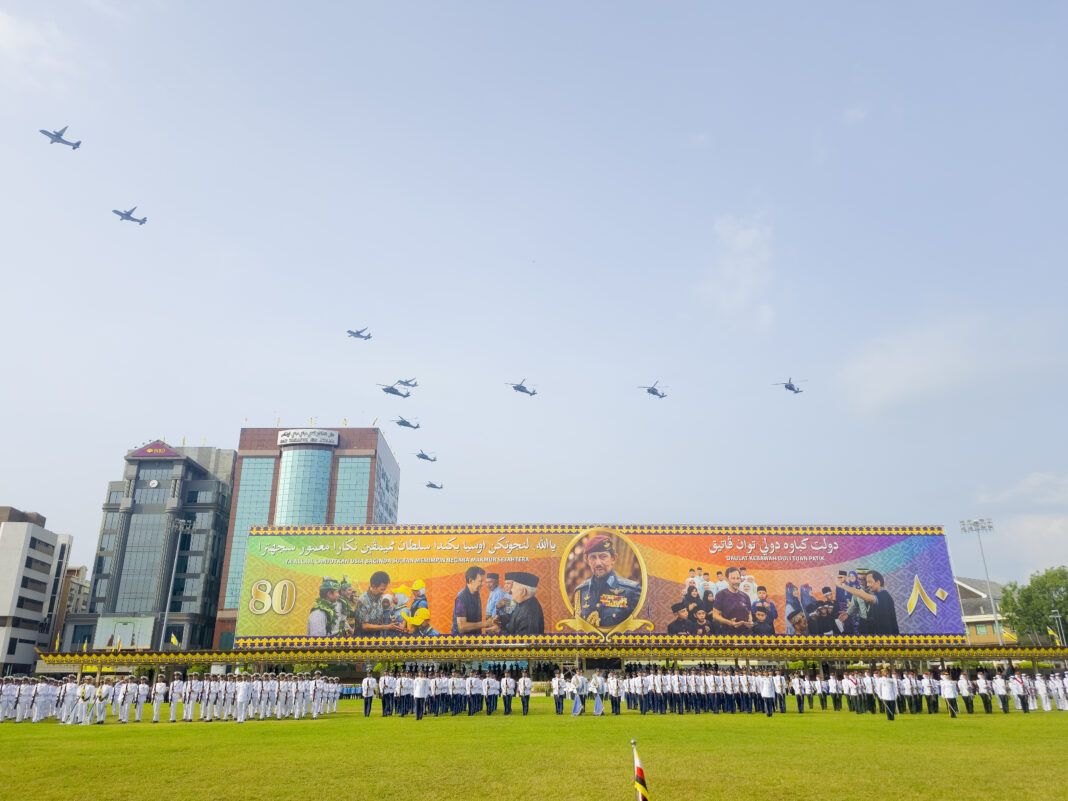
Brunei's preparations for one of its most significant state occasions are now in the final stretch, with organisers successfully conducting a comprehensive dress rehearsal for the ceremonial guard of honour parade that will mark His Majesty Sultan Hassanal Bolkiah, Sultan and Yang Di-Pertuan of Brunei Darussalam's milestone 80th birthday celebration. The full-scale run-through took place on Saturday, July 11, at Taman Haji Sir Muda Omar 'Ali Saifuddien in Bandar Seri Begawan, bringing together the kingdom's highest-ranking officials and ceremony coordinators to ensure every detail aligns with the grandeur expected of such a royal occasion.
The gathering reflected the exceptional significance attached to this birthday milestone for the 80-year-old sovereign, who has presided over Brunei since 1967. The presence of the Chief of Adat Istiadat Negara Yang Amat Mulia Pengiran Indera Setia Diraja Sahibul Karib Pengiran Anak Idris Pengiran Maharaja Lela Pengiran Muda Abdul Kahar underscored the ceremonial and constitutional importance of the event. As co-adviser for the National Committee orchestrating the 2026 celebrations, this senior official's involvement guarantees that the parade adheres to the most exacting standards of royal protocol and traditional Brunei ceremonial conventions.
The scale of government commitment to executing a flawless celebration was evident from the roster of senior ministers who attended the rehearsal. Datuk Seri Setia Awang Ahmaddin Abdul Rahman, Coordinating Minister for Social Policies and Manpower and Minister of Home Affairs, brought oversight of the domestic arrangements and social framework. Pehin Datu Lailaraja Major General (Rtd) Datuk Paduka Seri Awang Halbi Mohd Yussof, serving as Coordinating Minister for National Security, Minister at the Prime Minister's Office, and Minister of Defence II, ensured that security and defence protocols befitting a state occasion remained paramount. These coordinating ministers represent a deliberate structural approach to the celebration, distributing responsibility across multiple portfolios to guarantee comprehensive coverage of all operational aspects.
The National Committee's co-chairs, who attended the rehearsal, encompassed an intentionally broad cross-section of Brunei's government machinery. Beyond the coordinating ministers, Datuk Seri Setia Awang Nazmi Awang Mohamad, serving at the Prime Minister's Office with responsibility for public service governance, brought administrative rigour to proceedings. Datuk Seri Setia Dr Mohd Isham Jaafar, the Minister of Health, reflected considerations of public welfare during large-scale gatherings. Pengiran Datuk Seri Setia Shamhary Pengiran Datuk Paduka Mustapha, as Minister of Culture, Youth and Sports, ensured that the cultural resonance and national identity dimensions of the celebration remained central to planning.
The ceremonial guard of honour parade represents a cornerstone element of Brunei's approach to celebrating the Sultan's birthday, drawing together the armed forces, royal regalia, and thousands of citizens in a carefully choreographed display of national unity and reverence for the monarchy. Such parades serve multiple purposes within Brunei's political and social fabric: they reinforce the institution of the sultanate, demonstrate governmental efficiency and coordination, and provide a focal point for national sentiment and pride. The fact that rehearsals are being conducted with such meticulous attention reflects an understanding that any misstep or logistical failure could carry broader implications for public perception.
The choice of venue carries symbolic weight. Taman Haji Sir Muda Omar 'Ali Saifuddien, named after Brunei's first prime minister and later spiritual leader, represents a space deeply woven into the nation's political and cultural identity. Conducting the rehearsal and holding the actual parade at this location anchors the celebration within Brunei's historical narrative and reinforces continuity between past and present governance. The park has previously hosted significant state functions, making it an appropriate setting for a ceremony honouring the kingdom's longest-reigning modern monarch.
For Malaysia and other Southeast Asian nations, Brunei's careful orchestration of this occasion offers insights into how smaller monarchies within the region balance tradition with contemporary governance expectations. The involvement of such senior ministerial representation demonstrates that state occasions, while appearing ceremonial on the surface, actually serve as important mechanisms for demonstrating administrative capacity and national cohesion. In an era when media coverage of political events can rapidly shape international and domestic perceptions, the attention paid to rehearsals reflects a sophisticated understanding of statecraft.
The actual parade is scheduled to proceed on Wednesday morning at the same venue, following the successful completion of the dress rehearsal. This compressed timeline between rehearsal and execution suggests that organisers have achieved a high level of preparatory completion and confidence in the operational arrangements. For a nation like Brunei, where state pageantry carries particular weight in affirming the legitimacy and continuity of the sultanate, ensuring that such events proceed without incident constitutes a matter of genuine national importance.
The 2026 celebration also arrives at a significant moment in Brunei's national trajectory. As the kingdom navigates economic diversification challenges and regional geopolitical shifts, a successful large-scale national celebration offers an opportunity to reinforce social cohesion and governmental effectiveness. The mobilisation of such extensive ministerial resources and the precision evident from the rehearsal process suggest that Brunei's leadership views the Sultan's 80th birthday not merely as a festive occasion, but as a platform for demonstrating institutional strength and national unity during a period of substantial transition and external uncertainty.

