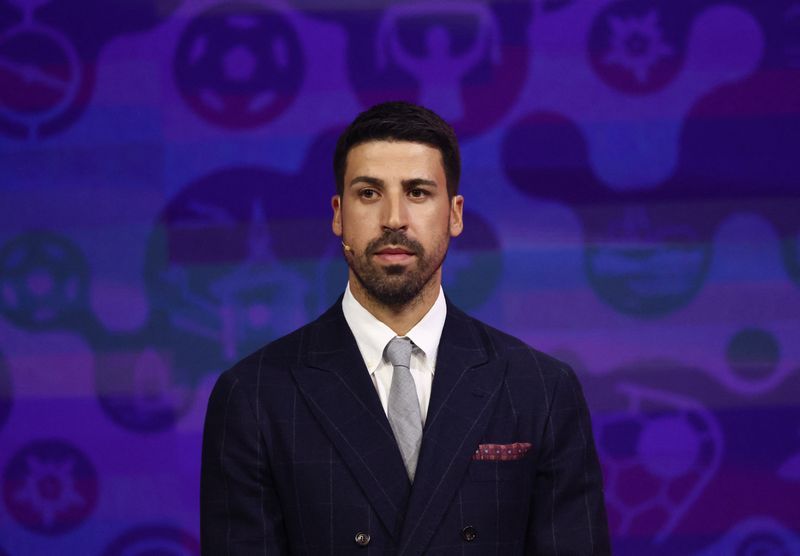
Sami Khedira carries the heritage of two nations with quiet confidence, and he sees nothing troubling about brothers standing on opposite sides of the pitch at the 2026 World Cup. The German midfielder and 2014 tournament winner, speaking at the Home of Football museum in New York, articulated a refreshingly inclusive vision of contemporary international football—one where multiple identities not only coexist but enrich the game itself.
Having grown up in Germany with a German mother and Tunisian father, Khedira understands intimately the complexity of straddling two cultures. His own brother Rani competes for Tunisia at major tournaments, representing their father's homeland. Rather than viewing such arrangements as problematic, Khedira frames them as emblematic of how the sport has evolved into something genuinely global. He rejected the notion that carrying two flags in one's heart creates friction or divided loyalties, insisting instead that this reflects the reality of families shaped by migration and modern life. "I see it as a modern, global world where we all come together," he explained. "And for me, in my world view, it's wonderful."
The 2026 World Cup will feature eight pairs of brothers navigating international football, with four playing together on the same squad and four representing competing nations. The split cases are particularly telling of contemporary football's demographic shift. Inaki and Nico Williams, who share the Athletic Bilbao pitch, pursue different international paths—one with Ghana, the other with Spain. Guela and Desire Doue are similarly divided, split between Ivory Coast and France respectively. Brian Brobbey and Derrick Luckassen, connected through their mother but carrying their fathers' names, represent the Netherlands and Ghana. Harry and John Souttar play for Australia and Scotland. These arrangements stretch far beyond isolated cases, revealing broader patterns of how international football accommodates family complexity in an interconnected world.
Khedira's perspective on such divisions stems partly from his own experience navigating questions about his authentic national identity. Growing up in Germany, he sometimes encountered skepticism about his Germanness, questioned because of his name and appearance. Conversely, in Tunisia he could be perceived as distinctly German. Rather than view this as an unresolvable contradiction, he embraced the premise that both assertions could simultaneously be true. "We have both nations in our heart," he said. "Both mentalities as well. And this one makes us special." This framing moves beyond mere tolerance toward genuinely celebrating the psychological and cultural richness that dual heritage brings to international competition.
A poignant moment crystallized these abstractions into something tangible for Khedira when he witnessed the Doue brothers singing both national anthems before France and Ivory Coast met in a friendly match earlier in June. The image stayed with him precisely because it transcended football's competitive framework, transforming the pre-match ceremony into something with profound cultural significance. He recognized in that moment how football possesses a unique capacity to communicate values that extend far beyond ninety minutes of play. The brothers' synchronized respect for two nations' identities conveyed a message about inclusion and belonging that resonates beyond sports. "How beautiful is that?" Khedira reflected. "That's multicultural, and that's a strong message to the world because football is so powerful."
The structural expansion of the World Cup to 48 teams has contributed meaningfully to this shift, creating pathways for traditionally smaller footballing nations to compete on sport's grandest stage. Cape Verde, Curacao, and Haiti can now envision genuine participation rather than ceremonial appearances, fundamentally altering how young players from these nations perceive their international options. The competitive compression means African and Asian teams are steadily narrowing gaps against established European and South American powerhouses. Khedira attributed this convergence to measurable improvements in educational infrastructure, coaching standards, and facility development across developing regions. However, he emphasized that European nations bear responsibility extending beyond simply recruiting dual-nationality talent—wealthy confederations should actively support grassroots development in their partners' home countries rather than merely benefiting from the convenient availability of experienced international players.
Yet beneath these celebratory observations lies a more troubling reality that Khedira acknowledged with evident concern: the intense pressure placed on teenage players before they possess the maturity to understand what committing to a national team truly entails. When multiple federations court the same young talent, each offering incentives and highlighting heritage claims, adolescents face decisions of staggering personal consequence without adequate emotional or psychological development. Khedira reflected on his own experience receiving overtures from the Tunisian federation while still a teenager, recalling the profound difficulty of making such a choice. He emphasized that no amount of political pressure, family heritage, or federation resources should dictate these decisions—they must emerge from something more intuitive and personal.
For Khedira, the answer to which nation a player represents comes down to what he described as "a gut feeling." Birthplace, parental heritage, and childhood residence all factor into the equation, but ultimately cannot be decisive. Rather, young players must be allowed—and protected—to follow their internal compass toward the community where they genuinely sense belonging. This philosophy rejects paternalism while simultaneously acknowledging the legitimacy of uncertainty. He expressed genuine respect for any player's process of deliberation, recognizing it as an "immense pressure over kids of such young age" that deserves understanding rather than judgment. He noted that when players consulted with federations out of respect, honoring the institutional relationships involved, this reflected maturity and cultural sensitivity worthy of recognition.
The broader implications of Khedira's perspective extend beyond individual cases toward how football itself evolves as a genuinely inclusive institution. Rather than viewing multicultural players and divided-family situations as complications requiring management, his vision embraces them as evidence of football's integration into increasingly complex, mobile societies. The sport becomes not a vehicle for reinforcing narrow national identities but rather a stage where contemporary reality—messy, multinational, and deeply personal—finds expression. As younger generations navigate unprecedented options regarding national representation, figures like Khedira provide crucial alternative frameworks that validate the legitimacy of dual loyalty while celebrating rather than lamenting the diversity this brings to international competition.