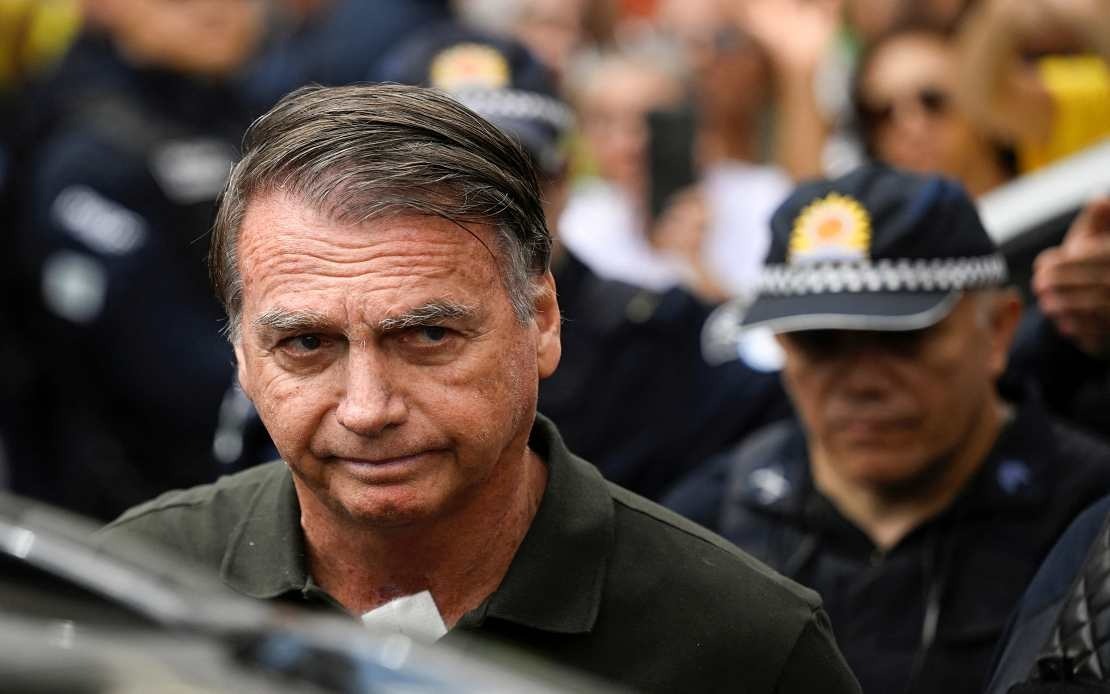
A Brazilian federal court has prohibited Argentine President Javier Milei from visiting former Brazilian President Jair Bolsonaro at his residence in Brasília, blocking what was intended as a high-profile show of right-wing solidarity in South America. Judge Alexandre de Moraes rejected Milei's request on July 19, denying the Argentine leader access to his politically beleaguered counterpart who is confined to his home while serving a sentence for his alleged involvement in an attempted coup.
Bolsonaro had anticipated hosting Milei on July 25, during what the Argentine president had planned as a visit to Brazil. The meeting was designed to serve dual purposes: strengthening ties between two of South America's most prominent conservative figures and simultaneously bolstering the candidacy of Flávio Bolsonaro, the former president's son, who is mounting a presidential campaign against incumbent Luiz Inácio Lula da Silva. The projected convergence of these political titans would have sent a powerful signal across the region's right-wing movements, particularly to those who view the Lula administration with scepticism.
Judge de Moraes justified the denial by invoking restrictions imposed just one day prior, on July 18. These tightened conditions explicitly prohibit Bolsonaro from receiving visits of a political or electoral character until the conclusion of the presidential election scheduled for October. The timing reveals a clear judicial attempt to insulate Brazil's electoral process from interference by the imprisoned former leader, whose legal troubles stem from his resistance to the Lula government's consolidation of power.
The catalyst for this intensification of restrictions was a handwritten letter authored by Bolsonaro that his son Flávio publicized through social media platforms. In the missive, the former president explicitly endorsed his son's presidential ambitions, a direct violation of the conditions governing his house arrest. The court determined that this action constituted a meaningful breach of the judicial orders constraining his conduct, warranting the imposition of more stringent limitations on his personal interactions and political communications.
The judge further prohibited Bolsonaro from disseminating political messages through intermediaries, a provision clearly designed to prevent him from continuing to influence electoral proceedings indirectly through family members or associates. Moraes characterized the defence's appeal regarding the Milei meeting as legally moot, suggesting that no valid grounds existed for an exception to the newly enforced restrictions. This dismissal underscores the judiciary's determination to enforce its authority over one of Brazil's most defiant political personalities.
Bolsonaro's legal predicament represents one of the most consequential political imprisonments in contemporary Latin America. Sentenced to more than twenty-seven years in prison on charges related to an alleged coup conspiracy, he currently serves his sentence under house arrest ostensibly for health-related reasons, though the arrangement appears to accommodate Brazil's complex political landscape. His confinement has not diminished his influence over Brazil's conservative political base, which explains the court's evident concern about his continued involvement in the electoral process.
The October presidential election looms as a critical juncture for Brazil's political trajectory. Lula, representing the left-centre Workers' Party, faces formidable opposition from multiple conservative candidates, including Flávio Bolsonaro, who represents continuity with his father's nationalist and economically liberal agenda. The judicial restrictions on the elder Bolsonaro reflect concerns that his political capital and media presence, even from confinement, could meaningfully sway electoral outcomes in a nation divided between competing visions of governance and economic policy.
For Malaysian observers, this episode illuminates how democracies navigate the intersection of judicial independence and political contestation. The Brazilian court's actions demonstrate both the judiciary's capacity to enforce constraints on political actors and the inherent tensions arising when imprisoned politicians retain significant influence over electoral coalitions. The aggressive prosecution of Bolsonaro contrasts sharply with the restoration of his opponents, illustrating how legal processes become enmeshed with electoral competition in polarized environments.
Milei's attempted visit underscores broader regional dynamics within Latin American conservatism, where right-wing leaders cultivate transnational networks to legitimize their political projects and counter what they perceive as leftist hegemony across the continent. The Argentine president's symbolic support for Bolsonaro reflects this strategic coordination, yet the Brazilian judiciary's intervention demonstrates that even cross-border political solidarity faces domestic legal constraints in contested democracies.
The court's decision reinforces Judge de Moraes' prominence as an enforcer of electoral rules and judicial authority in Brazil. As the head of Brazil's Superior Electoral Court during a contentious electoral period, his authority over Bolsonaro's conditions represents significant judicial power concentrated in one individual. This concentration raises questions about the balance between necessary electoral protections and the risks of judicial overreach, concerns that resonate with ongoing debates about institutional checks and balances throughout the region.
The implications extend beyond bilateral relations between Argentina and Brazil. The episode signals that South American judiciaries are prepared to intervene decisively in electoral processes, even when doing so constrains prominent political figures and their international allies. This assertiveness reflects broader trends across the continent where courts have become crucial actors in managing political conflicts, sometimes complementing and sometimes complicating democratic processes.

