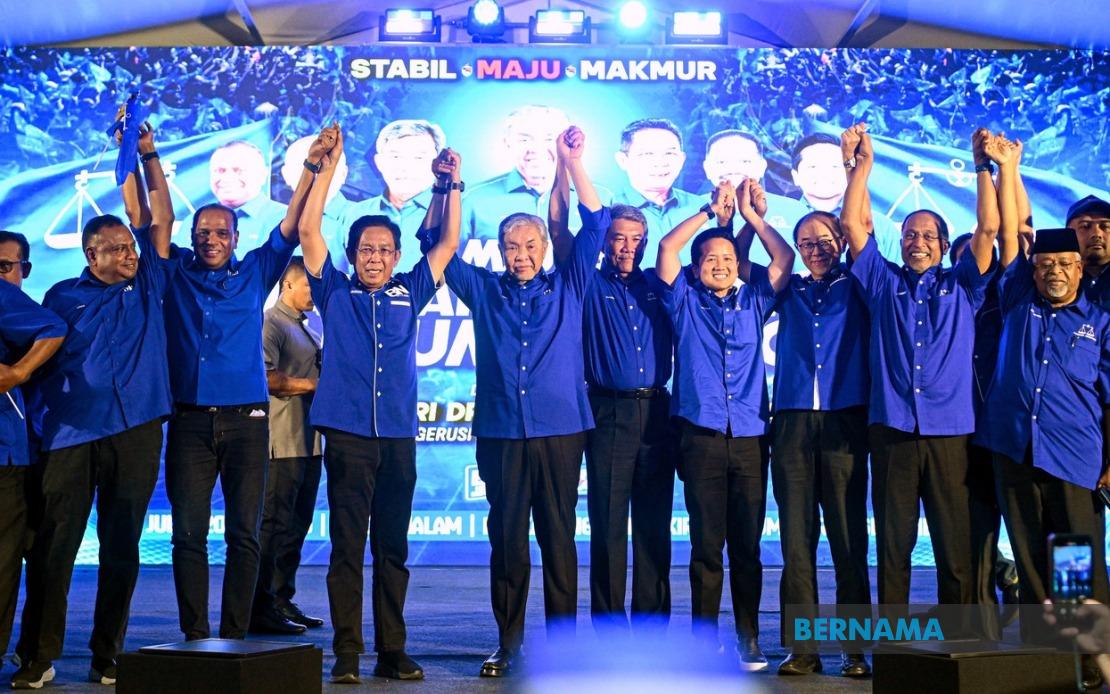
Barisan Nasional has formally presented its electoral roster for the upcoming 16th Negeri Sembilan state election, unveiling 25 candidates at a ceremony in Seremban tonight. The coalition's selection reflects a blend of continuity and fresh recruits, signalling its strategy to maintain strongholds while testing new political ground in the state that has long been a BN bastion in peninsular Malaysia.
Leading the charge is Negeri Sembilan BN chairman Datuk Seri Mohamad Hasan, who will contest the Rantau seat for what appears to be another term. His decision to seek re-election comes two decades into his tenure representing the constituency, a span that underscores the stability the ruling coalition values in its frontline representatives. Speaking at the launch event held at Tuanku Abdul Rahman Stadium in Paroi, Mohamad emphasised his gratitude to UMNO president Datuk Seri Dr Ahmad Zahid Hamidi for the endorsement, a public acknowledgment that reinforces the hierarchical endorsement process within the party and the broader BN framework.
Parallel to Mohamad's continued representation, the coalition has reconfirmed Datuk Seri Jalaluddin Alias as its standard-bearer in Pertang, where he has maintained his seat since 2013. Jalaluddin, who doubles as Negeri Sembilan's UMNO Liaison Committee chairman and Member of Parliament for Jelebu, represents a figure of dual influence bridging state and federal politics. His retention signals BN's confidence in his electoral appeal and administrative credentials in a seat he has held for over a decade, providing continuity in legislative representation.
Beyond these two prominent retentions, the coalition has maintained faith in other sitting members. Datuk Mohd Faizal Ramli will contest Linggi once more, while Datuk Mustapha Nagoor seeks another mandate in Palong. These selections indicate BN's approach of consolidating established positions through incumbents with proven track records, a strategy that typically reduces campaign risks in constituencies where the party's organisational machinery and voter base are entrenched.
However, the announcement revealed a significant caveat: BN has not yet finalised its candidates for 11 state seats. The outstanding constituencies—Klawang, Serting, Lobak, Sikamat, Ampangan, Bukit Kepayang, Mambau, Paroi, Lukut, Bagan Pinang, and Gemas—represent roughly a quarter of Negeri Sembilan's 36 state assembly seats. This incomplete roster suggests ongoing internal negotiations within the coalition's three main component parties, UMNO, MCA, and MIC, as they balance seat allocations and negotiate between competing aspirants.
For Malaysian and Southeast Asian observers, this candidate announcement carries broader implications regarding coalition politics in Malaysia. The BN, which has governed since independence but faced electoral setbacks in 2018, remains a dominant force in peninsular states despite losing federal power. Negeri Sembilan's election serves as a barometer for how effectively the coalition can mobilise support, particularly given demographic and political shifts that have challenged traditional party machinery. The mixture of continuity and unresolved candidacies reflects internal complexities that often characterise multi-ethnic, multi-party coalition governance in Malaysia's political system.
The retention of prominent figures like Mohamad Hasan, who holds significant national responsibilities as BN deputy chairman, underscores the entanglement between state and national politics. Such figures command resources and media attention that benefit their constituencies, though they equally represent potential vulnerabilities should national political fortunes shift. The Rantau seat, held by Mohamad for nearly two decades, has become almost synonymous with his political identity, making it strategically important for BN to defend his position as a confidence vote in the coalition's broader leadership.
The incomplete candidate list also hints at potential friction within BN's component parties over seat distribution and nomination processes. In Malaysian political culture, such delays sometimes precede last-minute announcements that attempt to balance representation across ethnic and geographic lines, particularly for MCA and MIC, which maintain separate organisational structures and constituency bases. The outstanding 11 seats will likely be allocated according to traditional power-sharing arrangements, though competition for nomination can occasionally spill into public view, creating intra-coalition tensions.
From a strategic perspective, BN's approach in Negeri Sembilan appears designed to present stability and experience to voters in a state where the coalition retains structural advantages. The party's decision to field known quantities in competitive seats while holding back announcements in other constituencies suggests a carefully staged campaign strategy. However, this approach also reflects the realities of coalition management, where multiple stakeholders must reach consensus before finalising electoral arrangements, a process that invariably extends into the final weeks before official nomination periods commence.
The electoral implications for Negeri Sembilan extend beyond state-level governance, as the state's performance often influences political narratives nationally. Should BN achieve a decisive victory, it strengthens the coalition's narrative of continued relevance and ability to govern effectively. Conversely, a poor showing would provide ammunition to opposition parties and potentially embolden dissidents within BN itself. The announcement of candidates, therefore, marks not merely an administrative milestone but the opening salvo in a competition that will shape perceptions of institutional stability and voter sentiment in Malaysia's political ecosystem.

