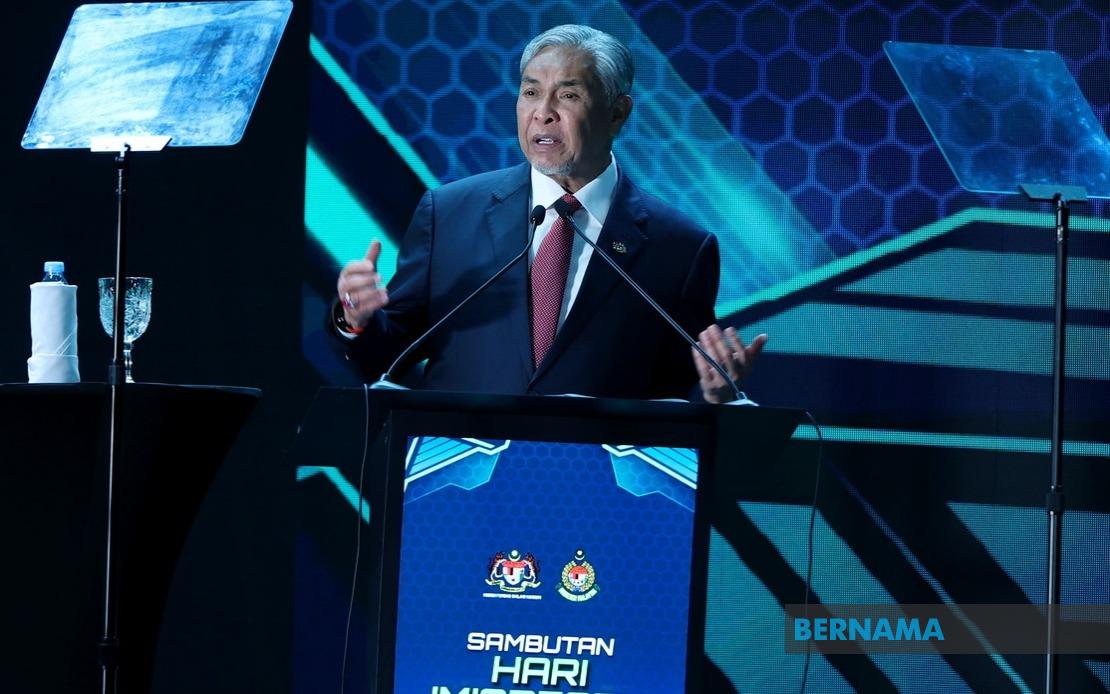
Barisan Nasional will maintain its involvement in the Unity Government, adhering to the formal resolution adopted at UMNO's most recent General Assembly, according to the coalition's chairman Datuk Seri Dr Ahmad Zahid Hamidi. Speaking at the 2026 Immigration Day celebration in Cyberjaya on July 21, Ahmad Zahid, who simultaneously serves as UMNO president and Deputy Prime Minister, stressed that the party's leadership views the assembly's decision as binding and beyond review or reconsideration. The emphasis on honouring this mandate underscores the significance BN places on maintaining stability within the current governing coalition.
Ahmad Zahid's statement carries particular weight given the ongoing state elections and the political pressures that invariably accompany such contests. By framing the assembly resolution as the supreme authority within UMNO's decision-making hierarchy, he sought to quell speculation about potential fractures in the coalition's unity. The assertion that no body supersedes the General Assembly reflects UMNO's traditional governance structure, where grassroots and mid-level party delegates wield considerable influence over major strategic decisions. This emphasises that any departure from the pro-Unity Government stance would require another assembly-level decision, a procedurally significant hurdle.
The timing of Ahmad Zahid's remarks gains additional importance when considered against Prime Minister Datuk Seri Anwar Ibrahim's recent warnings to government office-holders. Anwar had cautioned ministers, deputy ministers, and other government agency officials against leveraging their positions to publicly criticise Unity Government coalition partners during ongoing state election campaigns. Such boundary-setting reflects the inherent tensions within multi-party coalitions, where individual members may harbour competing interests or conflicting campaign strategies. By reaffirming BN's commitment, Ahmad Zahid effectively endorsed Anwar's position and signalled that BN members would comply with these protocols.
Ahmad Zahid separately addressed the Prime Minister's prerogative regarding ministerial appointments and removals. He characterised the power to appoint and dismiss Cabinet members as an unambiguous privilege of the Prime Minister, requiring no consultation or consensus from coalition partners. This clarification became pertinent after reports suggested that officials who breached Anwar's directive would face demands to resign from their ministerial portfolios. By confirming that such decisions rest solely with the Prime Minister, Ahmad Zahid demonstrated BN's deference to executive authority while simultaneously establishing clear boundaries for party members serving in government.
The broader context involves Malaysia's Unity Government, a multi-coalition arrangement that brings together formerly rival political camps to govern the country. BN, historically Malaysia's dominant political force, occupies a significant though not controlling position within this structure. Maintaining cohesion across diverse coalition members requires constant negotiation and mutual accommodation, particularly during election cycles when parties focus intensely on their respective bases and competitive positioning. Ahmad Zahid's restatement of loyalty to the coalition framework signals BN's preference for continuity over rupture, despite inevitable frictions arising from the inherent contradictions of coalition governance.
For Malaysian observers, BN's reaffirmation holds implications for the broader political landscape. Barisan Nasional's continued participation guarantees the Unity Government maintains substantial parliamentary representation and administrative experience across federal and state levels. Should BN withdraw or significantly reduce its engagement, the governing coalition would face destabilisation requiring negotiation with alternative partners or acceptance of reduced legislative capacity. Ahmad Zahid's explicit commitment therefore provides reassurance to other coalition members and stakeholders relying on stable governance frameworks during a period of electoral activity.
The state elections referenced implicitly in these statements represent crucial tests for the Unity Government's appeal and efficacy. Different coalition members face varying local political pressures and may harbour distinct policy preferences regarding state-level governance. Ahmad Zahid's insistence that ministers must refrain from attacking coalition partners during campaigns addresses the risk that intra-coalition competition could escalate into public recriminations damaging the partnership's overall credibility. By endorsing Anwar's position and emphasising the UMNO assembly's resolution, he sought to subordinate factional interests to coalition survival.
The emphasis on the General Assembly's supremacy carries particular significance for UMNO's internal dynamics. Party president Ahmad Zahid, despite wielding considerable formal authority, framed his endorsement of coalition participation as flowing from grassroots democratic decision-making rather than top-down leadership decree. This rhetorical strategy enhances the legitimacy of BN's commitment while insulating him from accusations of imposing unpopular decisions without consultation. It also suggests that any internal UMNO criticism of the coalition arrangement would need to mobilise the assembly membership rather than simply challenging party leadership.
The statements also reflect practical political calculus regarding BN's strategic interests. The coalition's participation in government provides access to federal resources, patronage networks, and administrative machinery that strengthen UMNO's organisational capacity and electoral prospects. Withdrawal would sacrifice these advantages without guaranteeing any compensatory gains. For BN members serving as ministers and deputy ministers, continued government participation maintains their authority and influence. Ahmad Zahid's reaffirmation therefore aligned with the material incentives facing party leadership and its constituent members.
Moving forward, this commitment constrains BN's tactical flexibility during the state elections and beyond. Party candidates cannot credibly position themselves as potential partners for opposition coalitions without creating internal tensions with the assembly resolution. Similarly, negotiations with other Unity Government partners regarding power-sharing, resource allocation, or policy direction must proceed on the assumption that BN intends to remain within the arrangement. This predictability, while limiting short-term negotiating leverage, enhances BN's value as a reliable coalition partner, potentially improving its bargaining position on specific disputes.
For regional observers monitoring Malaysian politics, BN's reaffirmation demonstrates the coalition's continued institutional strength despite periodic speculation about fracturing. The fact that Ahmad Zahid felt compelled to make explicit statements underscores awareness that coalition unity cannot be taken as automatic. Yet the invocation of the assembly resolution as binding authority suggests sufficient party consensus that major shifts in coalition orientation remain unlikely without extraordinary circumstances. This stability matters not only for Malaysian governance but for regional confidence in Malaysia's political predictability and continuity.

