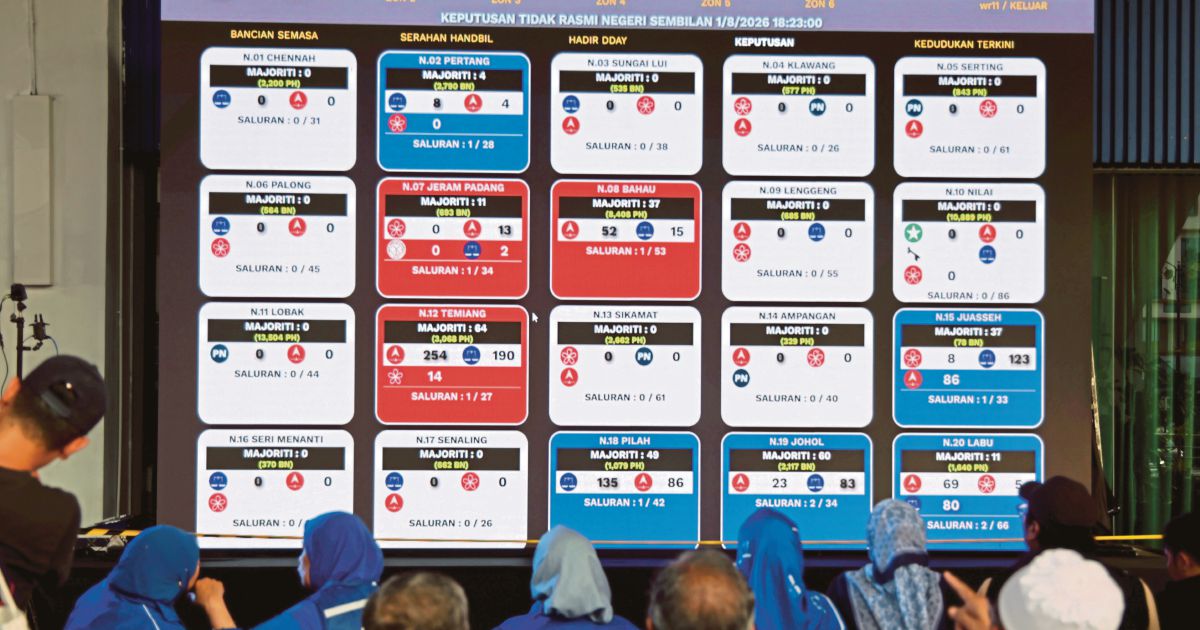
The Barisan Nasional and Perikatan Nasional coalition has declared it has secured 23 state assembly seats in Negri Sembilan, according to claims made by UMNO representative Datuk Dr Asyraf Wajdi Dusuki in Seremban. The figure, if verified, would give the combined opposition alliance a working majority in the state legislature, paving the way for government formation following the recent state election.
This announcement marks a significant development in Negri Sembilan's political landscape, where the outcome of the election carries implications beyond the state's borders. Negri Sembilan has historically served as a barometer for broader political sentiment in Malaysia, with its results often preceding significant shifts in national political dynamics. The state has been a traditional stronghold of both Barisan Nasional and UMNO, though recent years have seen increased competition from Perikatan Nasional, which has gained considerable traction in several states across the peninsula.
The coalition's claimed acquisition of 23 seats assumes particular importance given Malaysia's political trajectory over the past several years. The partnership between BN and PN, which includes UMNO, PAS, and other component parties, represents a consolidation of conservative and Islamist political forces in the country. Such alliances have become increasingly common following the 2022 federal election, where neither major bloc achieved outright dominance, necessitating elaborate coalition arrangements to secure parliamentary majorities.
For Malaysian voters and observers, the Negri Sembilan outcome provides crucial insight into the current distribution of electoral support across the peninsular states. The state's diverse demographics, encompassing urban centres like Seremban alongside rural constituencies, generally reflect the broader electoral patterns observed nationally. The BN-PN showing would suggest sustained support among traditional constituency bases, though the exact composition of seats—whether urban or rural, Malay-majority or mixed—remains to be fully assessed.
Peikatan Nasional's growing role in state governments carries implications for national governance trajectories. As PAS, UMNO, and allied parties incrementally consolidate control over additional state assemblies, they collectively accumulate administrative experience, patronage networks, and resource management authority. This gradual expansion of non-PKR and non-DAP governance structures potentially influences long-term power distribution ahead of the next federal election cycle.
The formation of a BN-PN government in Negri Sembilan would represent continuity in peninsular governance patterns, where these coalitions already control several other states. However, such arrangements occasionally generate internal tensions, as the participating parties maintain distinct ideological positions and competing interests for ministerial portfolios, allocations, and policy direction. Previous BN-PN collaborations have occasionally produced friction over resource distribution and leadership arrangements, dynamics that may emerge as the Negri Sembilan administration takes shape.
From a constitutional and administrative perspective, securing 23 seats establishes a mathematically secure government formation position, assuming intact coalition discipline. The assembly's size determines the specific threshold required, though simple majority mathematics typically requires slightly more than half of all seats. The ease or difficulty of government formation will depend partly on whether any defections or independent alignments complicate the legislative landscape, a risk factor in Malaysian state politics where opportunistic floor-crossing occasionally alters initial election outcomes.
Regional observers have closely monitored Negri Sembilan's election as an indicator of broader political momentum heading into potential federal electoral contests. The state has witnessed growing electoral sophistication among voters, who increasingly demand performance-based governance and value-for-money administration. The incoming administration, regardless of its composition, will face expectations for service delivery improvements, infrastructure development, and transparent financial management.
For the business community and investors, both locally and regionally, clarity on government formation carries practical significance. Negri Sembilan, positioned strategically between Kuala Lumpur and Selangor, functions as an important economic corridor. Political stability and continuity in administration typically provide reassurance for long-term investment commitments, particularly in manufacturing, logistics, and real estate sectors that characterise the state's economy.
The coalition's claimed victory also reflects demographic and voter preference patterns worth monitoring throughout Malaysia. The apparent success of the BN-PN combination in Negri Sembilan suggests that the partnership's messaging and campaign strategies resonated with sufficient portions of the electorate. Understanding precisely which constituencies, demographic groups, and campaign themes drove voters toward the coalition provides strategic information for all political formations preparing for future electoral contests.
Looking forward, the composition of the Negri Sembilan state government will establish important precedents for executive functioning under BN-PN coalitions, particularly regarding inter-party power-sharing arrangements and policy coordination. The state government's performance over the coming years will accumulate political capital or undermine confidence among component parties, influencing their willingness to maintain such partnerships in subsequent electoral cycles.

