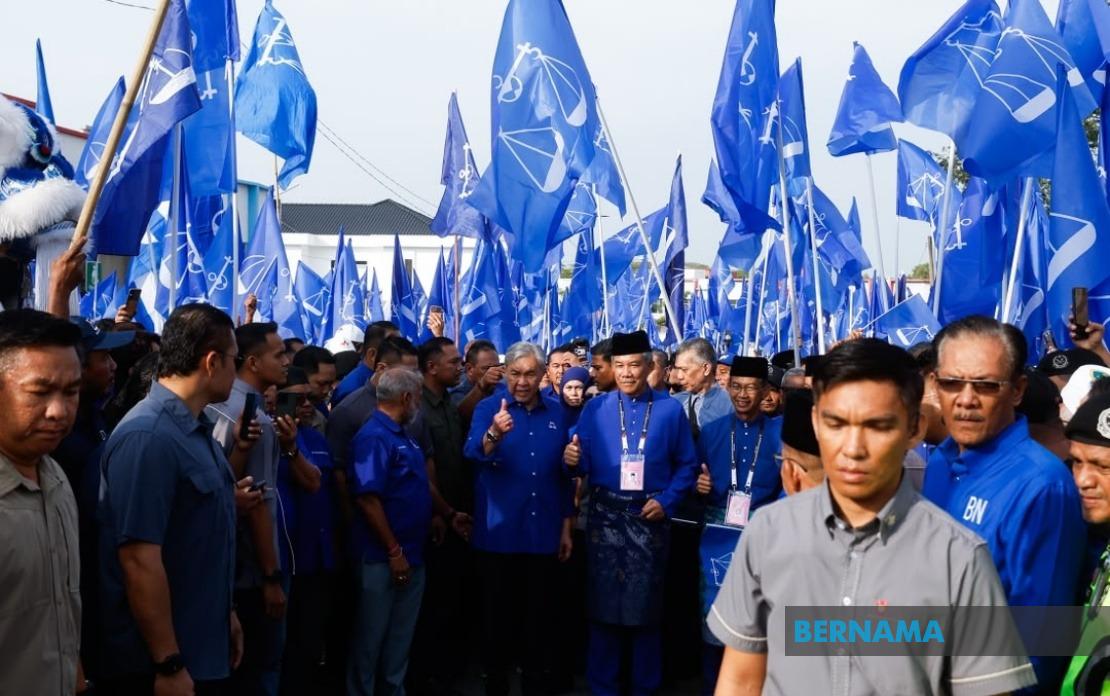
The nomination phase of Negeri Sembilan's 16th state election became a showcase of party unity on Thursday, as Barisan Nasional's most senior figures fanned out across the state to stand alongside their candidates. BN chairman Datuk Seri Dr Ahmad Zahid Hamidi, who doubles as UMNO president, personally escorted his deputy Datuk Seri Mohamad Hasan to the Dewan Seri Rembau nomination centre in the early morning, arriving at 8.40 am to witness the submission of papers for the Rantau state seat—a constituency Mohamad has represented continuously since 2004.
The strategic appearance of top-tier party figures at nomination ceremonies serves multiple functions within Malaysia's political landscape. Such visible endorsements signal to party members and voters alike that the leadership stands firmly behind its chosen candidates, while also generating media attention and setting the narrative tone for the campaign period ahead. The presence of Ahmad Zahid, in particular, underscores UMNO's investment in retaining control of Negeri Sembilan, a state the party has traditionally dominated but where political winds have shifted in recent election cycles across the country.
All eight designation centres across the state began accepting nomination papers simultaneously at 9 am, with the filing window closing after just one hour—a compressed timeframe that necessitated careful coordination and planning by party officials. This tight schedule meant that candidates needed to have their documentation meticulously prepared and their nominating teams primed for rapid submission. The efficiency of the process reflected months of preparation by party machinery, particularly given the complexity of managing nominations across multiple constituencies.
The BN deployment of senior party machinery extended well beyond Rembau. In Port Dickson, BN secretary-general Datuk Seri Dr Zambry Abd Kadir personally shepherded Datuk Mohd Faizal Ramli through the nomination process for the Linggi state seat, demonstrating the party's systematic approach to candidate support across diverse constituencies. Similarly, UMNO vice-president Datuk Seri Johari Ghani accompanied Suhaimizan Bizar in the Gemencheh nomination process, situated within the Tampin parliamentary constituency, where BN has faced competitive races in recent years.
The Jempol parliamentary area received particular attention from UMNO hierarchy, with secretary-general Datuk Dr Asyraf Wajdi Dusuki coordinating the simultaneous nominations of three candidates—Datuk Mustapha Nagoor contesting Palong, Datuk Mohd Zaidy Abdul Kadir in Jeram Padang, and Chong Fui Ming vying for Bahau. This concentration of leadership support in a single parliamentary zone suggests that UMNO views this area as strategically significant, possibly due to competitive pressure from opposition parties or demographic shifts that demand intensive organisational engagement. The coordination required to manage three nominations simultaneously while maintaining media visibility exemplifies modern electoral campaign choreography.
The broader coalition also demonstrated cohesion through partner parties' participation. Tan Sri Abdul Hadi Awang, president of PAS, accompanied Mohd Fairuz Mohd Isa in the nomination process for the Serting state seat, reflecting the continued partnership between UMNO and PAS within the BN framework—a coalition arrangement that has proven crucial for maintaining political stability in several Malaysian states. Meanwhile, Parti Orang Asli Malaysia (ASLI), a smaller component party, fielded Dayana Dal as its candidate for Jeram Padang, with party president Rashid Ka providing symbolic support and legitimacy to the candidacy.
The Negeri Sembilan State Legislative Assembly had been formally dissolved on June 5 following consent from Tuanku Muhriz Tuanku Munawir, the Yang Dipertuan Besar of Negeri Sembilan. This administrative step set in motion the entire electoral machinery, creating a nearly two-month runway between dissolution and the scheduled polling date of August 1. Early voting has been fixed for July 28, allowing voters who are unable to cast ballots on election day to participate in the process—a provision increasingly important for Malaysian workers who migrate temporarily for employment or have commitments outside their home constituencies.
The compression of the nomination window into a single hour across all eight centres created logistical challenges that tested party preparedness. Each nomination centre required sufficient staffing to process paperwork rapidly, verify candidate eligibility, and handle any last-minute documentation issues. The Election Commission's simultaneous opening and closing of all centres ensured parity across constituencies and prevented situations where candidates might gain strategic advantage through timing. This uniform approach reflects the commission's effort to maintain electoral integrity and fairness, though it places premium on advance preparation by competing parties.
For Malaysian political observers, the visible turnout of BN's hierarchy at nomination centres carries significance beyond mere procedural compliance. It signals confidence in the party's electoral prospects while also serving as a loyalty test—candidates and party members interpret such leadership engagement as validation of their candidacies and assurance of campaign resource allocation. In a country where internal party dynamics often determine electoral outcomes as much as inter-party competition, these ceremonial moments carry weight. The orchestrated appearances suggested that BN had already determined its preferred candidates and was committed to presenting a unified front.
The Negeri Sembilan election arrives at a pivotal moment for Malaysia's political landscape. The state, historically dominated by UMNO-led coalitions, has seen its political complexion shift through various phases of federal-level political restructuring. How voters respond to the parties' respective offerings in August will provide insights into whether BN has successfully rebuilt public confidence following past electoral setbacks, or whether opposition parties have gained sufficient momentum to challenge the coalition's traditional strongholds. The nomination day imagery—with senior figures flanking candidates—represents the beginning of what promises to be a closely watched campaign in a state that has often served as a barometer for broader Malaysian political trends.
With nomination day complete and the official campaign period now underway, all attention turns toward voter outreach and persuasion efforts over the coming fortnight. The calibre of candidates selected and the intensity of party machinery deployed will become clearer as the campaign progresses toward early voting on July 28 and the main election day on August 1, providing Malaysians with their latest opportunity to reshape their state government.

