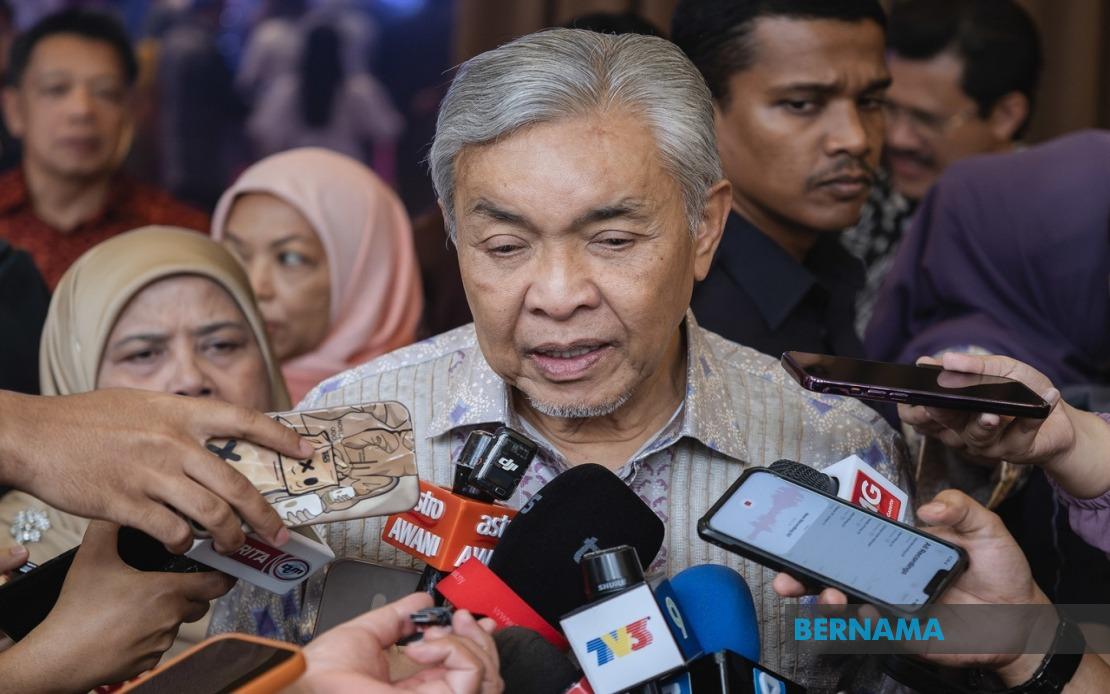
Deputy Prime Minister Datuk Seri Dr Ahmad Zahid Hamidi has drawn a firm boundary between Barisan Nasional's electoral strategy and any involvement in constitutional affairs, pledging that the coalition will not interfere in issues touching on the royal institution or the Negeri Sembilan Council of Justice and Laws ahead of the state polls. The statement, made after attending a service excellence ceremony at the Ministry of Rural and Regional Development, reflects heightened sensitivity around the political environment as the coalition prepares to contest 36 state seats on August 1.
Ahmad Zahid, who leads UMNO and serves as the coalition's key voice on federal-state relations, emphasised that respecting the constitutional boundaries of royal institutions is non-negotiable for his party. The commitment was articulated during meetings with Negeri Sembilan's party hierarchy as BN works through the mechanics of campaign preparation. Such declarations are typically offered when there exists the potential for political actors to be drawn into sensitive institutional matters, suggesting awareness within BN's hierarchy that the state election campaign could intersect with ongoing palace-related governance questions in ways that demand careful navigation.
The decision to contest without the power-sharing arrangement that characterised the 15th state election represents a significant shift in BN's tactical approach. During that previous contest, the coalition had worked in tandem with components of Pakatan Harapan, a partnership that created complex political dynamics and required careful coordination. Ahmad Zahid made clear that such arrangements will not be replicated this time, forcing BN to mount a standalone campaign relying entirely on its internal strength and cohesion. This structural change means the coalition cannot afford organisational friction at any level, making his emphasis on unity across leadership tiers and membership particularly pointed.
For Malaysian political observers, Ahmad Zahid's remarks underscore a recurrent challenge in the country's constitutional landscape: the interaction between electoral politics and institutions that sit above day-to-day partisan contestation. The Negeri Sembilan Council of Justice and Laws, a state-specific body that advises on legal and governance matters affecting the sultanate, carries particular significance because it bridges the gap between advisory monarchy and executive government. BN's undertaking to remain outside that sphere is in effect a promise that the coalition's pursuit of electoral victory will not translate into pressure on institutions whose independence—at least in formal terms—should insulate them from party political influence.
Negeri Sembilan occupies an interesting position within Malaysia's federal architecture, as one of nine states with hereditary rulers whose constitutional position requires both deference and, in practice, careful political management. The state has navigated complex periods of governance, and any signal that electoral competition might involve jockeying for influence over the palace or its advisory institutions could destabilise the delicate political settlement that underpins orderly state administration. Ahmad Zahid's publicly stated commitment therefore functions as insurance against such destabilisation, reassuring the palace itself, civil society, and rival political formations that they need not fear attempts to instrumentalise royal institutions for partisan ends.
The timing of these remarks also carries strategic weight as BN recalibrates its approach after the 15th election's coalition model proved difficult to execute. Operating without a PH partnership means BN must activate deeper reservoirs of internal discipline and loyalty to remain competitive. When a coalition's leader speaks of unity across all organisational levels, the implicit message is that individual ambitions must be subordinated to collective success. Such language becomes necessary precisely when existing power-sharing arrangements have dissolved, leaving no external ballast to help hold various factions together.
From a regional perspective, Malaysia's state elections continue to matter as laboratories for testing coalition politics at scales smaller than the federal level, where experimentation incurs lower systemic risk. Negeri Sembilan's August 1 contest will offer insights into whether BN can sustain electoral momentum as a unitary formation without institutional props, and whether the coalition's strategic disciplines hold across the grassroots levels where party workers and local leaders make daily decisions about how aggressively to campaign. Ahmad Zahid's emphasis on unity rather than individual advancement suggests internal tensions exist, even if his public framing seeks to project confidence.
The invocation of respect for royal institutions also reflects broader Southeast Asian patterns in which even highly competitive electoral systems coexist with formal or informal requirements that certain institutions remain insulated from partisan contestation. Thailand, Cambodia, and other regional states have grappled with the boundary between democratic politics and constitutional sanctity. Malaysia's approach, in which the monarchy commands genuine constitutional authority within its domains while electoral competition proceeds robustly elsewhere, requires political elites to internalise norms about which battles are permissible and which would overstep acceptable bounds. Ahmad Zahid's statement can be read as both reassurance and reminder of those boundaries.
For voters in Negeri Sembilan, the declaration offers a degree of implicit reassurance that their state's institutional foundations will not become pawns in electoral strategy. This matters particularly for citizens who may harbour concerns about the integrity of state-level governance or who want to see constitutional processes respected even when political stakes run high. BN's public positioning on this question may well factor into how swing voters perceive the coalition's fitness to govern responsibly at the state level.
The August 1 election will reveal whether BN's new go-it-alone strategy proves more effective than the previous power-sharing model, and whether the coalition's internal unity initiatives translate into electoral performance. Ahmad Zahid's emphasis on staying clear of palace matters suggests the coalition intends to compete on conventional grounds: local development records, service delivery, and organisational reach, rather than through appeals to supporters that might involve institutional leverage. In the calculus of modern Malaysian politics, where the line between electoral contestation and constitutional respect must be continuously redrawn, such restraint may paradoxically prove to be BN's strongest asset.

