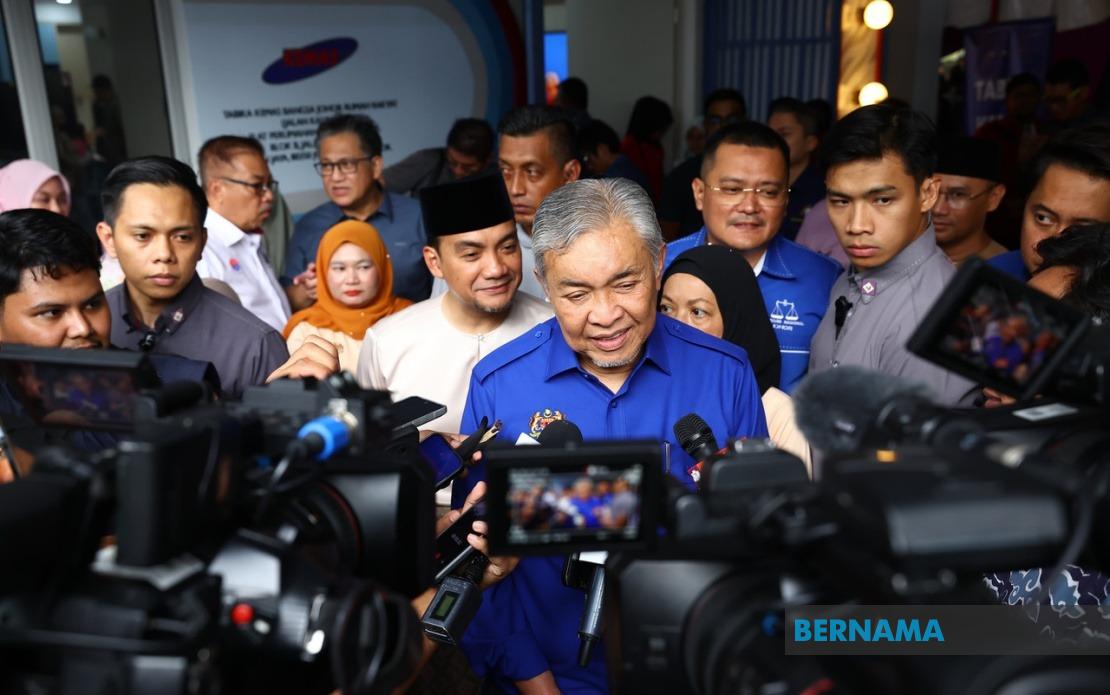
Barisan Nasional has publicly acknowledged the proposals laid out by Pakatan Harapan for the upcoming Johor state election, with party chairman Datuk Seri Dr Ahmad Zahid Hamidi stating that BN respects the opposition coalition's platform despite their electoral rivalry. Speaking in Johor Bahru following a community engagement session, the Deputy Prime Minister framed BN's receptiveness as consistent with Malaysia's democratic values, indicating that the coalition welcomes substantive policy debate between competing visions for the state.
Ahmad Zahid's remarks represent a measured acknowledgement of PH's Johor Health Scheme, deposit assistance for first-time homebuyers, a RM500 million youth development fund, and education sector initiatives that formed the centrepiece of PH's 10-point manifesto unveiled on the same day. This diplomatic posture reflects the tenor of Malaysian electoral campaigns, where leading figures typically emphasize institutional respect even as they campaign vigorously against opposing parties. The BN chairman's comments were delivered at an event in the Larkin Court 1 flats, attended by Johor Menteri Besar Datuk Onn Hafiz Ghazi and BN's Larkin state seat candidate Mohd Hairi Mad Shah.
BN's messaging strategy, however, pivoted quickly toward emphasizing its own accomplishments rather than dwelling on PH's proposals. Ahmad Zahid highlighted that the BN-controlled state government had fulfilled more than 90 per cent of its manifesto commitments during the previous term, a figure designed to establish credibility and demonstrate governance competence ahead of the July 11 polling day. This claim serves as a foundation for BN's assertion that its current manifesto reflects a comprehensively designed agenda addressing all social segments without excluding any racial or ethnic community.
The BN chairman's framing of the party's policy platform emphasizes universality and lifecycle inclusivity, extending from expectant mothers through early childhood, school years, tertiary education, and support for single parents. By repeatedly invoking the concept of "Bangsa Johor," Ahmad Zahid sought to transcend conventional racial and communal divisions, arguing that all residents of the state qualify for identical benefits regardless of background. This rhetorical approach acknowledges the demographic complexity of Johor while attempting to pre-empt accusations that BN's traditional support base privileges any particular community.
Ahmad Zahid, who also serves as Rural and Regional Development Minister, used the occasion to reaffirm his personal commitment to advancing Johor's development trajectory. The dual positioning as both national minister and prominent BN figure in a state election context reflects the intertwining of federal and state-level politics in Malaysia's Westminster-derived system. His pledge to sustain ministerial support for Johor's growth underscores how national-level appointments become campaign assets in state elections, particularly in economically significant states like Johor.
The Johor state election represents a substantial electoral undertaking, with 172 candidates contesting 56 state assembly seats. Early voting was scheduled for July 7, with the main polling day set for July 11, providing both coalitions limited time to mobilize supporters and build momentum. This compressed campaign timeline heightens the intensity of daily political messaging and makes each public statement from senior figures particularly significant in shaping voter perceptions.
PH's manifesto unveiling, occurring simultaneously with Ahmad Zahid's comments, highlights the competitive dynamic characterizing this election. The opposition coalition's emphasis on health scheme expansion, housing affordability, and youth employment reflects priorities that resonate with younger voters and middle-income households—constituencies potentially persuadable by well-articulated alternatives to BN governance. PH's RM500 million youth development fund, in particular, signals a specific counter-proposal to concerns about graduate employment and economic opportunity.
The electoral context in Johor carries particular weight within Malaysia's broader political landscape. As the nation's second-largest state by population and a major economic centre, Johor's election results influence perceptions of each coalition's national viability. A strong performance by either BN or PH in Johor reverberates through subsequent state-level contests and shapes calculations about the 2025 general election environment. For BN, defending its traditional Johor stronghold remains crucial to maintaining coalition credibility nationally.
Ahmad Zahid's diplomatic acknowledgement of PH's proposals, while simultaneously emphasizing BN's superior track record, reflects sophisticated campaign strategy balancing institutional respectability with competitive aggression. By refusing to dismiss or denigrate PH's manifesto, BN maintains the appearance of confident incumbency while simultaneously framing the election as fundamentally about proven delivery versus untested promises. This positioning requires BN to substantiate its 90 per cent claim and demonstrate tangible improvements in voter welfare since the previous election cycle.

